• The move to the new server is done. There are some software and database maintenance updates in process. This has us passing the hat around to help out. We appreciate any donations. Seriously, even a dollar helps. The payment page may be found here - https://www.audiokarma.org/support.html

Help identifying tube part

angelaudio

Super Member
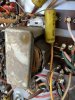
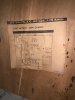
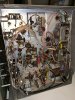
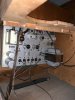
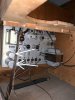
3B4311CC-6716-4F2D-BA24-A97BE8B7E1E4.jpeg 03E2412B-B835-41C1-8614-171BB418C791.jpeg 1A9CC5F0-5397-4353-87A0-ADD9AA77FDDB.jpeg 4AA3EC51-E4B5-48B9-94B2-5E60B5F42217.jpeg DA6D813C-BCF7-4C1A-8041-0B1B7B385DE6.jpeg Hello fellow AK’ers I am a total newbie when it comes to tube (and electronics too for that matter) and I need help identifying what looks to be a worn out part in my Clairtone Console pull chassis.

I looked online and I believe the part might be a choke but I’m uncertain.

Also, where can I find a replacement part and how do I identify exactly what replacement I’ll need?

The part in question is the one that I took a picture of close up.

Thanks in advance!
 
Register to hide this ad
There are two items that you photographed close up and they look to be the two output transformers that are mounted on the underside of the chassis. How did you determine that (one or both of) these is/are "Worn out"?

As the output tubes are only 2 6GW8, it would appear to be a single-ended design, so would be SE output transformers
 
There are two items that you photographed close up and they look to be the two output transformers that are mounted on the underside of the chassis. How did you determine that (one or both of) these is/are "Worn out"?

As the output tubes are only 2 6GW8, it would appear to be a single-ended design, so would be SE output transformers

Honestly I’m new to electronics and since I am getting a humming sound from my speakers I assumed these might be the culprits because to me they look ‘melted’ around the top. Pardon my inept descriptions and/or guesses.
 
Does the hum change as you change the volume control or stay the same? Does it appear the same in both channels?

The amp likely needs new filter caps and coupling caps.
 
The humming is more likely caused by needing old capacitors and possibly resistors replaced. The power supply caps are typically those large cylindrical metal units on the upper surface (bottom LHS of that last pic). Other caps that would probably need replacing are those red metal cylindrical ones underneath, as well as the yellow and tan ones.

Answers to questions posed by RWood above will help understand better.
 
Does the hum change as you change the volume control or stay the same? Does it appear the same in both channels?

The amp likely needs new filter caps and coupling caps.


It stays the same. And yes it does appear the same in both channels.

Is there a website that you know of where I can find the parts you mentioned? And if so what tools would I need to do the repair?
 
The humming is more likely caused by needing old capacitors and possibly resistors replaced. The power supply caps are likely those large cylindrical metal units on the upper surface (bottom LHS of that last pic). Other caps that would likely need replacing are those red metal cylindrical ones underneath, as well as the yellow and tan ones.

Answers to questions posed by RWood above will help understand better.

Thank you for your help Tinkerbelle :)
 
Honestly I’m new to electronics and since I am getting a humming sound from my speakers I assumed these might be the culprits because to me they look ‘melted’ around the top. Pardon my inept descriptions and/or guesses.

Never assume! :no:

Those two transformers under the chassis are the left & right speaker output transformers. They drive the speakers from the 6GW8 output tubes.

Your hum is 99 percent caused by one or both of these can capacitors. Since they are factory original, they are way past their due date anyway so just plan on replacing them both and all others also. After the recap, you will probably be blown away even more. :rockon:
Claritone.JPG

PS, those two cylindrical capacitors have more than one capacitor inside so take a look around the cans as there should be engravings that show their ratings. Sometimes there is only one but most of them have 3 or 4 capacitors inside.
 
Last edited:
I agree with all of the above. Wax capacitors are awful and hygroscopic. Electrolytics in the signal path cause distortion. Plus they're all shot at this point from age, and if one shorts out in the power supply you'll blow the rectifier and transformer winding, and if one shorts out as a coupling capacitor you'll end up with DC on the grid and chernobyl the tube.

To replace the power supply capacitors any of the major brands are good.
To replace the signal capacitors, the polypropylene film capacitors from Parts Express are inexpensive and have nice properties.

Various threads on AK will explain how to restuff the cans. Also how to add fuses to the transformer B+ winding and the rectifier, and how to add diodes to the rectifier to take up the PIV slack and greatly extend its lifespan.
 
I'd obtain the schematic or draw out the power supply schematic before even thinking about firing up the soldering iron.

Plate voltage is probably around 250v or more so please be careful and make sure the unit is fully discharged before attempting to work on it.

Never assume! :no:

Those two transformers under the chassis are the left & right speaker output transformers. They drive the speakers from the 6GW8 output tubes.

Your hum is 99 percent caused by one or both of these can capacitors. Since they are factory original, they are way past their due date anyway so just plan on replacing them both and all others also. After the recap, you will probably be blown away even more. :rockon:
View attachment 1466837

PS, those two cylindrical capacitors have more than one capacitor inside so take a look around the cans as there should be engravings that show their ratings. Sometimes there is only one but most of them have 3 or 4 capacitors inside.

I agree with all of the above. Wax capacitors are awful and hygroscopic. Electrolytics in the signal path cause distortion. Plus they're all shot at this point from age, and if one shorts out in the power supply you'll blow the rectifier and transformer winding, and if one shorts out as a coupling capacitor you'll end up with DC on the grid and chernobyl the tube.

To replace the power supply capacitors any of the major brands are good.
To replace the signal capacitors, the polypropylene film capacitors from Parts Express are inexpensive and have nice properties.

Various threads on AK will explain how to restuff the cans. Also how to add fuses to the transformer B+ winding and the rectifier, and how to add diodes to the rectifier to take up the PIV slack and greatly extend its lifespan.

So I think I’ve come to a conclusion....it seems like I’m waaaaaaaay in over my head! Well, at least for the time being until I get a good grip on tube theory and schematics! I’ll be honest I don’t even know how to read schematics but I’m determined to make this work and am definitely not in a rush. Of course I would love to get this thing going sooner than later but not only does the repair guy quoting me more than I can afford at this time but I want to start fixing these immaculate amps...I am more interested in these than I am in solid state:banana:
 
So I think I’ve come to a conclusion....it seems like I’m waaaaaaaay in over my head! Well, at least for the time being until I get a good grip on tube theory and schematics! I’ll be honest I don’t even know how to read schematics but I’m determined to make this work and am definitely not in a rush. Of course I would love to get this thing going sooner than later but not only does the repair guy quoting me more than I can afford at this time but I want to start fixing these immaculate amps...

You're not in over your head. You just don't know the jargon and the components. You'll learn. It's not hard.

You're right to not use a repair tech. Most of the time you pay a huge sum for little services and even less competence. Besides, your level of satisfaction will be far greater if you do it yourself.

None of this is impossible for someone who can solder. Read the forums, look at the guides written by those who repair radios, and you'll figure it out.

Replacing a bunch of capacitors, I'd do the resistors, too, is maybe four or five evenings work. You'll get the hang of it.
 
We all start somewhere. If you plan to get into tube amp repair, take it slow with simple steps. There are a few options to get you going.

Reading up a few restoration threads here will give some useful information. That article linked by maxhifi in post #15 above is very informative and has easy to follow details on simple capacitor identification and replacement. That type of article is recommended reading before diving in with a soldering iron. I would suggest spending quite a few moments digesting that information. Replacing old capacitors is often the biggest part of what is needed and certainly a good place to start. Also, rather than trying to address every potential issue in this console piece, just take a few simple steps to get familiar, while addressing the likely major culprits at the same time. Once you have some background knowledge sinking in you can start scoping out a plan for this unit. I would suggest identifying those caps we've indicated above. Take a look at the information on the side of each and write it down, such as 0.05µF (MFD), 200VDC, so you start to make a list of components that will need to be bought to replace them. The caps are usually relatively inexpensive. The expense associated with having a tech do the work is more likely the time expended. Once the needed cap values are identified you can move on to the replacement plan. Not everyone implements replacement the same way so you might get different valid input and opinions. Decide on a plan forward, purchase parts then replace is just one piece at a time and many here can assist with how best to approach this.

If you prefer a bit of personal help, an option would be to see if there are other AKers in your drive-able neighborhood who might be able & willing to share an hour or two with you to get started. Updating your personal information with your location so that it shows under your avatar lets others know where you are. Often, a helpful AKer is not too far away. In a similar vein, if you hadn't noticed, some areas have local meet ups, where AKers share music, equipment, ideas, and just good company. For example, this Events & Happenings forum has info on some that are currently ongoing. Lots of helpful folks attend these.

There are high voltages generated in tube equipment so read the safety guidelines to follow and stay alert. If you are unsure ask plenty of questions; don't guess or assume. Be safe and have fun with it.
 
Back
Top Bottom