• The move to the new server is done. There are some software and database maintenance updates in process. This has us passing the hat around to help out. We appreciate any donations. Seriously, even a dollar helps. The payment page may be found here - https://www.audiokarma.org/support.html

Help with Scott 222 : Red Plating

B Side

Member
Hi! I'm new to tube amps so asking for help to determine what is wrong with my Scott 222.

I observed that the LEFT channel has a lower volume than the right channel. I did some rough testing with a phone app and the left channel seems to be about 4-5 decibels lower than the right channel.
So I swapped the output tubes EL84 (V4+V5 switch with V104+V105). Left channel is still weak. Next I swapped the driver inverter tubes. The Left channel is still weak. I did not bother switching the pre-amp and phono tubes as the left channel has a lower volume regardless of source. I also switched the speaker cables and speakers, but the left channel continue to have low volume. I thought as long there is no clipping, then maybe I can live with it by adjusting the balance knob.

Then I ordered quad matched JJ EL84 tubes as back-up. Put them on the amp today, and when I powered on the amp heard some slight crackle which quickly went away. I thought nothing of it so when the tubes where sufficiently heated I started playing some music. This time the LEFT channel was considerably weaker than the right that I have to drastically adjust the balance knob. After about 40 minutes, I noticed that the left channel went almost silent. Even when I turn the knob all the way to the left, you could barely hear any sound coming out of the left speaker. That's when I noticed that one EL84 (in the V4 slot) was red plating. Not sure how long it was red plating as I was trying to have dinner while this was all going on. I immediately turned off the amp scared that it might cause bigger problems.

I took out the JJ tubes and put in the old tubes that came with the unit. I ran the amp and did not observe any red plating. But the old problem of the weaker LEFT channel is still there (not as weak as when I was using the JJ tubes).

So my questions :
1) Why did the JJ tube red plate while the old tube (Japan, brand not legible) never red plated all this time?
2) What is causing the weak output on the LEFT channel? Is it connected to the red plating issue?

Thanks to all the experts who are willing to help!
 
Register to hide this ad
Where to start....... Some history of this Scott 222 is necessary. Have the power supply capacitors been replaced? Have the coupling caps been replaced? Which model 222 is it? There are at least four different versions. Do you have a multimeter? Did you adjust the bias when you changed the output tubes? The JJs may not be up to the task, some versions of the 222 require 7189 tubes or equivalent.
Red plating is caused by exceeding the tube's plate current rating, there a few causes: leaky coupling cap, incorrect or no bias, etc. The weak output, after your tube swapping, could be related to the red plating issue.
 
First thing that I would check are the coupling capacitors to the grids of the output tubes.

222 and 222B will use 6BQ5 tubes. The 222C/D require 7189 tubes. The 222C picked up the 299 line after the 299C went to 7591 outputs.
 
Where to start....... Some history of this Scott 222 is necessary. Have the power supply capacitors been replaced? Have the coupling caps been replaced? Which model 222 is it? There are at least four different versions. Do you have a multimeter? Did you adjust the bias when you changed the output tubes? The JJs may not be up to the task, some versions of the 222 require 7189 tubes or equivalent.
Red plating is caused by exceeding the tube's plate current rating, there a few causes: leaky coupling cap, incorrect or no bias, etc. The weak output, after your tube swapping, could be related to the red plating issue.
First thing that I would check are the coupling capacitors to the grids of the output tubes.

222 and 222B will use 6BQ5 tubes. The 222C/D require 7189 tubes. The 222C picked up the 299 line after the 299C went to 7591 outputs.

Thanks for weighing in. Some additional info.
It is a 222 (I think also referred to as 222A). There is no bias setting as this model is cathode biased (as I understand it's like 'auto-bias'). The 222 utilizes 6BQ5/EL84 output tubes.
It was recently refurbished and I saw some new wirings and caps when we (me and the guy I bought it from) looked at the underside. He also said he had one of the OPTs newly rewinded (not sure which one though).

So @ramjet, do you think it's a leaky coupling cap? Can the cathode bias be way off? How come only the JJ tube red plated (I have read that JJ's are solidly built)?
Have never worked on amps (maybe clean pots from time to time) so I have no measuring tools of any sort.

Need some ideas on where to focus on when I start talking to the tech repair guy.
 
Also an additional question. Can I still run the amp with the jap tubes (weaker LEFT channel) while I have not taken it in for repair (will I be risking any further damage)? OR I should not run it until this is all sorted out?
 
Also an additional question. Can I still run the amp with the jap tubes (weaker LEFT channel) while I have not taken it in for repair (will I be risking any further damage)? OR I should not run it until this is all sorted out?
I wouldn't have run it after I heard the crackling so I definitely wouldn't run it now.
Get it checked out and singing again before you do further damage.
Good luck
 
One thing with this, it really would benefit from tubes that are reasonably well matched because of the partially shared cathode resistor. This used 4 tube heaters in series with a 1.2k across it that is common to all 4 tubes. Each tube also has a 220 ohm in addition to this so its a lot less picky than it would be otherwise but putting really tired tubes with really strong ones is not going to work so well here.

and a big +1 on coupling caps being highly suspect. I'd also wonder about the cathode caps. If those are leaky or shorted it will seriously mess with gain and bias on the tube(s). Cathode caps are C27, 28, 127, 128. C202 is also common to all four tubes.

something else possibly worth a look, V1, 2, 101, 102 heaters are in this circuit too. If those have been replaced with tubes of a different type that might have different heater properties it will mess with things. Any old production 12a*7 will work fine here, I have no idea about new production ones. Hopefully someone who has tested heater currents on new production can offer some info here.
 
Thanks for weighing in. Some additional info.
It is a 222 (I think also referred to as 222A). There is no bias setting as this model is cathode biased (as I understand it's like 'auto-bias'). The 222 utilizes 6BQ5/EL84 output tubes.
It was recently refurbished and I saw some new wirings and caps when we (me and the guy I bought it from) looked at the underside. He also said he had one of the OPTs newly rewinded (not sure which one though).

So @ramjet, do you think it's a leaky coupling cap? Can the cathode bias be way off? How come only the JJ tube red plated (I have read that JJ's are solidly built)?
Have never worked on amps (maybe clean pots from time to time) so I have no measuring tools of any sort.

Need some ideas on where to focus on when I start talking to the tech repair guy.
Let's start with your last post first. Stop using it until it is sorted out.

A leaky coupling cap will cause red plating. If these are original to the unit they should be replaced. If they have been replaced at some time one or more still could be bad. They are not expensive. Replace them.
Cathode bias can be off for a number of reasons, cathode resistors changed value or open, cathode bypass cap leaking, bad cap in the power supply (in the linked schematic from kvflyer the cathodes of the output tubes go to the 48vdc supply and not ground) as well as a bad tube (these are not all the possible causes of the bias being off).
As to why the JJ tube red plated I can only guess as the amp is not on my bench but I always look at the usual suspects in a sixty plus year old tube amplifier; coupling caps, power supply electrolytic caps, resistors that have changed value and anything that looks or smells bad.

There is one other thing, the rewound (maybe?) output transformer. If it is in some way different from what the original one was then that throws another wrinkle into the mix.

Can we see some pictures of the underside of the amp?
 
Last edited:
As mentioned above, capacitors, capacitors, capacitors. The 222 was in the era of 1959-60. There is a good chance that the capacitors are not Mylar; rather paper and should be replaced. If they are Pyramid brand, they are probably paper and are suspect.

Is it possible to get a picture of under the chassis?
 
Thanks guys for the crash course on coupling caps, cathode resistors and tubes. Never too old to learn.
Will post a pic when I get home.
 
Don't forget to clean and re-tension ALL of the tube sockets. Bad connections with the pins can cause some of these effects too. It wouldn't hurt to clean the controls and switches with deoxit while you're at it. That might also improve the channel balance. If the unit is still bone stock, it would be a good time to do a full recap and replacement of plate resistors. A lot of people sell kits to make this job a lot easier.

Also- check the condition of your 12AX7 tubes. These units power the 12AX7 heater string with the DC voltage emanating from the 7189 tube cathode bias. If you have red plating from high bias, you might be running too much current through the 12AX7 heaters as well.
 
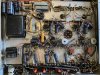
Okay, pics of the underbelly :
Scott 222 Underbelly.jpg

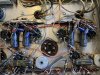
And close-up of the caps at the tube sockets:
Close-Up of caps near tube sockets.jpg

Without testing, does anything seem 'out of spec' or funky to you guys?
 
Don't forget to clean and re-tension ALL of the tube sockets. Bad connections with the pins can cause some of these effects too. It wouldn't hurt to clean the controls and switches with deoxit while you're at it. That might also improve the channel balance. If the unit is still bone stock, it would be a good time to do a full recap and replacement of plate resistors. A lot of people sell kits to make this job a lot easier.

Also- check the condition of your 12AX7 tubes. These units power the 12AX7 heater string with the DC voltage emanating from the 7189 tube cathode bias. If you have red plating from high bias, you might be running too much current through the 12AX7 heaters as well.

Thanks @Dadbar. How do you clean the tube sockets? You don't use deoxit on those, right?
 
The molded paper coupler caps around the output tubes look to have been clipped and tack re-soldered. There may be a bad joint there if the soldering was bad or deteriorated, contributing to red plating. As gadget says, best to ditch all the molded paper Pyramid and Black Cat caps, but particularly these critical coupling caps.

The 'clip and tack' work may have been to test these caps, but (as I read on AK once), the best 'test' for these type caps is the sound they make when they hit the waste basket after removal (any sound at all being a bad test result). You lose nothing and probably gain in sound quality by replacing these with new production, good quality caps. They don't have to be boutique either--Orange Drop, Illinois Capacitor MPW,or Panasonic (all polypropylene) will sound great in my experience. The IC's are smaller physically and may be easier to install, to boot.

Good luck with the 222--very nice amps!
Dave
 
Okay, pics of the underbelly :
View attachment 2330746

And close-up of the caps at the tube sockets:
View attachment 2330747

Without testing, does anything seem 'out of spec' or funky to you guys?

A lot. Sorry, you did ask. To be very critical, there are cleaner and better ways of bypassing the can electrolytic capacitors than what was used here. New manufacture cans are also available from a number of sources and offer an original looking result as well. As others have said, the Pyramids and Black Cats must go and how hard would it have been to use axial vice radial caps to bypass the cathode resistors? It's just a cosmetic thing but I come from the old school that says it must first be neat and mechanically correct first.

I restored one of these a few years ago. They sound really sweet when they are correct.
 
A lot. Sorry, you did ask. To be very critical, there are cleaner and better ways of bypassing the can electrolytic capacitors than what was used here. New manufacture cans are also available from a number of sources and offer an original looking result as well. As others have said, the Pyramids and Black Cats must go and how hard would it have been to use axial vice radial caps to bypass the cathode resistors? It's just a cosmetic thing but I come from the old school that says it must first be neat and mechanically correct first.

I restored one of these a few years ago. They sound really sweet when they are correct.

This amp's refurbishing may have been done back in the late 1980s - early 1990s. OEM makers of axial caps were limiting production, to ramp up radial ones for solid-state manufacturers. Luckily, there was a renaissance of tube amps in the mid 1990s, so firms starting making a good range of axial caps, again. Also, the yellow Sprague ATOM in this amps dates the refurb back to the late 1980s. :idea: :)
 
Back
Top Bottom