• The move to the new server is done. There are some software and database maintenance updates in process. This has us passing the hat around to help out. We appreciate any donations. Seriously, even a dollar helps. The payment page may be found here - https://www.audiokarma.org/support.html

High Current/Low Budget - Big Speakers/Little Understanding

MAVRICK

New Member
I'm still trying to learn about this high end audio stuff. So, at the risk of sounding dumb... It's been strongly emphasized that I will need "high current" amplifier/s to drive my speakers (Infinity RS 4.5's). My speaker manual states that I need a minimum of 100 watts, or if bi-amped, 75 for the top and 100 for the bottoms. While I make no claims to have my mind fully around the concept, I do know wattage and current are different things.

I'm not a wealthy man. Therefore, I seem to be attracted to older, used equipment. I currently have a Yamaha M-70 (Class A/B), an M-45 (Auto Class A, A/B). and I am about to acquire a MX-600 (Auto Class A, A/B). I gonna guess that none of these would be considered high current?

What specifications would help me identify what a "high current" amp would be?
 
Register to hide this ad
The words high current are oft overused in marketing copy. The idea in and of itself simply means that the amplifier is able to deliver power when it's required into loudspeakers which present a difficult load ... without I'll side effects - shutting down, overheating, blowing up, etc.

Amps that truly meet this criteria are not inexpensive. Mainly because special care has been taken in designing a power supply that makes this possible. This means beefier parts and more of them, which increases cost accordingly. The McIntosh MC7200 is typically considered to be a bargain in such a design. Some NAD, Adcom, hafler, and Yamaha power amps also make good candidates and can be had for less but you do get what you pay for in regard.
 
The words high current are oft overused in marketing copy. The idea in and of itself simply means that the amplifier is able to deliver power when it's required into loudspeakers which present a difficult load ... without I'll side effects - shutting down, overheating, blowing up, etc.

Amps that truly meet this criteria are not inexpensive. Mainly because special care has been taken in designing a power supply that makes this possible. This means beefier parts and more of them, which increases cost accordingly. The McIntosh MC7200 is typically considered to be a bargain in such a design. Some NAD, Adcom, hafler, and Yamaha power amps also make good candidates and can be had for less but you do get what you pay for in regard.

Thank You. I appreciate the specific suggestions. You did say "some" Yamaha's. Albeit, not the best choice, do you think my amps would fit the bill in the short term? I suspect they may be too much wattage and not enough "current" if that's a thing? Perhaps they would be safe to use at low to moderate volume? Since the good amps are quite pricey, should I be concerned with buying used, or should I sit this game out until I can pay to play?
 
Personally, I think your yammies should be fine. You can never have "too many" watts. The volume knob is your friend. Keep it sensible.
 
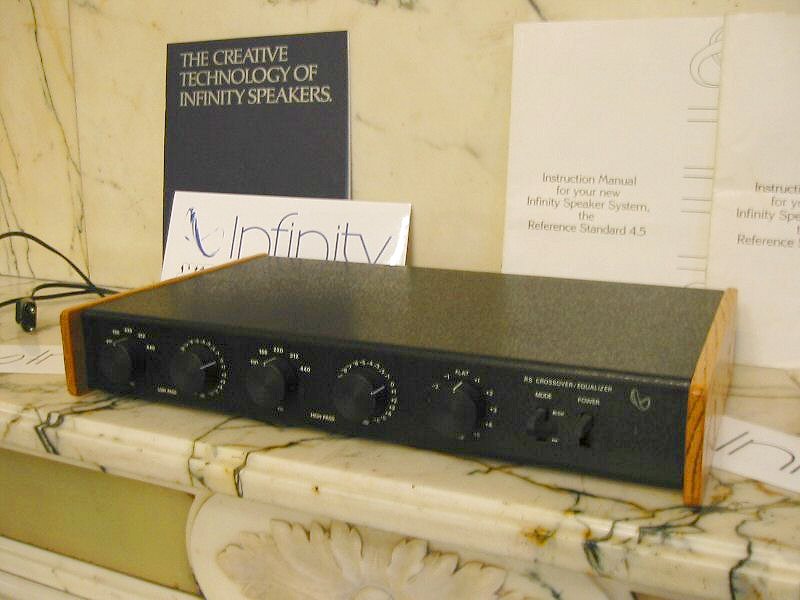
Do you have the external crossover required for the RS 4.5?
AK'er 7.62 is enjoying his 4.5's and could help you out over on the "Infinity Forum".
You could hookup each amplifier, hear the results first hand at low to progressively high volume level to experience the amp running out of steam and more importantly signs of over heating, if any.
Have fun.
RS4.5-13.jpg
 
Since I’m not familiar with the amps that you own, I cannot say with any certainty that they’ll fit the bill. If an amp can’t deliver current at certain times, the result is that you won’t be able to appreciate the speaker’s full capabilities. Read threads here at which an AKer connects a different amp to a pair of speakers and says - I had no earthly idea these speakers could sound like this! Almost always this is simply the result of this particular amp being able to drive the speakers the way the speaker designer envisioned - and being able to deliver current as the speaker requires it is a key component.
 
By the way, to address a point you make earlier in regards to wattage vs current ... wattage is the product of voltage and current. And voltage is that which causes current to flow. Therefore a high current amplifier is simply one that can maintain its output voltage when voltage and current are not in phase - which is quite often.
 
The words high current are oft overused in marketing copy. The idea in and of itself simply means that the amplifier is able to deliver power when it's required into loudspeakers which present a difficult load ... without I'll side effects - shutting down, overheating, blowing up, etc.
By the way, to address a point you make earlier in regards to wattage vs current ... wattage is the product of voltage and current. And voltage is that which causes current to flow. Therefore a high current amplifier is simply one that can maintain its output voltage when voltage and current are not in phase - which is quite often.
This is quite true.
 
The fact the Yamahas can do CLASS-A is a good indication they can handle some current. If bi-amped with the external xovers you shouldn't have any trouble. The M-70 does 200W/ch, the M-45 125W/ch. Sounds like a fun project.
 
I do have the external crossover unit and I my intent is to hook these dudes up using bi-amplification. I think I now have everything I need to do this. IMG_7248.jpg
 
I do have the external crossover unit and I my intent is to hook these dudes up using bi-amplification. I think I now have everything I need to do this. View attachment 1494903
FYI, I believe the 4.5s (and all Infinity) were designed to have the tweeters toward the inside of the setup. Then it's possible you could eliminate the need for toe in. Just my two cents. :dunno:
 
A commonly used indicator of a high current amplifier is one that has 50% or more power at 1/2 load ie:

200wpc@ 8 ohms/300wpc@ 4 ohms

Not high current:
200wpc @ 8 ohms /220wpc@ 4 ohms

Found some specs. So I will infer that this is not really "High Current" amplifier.
45 specs.JPG
 
FYI, I believe the 4.5s (and all Infinity) were designed to have the tweeters toward the inside of the setup. Then it's possible you could eliminate the need for toe in. Just my two cents. :dunno:

Thanks. I wasn't sure about the positioning. This image is just a temporary set-up anyway. My logic was to spread the tops due to spacing constraints. Once I get to the critical listening stage, I will surely be moving stuff around and probably be adding some type of diffusion on the wall. Probably move the CV's out of the space altogether?
 
I echo sqlsavior's comments. Give 'er a whirl.

Returning to your question about high current, after looking at the innards of an M45, I would not consider it such. That is based upon its relatively small power supply and use of only two pair of output devices per channel.

m45.jpg

By contrast, here is a 100 watts/channel Threshold Stasis 3 I used for nearly thirty years driving demanding electrostats. Note that both amplifiers are about the same width. It used 16 output devices per channel with a 105 joule power supply. Such obviated the need for protection circuitry and never gave me any problems.

stasis.jpg
 
Last edited:
I echo sqlsavior's comments. Give 'er a whirl.

Returning to your question about high current, after looking at the innards of an M45, I would not consider it such. That is based upon its relatively small power supply and use of only two pair of output devices per channel.

View attachment 1495172

By contrast, here is a 100 watts/channel Threshold Stasis 3 I used for nearly thirty years driving demanding electrostats. Note that both amplifiers are about the same width. It used 16 output devices per channel with a 105 joule power supply. Such obviated the need for protection circuitry and never gave me any problems.

View attachment 1495173
Thanks! ...And that looks like one heavy duty piece of equipment!
 
I echo sqlsavior's comments. Give 'er a whirl.

Returning to your question about high current, after looking at the innards of an M45, I would not consider it such. That is based upon its relatively small power supply and use of only two pair of output devices per channel.

View attachment 1495172

By contrast, here is a 100 watts/channel Threshold Stasis 3 I used for nearly thirty years driving demanding electrostats. Note that both amplifiers are about the same width. It used 16 output devices per channel with a 105 joule power supply. Such obviated the need for protection circuitry and never gave me any problems.

View attachment 1495173
Excellent example which fully illustrates where the money goes . . . well done.
 
Voltage is cheap. Amperage is expensive.

"High Current" in common usage (advertising copy and other propaganda sheets) means the amplifier is suitable for use with 4-ohm nominal speakers.

"High Current" in real life means the amplifier is suitable for use with 1-ohm nominal speakers, maybe sub-one-ohm.

Then some manufacturer starts throwing around silly "amperage" specifications that have zero relevance to a real-world speaker load or music signal. If you're seeing some goofy amperage spec like "40 amperes" or "80 amperes" you'd better be questioning their methodology.

Of course, there's more to speaker load than just the impedance. Capacitance and inductance matter, too. The best amps can throw power into reactive loads, not just resistive.
 
Last edited:
Back
Top Bottom