• The move to the new server is done. There are some software and database maintenance updates in process. This has us passing the hat around to help out. We appreciate any donations. Seriously, even a dollar helps. The payment page may be found here - https://www.audiokarma.org/support.html

HK FA-3000X Cap replacment/Variac questions

Ric Harris

Active Member
I just sniped my very first piece of tube audio on ebay this morning, a HK FA 3000X.
It appears complete and I know these things need to be powered up gradually but being I don't own a Variac at the moment I am just wondering if I just replaced the caps ahead of time would it still be necessary to power it up slowly?
Also on the bad idea front I have a heavy duty dimmer switch ( 3-4 amp) dare I?
 
Register to hide this ad
The dimmer switch, might be a ss pwm type dimmer, which would be very noisy, and is not designed to work with transformers, it may even damage it. A dim bulb unit would be best.Bringing it up slowly is even a good idea after any service work is done in case of mistakes.
 
The dimmer switch, might be a ss pwm type dimmer, which would be very noisy, and is not designed to work with transformers, it may even damage it. A dim bulb unit would be best.Bringing it up slowly is even a good idea after any service work is done in case of mistakes.
I plan on making a dim bulb unit today as I got all the goodies for that left over from rewiring my garage. I even have a porcelain fixture and fiberglass housing sitting around someplace. However the dim bulb is for safety/short circuits. I found a Variac for under 50.00 I may just suck it up and buy it.
 
I can't find a schematic for it.:mad: I was hoping I could order caps right away and locate tubes if I needed them. Whats the likelihood those ancient caps have enough vigor left in them. I've seen 60's caps that still were good and 80's and 90's ones that were already tired out. Time will tell I guess.
 
Electrolytic caps are a gamble, I still have the original caps in my late 1950's Fairchild amps, but I don't regularly use them, and I monitor them for heat when I first fire them up after a rest. They don't have any sign of hum. I have brought up ~50 or so pieces in 2012 and 3 or 4 couldn't be run for any extended time because of heating of the caps. I also changed many leaking paper caps, in that lot, for electrical leakage.I always use a variac when bringing something up that was not recently used.
 
Electrolytic caps are a gamble, I still have the original caps in my late 1950's Fairchild amps, but I don't regularly use them, and I monitor them for heat when I first fire them up after a rest. They don't have any sign of hum. I have brought up ~50 or so pieces in 2012 and 3 or 4 couldn't be run for any extended time because of heating of the caps. I also changed many leaking paper caps, in that lot, for electrical leakage.I always use a variac when bringing something up that was not recently used.

I have a variable power supply for my router that has a internal transformer and for all intents and purposes I can't find any differences with it and the 50.00 variac. Router motors are fussy and don't like dirty electricity. I have large step down that I run 120 in 120 out in front of the variable power supply just because the local utility has suspect juice. In fact I have a cap unit I got for smoothing out the juice in front of that. It's overkill but there's a cheese plant near by that when it fires something up over there you get the draw down followed by the burst of voltage. That's not supposed to happen according to the utility but they lie.
 
I have a variable power supply for my router that has a internal transformer and for all intents and purposes I can't find any differences with it and the 50.00 variac. Router motors are fussy and don't like dirty electricity. I have large step down that I run 120 in 120 out in front of the variable power supply just because the local utility has suspect juice. In fact I have a cap unit I got for smoothing out the juice in front of that. It's overkill but there's a cheese plant near by that when it fires something up over there you get the draw down followed by the burst of voltage. That's not supposed to happen according to the utility but they lie.
Hi Ric, if your variable power supply outputs ACV of around 5A that should cover you. But if you think you will be working on other tubed units i would consider the variac as an essential tool like a DMM or 2. There are always posts about people turning on there newly rebuilt amp with a full power on blowing fuses, resistors, or having tubes go Fukushima . With a SSR, ss rectifier, in place of your rectifier tube if that is what you have, you can start to monitor voltages as low a 1vac, but usually i start at 10vac. From that you can check if your ps is working correctly and then check the B+ through out the amp. If all B+ voltages check out then the next step is to get the tubes to start conducting which is at around 60vac. Once the tubes are warm they will start to pull down the B+. From thiis point you can install some cheap throwaway test speakers and hopefully you will not hear any untoward noises. Checking voltages at this point will should also get you some faint ticks or pops as the meter probe contacts the plates of the tubes. Once you get at around 70vac your cathode bias resistors will begin conducting and you should get readings there. You can also plug in your walkman or ipad or some signal source and you should get some music out of the speakers. If you do get sound things are looking good, but you need to watch for issues, like parts overheating or odd noises from the speakers, etc. Basically, that is how i approach a first power up.
 
It may be an autotransformer. Variac is just a brand name of autotransformer, along with Powerstat. As long as its not a triac based thing like a light dimmer and is rated for the current draw it will probably work fine. Triacs chop up the waveform, they make motors hum horribly and do pretty much the same to transformers.
 
Hi Ric, if your variable power supply outputs ACV of around 5A that should cover you. But if you think you will be working on other tubed units i would consider the variac as an essential tool like a DMM or 2. There are always posts about people turning on there newly rebuilt amp with a full power on blowing fuses, resistors, or having tubes go Fukushima . With a SSR, ss rectifier, in place of your rectifier tube if that is what you have, you can start to monitor voltages as low a 1vac, but usually i start at 10vac. From that you can check if your ps is working correctly and then check the B+ through out the amp. If all B+ voltages check out then the next step is to get the tubes to start conducting which is at around 60vac. Once the tubes are warm they will start to pull down the B+. From thiis point you can install some cheap throwaway test speakers and hopefully you will not hear any untoward noises. Checking voltages at this point will should also get you some faint ticks or pops as the meter probe contacts the plates of the tubes. Once you get at around 70vac your cathode bias resistors will begin conducting and you should get readings there. You can also plug in your walkman or ipad or some signal source and you should get some music out of the speakers. If you do get sound things are looking good, but you need to watch for issues, like parts overheating or odd noises from the speakers, etc. Basically, that is how i approach a first power up.
I have plenty of junk speakers and before I even power up the receiver I'll be pulling the bottom plate off to inspect everything and check to make sure nothing is burnt and that the wiring is still attached to it's proper locals. As for the B+ I know what your talking about but I'm not sure where to hook up the multi meter to read it. I'll see if Uncle Doug has any video's on the subject. Thanks for the advice also how long of a duration should I run it at say 60 or 70vac before I open it up to 120 providing all is going well.
 
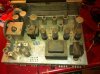
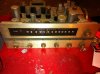
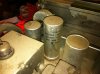
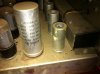
Here she be filthy but complete. The original 7408 tubes have been replaced with 6v6GTA's it's not the exact equivalent and I am not sure what the difference is but I have my eye on some Mullard 7408's in case these are not up to snuff. The glaring question is what kind of caps would a guy buy to replace these ones the a variable depending on the voltage. Pictured below. They're nothing I've ever seen but my oldest rig is a Heathkit AA-21 and it doesn't have caps marked like these guys.
I have to admit it may end up being a bit of a money pit but I think it will clean up nicely. The cabinet need a refinish but it's clean otherwise.
Time will tell.
 

Attachments

  • IMG_0064.JPG
    IMG_0064.JPG
    91.6 KB · Views: 21
  • IMG_0076.JPG
    IMG_0076.JPG
    86.4 KB · Views: 19
  • IMG_0074.JPG
    IMG_0074.JPG
    78.6 KB · Views: 19
  • IMG_0068.JPG
    IMG_0068.JPG
    90.3 KB · Views: 19
  • IMG_0073.JPG
    IMG_0073.JPG
    81.4 KB · Views: 19
The pictures show your amp to be in original condition, at least from the top view. That is no work has been done to it. Also, no rectifier tube is visible and one of the can caps has a cardboard cover to it. That most likely means that the power supply rectification is via a voltage doubler system using 2 SS diodes. The cardboard covered cap is almost always in need of replacement as it is the first cap in the ps and takes the full brunt of initial AC smoothing.So, you might as well replace all of the can caps. The coupling caps between the tube stages , especially between the phase splitter to the power tubes are the other caps that need replacement for reliable service from your amp. But all of this is wasted time, if one or more of the transformers are blown. That is why it is important to get a variac to check the power trans and output trans. Since your amp has SSR the rectifiers will work as soon as some AC appears. If you decide to get a variac and need to know how to proceed from there just ask. good luck.
 
Usually I raise the voltage 10 volts an hour and check the can caps for any signs of heating, if any start to get warm, I stop raising the voltage, and back off a little, around 80 volts the amp will play, around 100 the tuner may play you should change the coupling caps to the opt tubes before you start.(as primosounds said) You may want to stay at 110v for a time, the last 10v seems to be the the the most tricky if the caps have trouble.The cap nearest the opt tube may be warmed by the tube, if it gets warm, you could place something between them during the check.If any of the caps corrosion around the terminals indicating leakage of the electrolyte, replace the cap before going above 110v
 
Last edited:
Is Alive! :rockon:
I brought it up slowly but it wasn't until I hit the 100v mark that i could hear any sounds of life. Once I put a full 120v it took at least 10 min before those caps were juiced up enough, but once it woke up it really came alive. The controls I cleaned ahead of time and they're not scratchy nor has it made even a pop. The Bass on this is huge I may add.
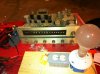
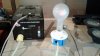
I removed it from my buddy's variac and now I have it still isolated on my stepper transformer. The dim bulb tester has a slight glow no variations in it's intensity what so ever. The 6v6GTA's I measured with my laser guided inferred thermometer and they all read about 155 degrees. Much cooler than I would have thought. I'm now going to see if I can wake up the tuner.
One question is would this rig benefit from putting 7408 tubes as it came with originally.
20170911_154626.jpg
I am a happy camper today!!!
 
Usually I raise the voltage 10 volts an hour and check the can caps for any signs of heating, if any start to get warm, I stop raising the voltage, and back off a little, around 80 volts the amp will play, around 100 the tuner may play you should change the coupling caps to the opt tubes before you start.(as primosounds said) You may want to stay at 110v for a time, the last 10v seems to be the the the most tricky if the caps have trouble.The cap nearest the opt tube may be warmed by the tube, if it gets warm, you could place something between them during the check.If any of the caps corrosion around the terminals indicating leakage of the electrolyte, replace the cap before going above 110v
It took a good while for those old caps to juice up but once they hit full that old amp kicked into high gear. So far I've seen no sign of leaks and I checked their temps with my inferred and they were all about 85 degrees and the transformers were in the low 90's so I see that as a very good sign. Had and of those transformers gotten above 130-140 I would have been concerned hotter than that and it would have been shut down now. She's been running for 2 hours and all seems stable. No hum either...so far knock on wood. Also had there been any corrosion I wouldn't have tried firing it up. Had a large filter cap explode once and that was once too many.
 
Back
Top Bottom