• The move to the new server is done. There are some software and database maintenance updates in process. This has us passing the hat around to help out. We appreciate any donations. Seriously, even a dollar helps. The payment page may be found here - https://www.audiokarma.org/support.html

How does a linear Tracking turntable work?

NH-MAN

Addicted Member
Just curious, I have never had one. Does it have a drive motor for the arm? When you look at a record it appears that the grooves are not always equal distances apart or are they really the same. If they are not equal wouldn't that pull the needle to one side if the tone arm is being feed a fixed speed? just wondering.
 
Register to hide this ad
Depends on the table. Some are motor some are belt some are air etc. lots of variety. There are quite a few posts here and articles about on this topic. Me, I am a linear fan and have quite a few. Use them more than my pivot point arms.
 
Nearly all linear trackers have some kind control mechanism to make the tonearm stay at right angles to its base. Only exception I know of is the Marantz 12, which had a very low friction assembly when set up right, and the tonearm was moved by the record. I believe there are some air bearing arms which work similarly.
Simplest is the Rabco/HK mechanism which the tonearm assembly sits on a rubber roller (which sits on a rotating shaft) , which keeps it at tangency to the groove.
The Rabco SL8 had a pivoted arm assembly, and used mechanical contacts which caused the arm to move when not tangential.
Nearly all the tangential turntables of the late 70's on used a pivoted arm with some kind of optical sensor whose signal was used to move the base when tangency was lost.
 
The majority of them have a motor which is usually driving a carriage to advance the tone arm. The arm on most have a type of sensor that as the tone arm moves just slightly it effects a sensor that then activates the motor to move a carriage to advance the tone arm. The carriage will advance until the arm is back tangent. In effect it is hundreds of small pivots. But keep in mind the tracking error is very minute as the stylus just barely get out of tangent and then the carriage corrects it. The best systems reduce the amount of small hops as they react to the slightest of out of tangent positions and by the looks of it the cart is advancing just perfectly and it doesn't appear to ever stop. And as you notice the grooves are not evenly spaced. Because low frequency and more dynamic sections require more spacing than quiet sections with no bass, or low bass frequencies. If you reduce the bass, and the amptitude you reduce the spacing and you can greatly increase the play time on a record disc. RIAA equalization helps in that as well.

Air bearings just use the pressure on the stylus to advance the arm just as a pivot arm does. But because the pivot point on the straight LT tone arm is moving right along with the stylus the tracking error is always pretty much the same, just ever so slightly off actually. .
 
With todays technology I would think an enterprising company could make a really good LT table. Possibly using an Magnetic linear motor to advance the cart, which would eliminate any connection between a drive motor and the tone arm cart. Linear motor technology has come a long way. And if they used a laser to keep track of the very center of the groove and then relay that location to a PC chip they could have a fixed tonearm on a carriage driven by magnetic drive rather than by a rotary drive motor, the stylus could be in real time always dead on center of the v groove. Even the carriage could not only be driven by the magnetic force, it could also be almost complete isolated from the table by a mag lift type of rail system. I think the only limitations are cost.

Another way that I just thought of which might be the simplest way and that would be if the company who cuts the record had a digital recorder that recorded the exact location of the tone arm during the cutting process, and then digitally print that info in the inner area of the record, and than then the turntable company would have a digital copy of the exact movement rate of the carriage needed to advance the stylus rather than have the stylus come out of tangent and than have to correct it. That is all that would have to be done.

 
Last edited:
Nearly all linear trackers have some kind control mechanism to make the tonearm stay at right angles to its base. Only exception I know of is the Marantz 12, which had a very low friction assembly when set up right, and the tonearm was moved by the record. I believe there are some air bearing arms which work similarly.
Simplest is the Rabco/HK mechanism which the tonearm assembly sits on a rubber roller (which sits on a rotating shaft) , which keeps it at tangency to the groove.
The Rabco SL8 had a pivoted arm assembly, and used mechanical contacts which caused the arm to move when not tangential.
Nearly all the tangential turntables of the late 70's on used a pivoted arm with some kind of optical sensor whose signal was used to move the base when tangency was lost.
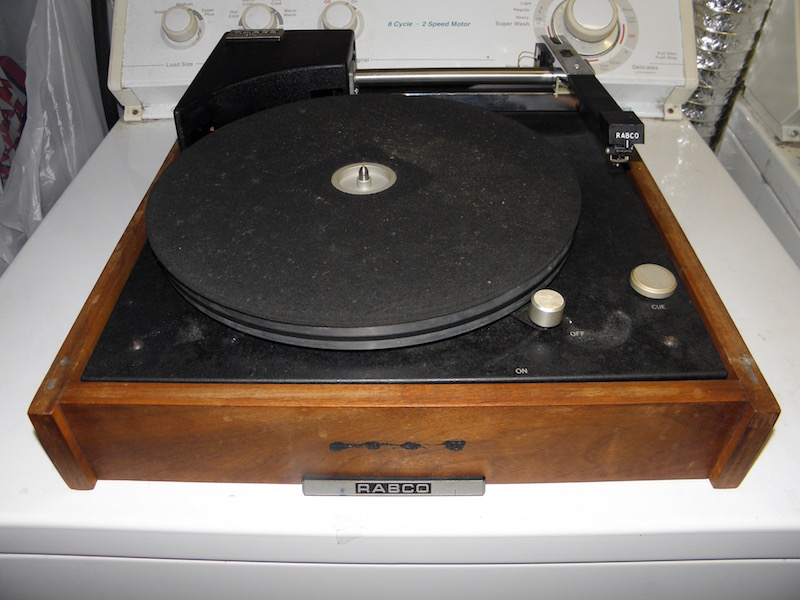
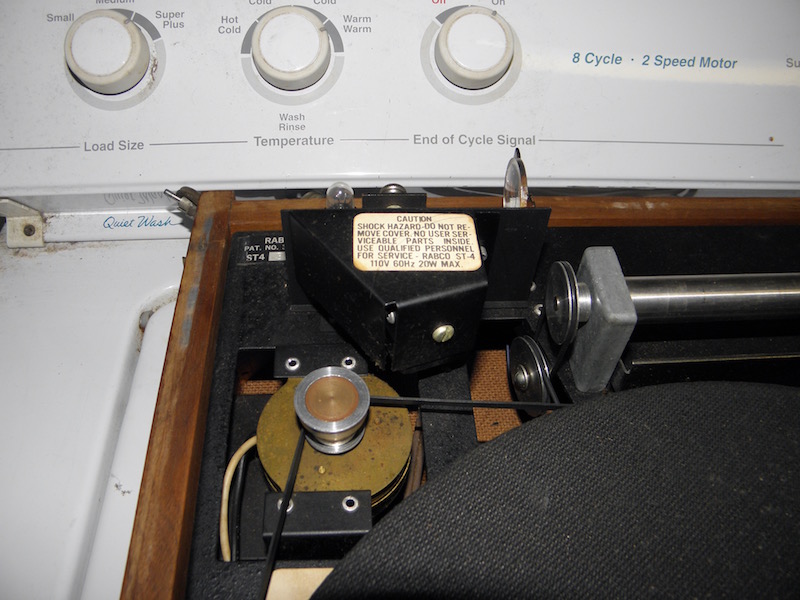
The Rabco ST-4, made before Harman-Kardon bought the company, had the roller on top of the chassis. It was driven from the rotation of the platter by a pair of belts and pulleys, and a series of idler wheels ensure that it stays true to the groove as it rides the roller. Pretty ingenious, really.
rabco3.jpg

rabco4.jpg
 
With todays technology I would think an enterprising company could make a really good LT table. Possibly using an Magnetic linear motor to advance the cart, which would eliminate any connection between a drive motor and the tone arm cart. Linear motor technology has come a long way. And if they used a laser to keep track of the very center of the groove and then relay that location to a PC chip they could have a fixed tonearm on a carriage driven by magnetic drive rather than by a rotary drive motor, the stylus could be in real time always dead on center of the v groove.

This is exactly what Pioneer did in 1979 when they released PL-L1 model. Worked very well and was likely the best tangential tracking method of all times.
 
The majority of them have a motor which is usually driving a carriage to advance the tone arm. The arm on most have a type of sensor that as the tone arm moves just slightly it effects a sensor that then activates the motor to move a carriage to advance the tone arm. The carriage will advance until the arm is back tangent. In effect it is hundreds of small pivots. But keep in mind the tracking error is very minute as the stylus just barely get out of tangent and then the carriage corrects it. The best systems reduce the amount of small hops as they react to the slightest of out of tangent positions and by the looks of it the cart is advancing just perfectly and it doesn't appear to ever stop. And as you notice the grooves are not evenly spaced. Because low frequency and more dynamic sections require more spacing than quiet sections with no bass, or low bass frequencies. If you reduce the bass, and the amptitude you reduce the spacing and you can greatly increase the play time on a record disc. RIAA equalization helps in that as well.

Air bearings just use the pressure on the stylus to advance the arm just as a pivot arm does. But because the pivot point on the straight LT tone arm is moving right along with the stylus the tracking error is always pretty much the same, just ever so slightly off actually. .
Bravo Ken. Maybe the best explanation I've seen.
With todays technology I would think an enterprising company could make a really good LT table. Possibly using an Magnetic linear motor to advance the cart, which would eliminate any connection between a drive motor and the tone arm cart. Linear motor technology has come a long way. And if they used a laser to keep track of the very center of the groove and then relay that location to a PC chip they could have a fixed tonearm on a carriage driven by magnetic drive rather than by a rotary drive motor, the stylus could be in real time always dead on center of the v groove. Even the carriage could not only be driven by the magnetic force, it could also be almost complete isolated from the table by a mag lift type of rail system. I think the only limitations are cost.

Another way that I just thought of which might be the simplest way and that would be if the company who cuts the record had a digital recorder that recorded the exact location of the tone arm during the cutting process, and then digitally print that info in the inner area of the record, and than then the turntable company would have a digital copy of the exact movement rate of the carriage needed to advance the stylus rather than have the stylus come out of tangent and than have to correct it. That is all that would have to be done.
Double bravo for designing an even better method. I especially like the digital time-code (time-space code) to guide the arm.

The idea reminds me — I did sound transfers on a movie, many years ago. On-set, Sound was recorded on 1/4" mag tape (Nagra recorder). It was then converted to an "optical track" on the edge of print shown at theaters; the projector "read" the optical track and sent it to the theater's amps/speakers.

Looks like pic below (next to the sprocket-holes).

I always wondered why this tech was never used for home audio...

35mm_film_audio_macro.jpg
 
Here's how the Rabco arm is driven, basically by a belt from the same spindle that turns the platter which is itself driven by a belt from the motor. The arm drive roller "tire" turns on a long cylinder, and the speed is controlled by the angle at which the tire contacts the cylinder.

PhotoPictureResizer_190712_214208862_crop_1670x933.jpg
 
I had a Mitsubishi LT-V5 for a couple of years as my main player. Great fun, a vertical TT so shows off those picture discs nicely.
It actually sounded rather good once I'd fitted a Shure M75ED cart, though prone to feedback if not sited carefully.

My enduring memory however is my shock, found when I changed the belt, to find the tangential arm was being moved by a bit of string.
After all the high tech gubbins involved in keeping the arm in the right place it seemed a bit basic to say the least.

Worked ok though.
 
Here's how the Rabco arm is driven, basically by a belt from the same spindle that turns the platter which is itself driven by a belt from the motor. The arm drive roller "tire" turns on a long cylinder, and the speed is controlled by the angle at which the tire contacts the cylinder.

View attachment 1561113

Only true for the Rabco arm on the HK ST series tables not the Rabco SL8 or 8e arm. The 8 is a Rube Goldberg operation using a ball chain to move the transport once a leaf switch is activated to bring the arm back to a tangent position. Works great and this arm was very popular. Now brings some decent money used.
 
The Rabco ST-4, made before Harman-Kardon bought the company, had the roller on top of the chassis. It was driven from the rotation of the platter by a pair of belts and pulleys, and a series of idler wheels ensure that it stays true to the groove as it rides the roller. Pretty ingenious, really.
rabco3.jpg

rabco4.jpg
Looks like your "Rabco" name plate came loose during the spin cycle.
 
I know this link won't hold up over time, but if anyone ever got a hankering for the rare beast that is the Pioneer PL-L1, one just showed up on HiFiDo. Just a bit more than a couple grand (not including shipping!) and it's all yours...annnd you'll need a headshell and cart on top of that. https://www.hifido.co.jp/19-22930-3...T=0&M=0&LNG=E&OD=0&O=0&L=50&SD1=0&SD2=0&SD3=0

I will hazard a guess it won't last a week on there.

- Jeff
 
Only true for the Rabco arm on the HK ST series tables not the Rabco SL8 or 8e arm. The 8 is a Rube Goldberg operation using a ball chain to move the transport once a leaf switch is activated to bring the arm back to a tangent position. Works great and this arm was very popular. Now brings some decent money used.

Right. I was going to mention HK models like my ST-6 and ST-7 but forgot.
 
Right. I was going to mention HK models like my ST-6 and ST-7 but forgot.
The tracking system is fascinating, but the implementation is a resonance festival. The Mitz LT- 30 is dead as Hogans goat and may sound sterile to some as a result, the PL-L1000 is somewhere between in resonant liveliness. This makes the TTs somewhat interactive to room sound as well as the playback vibration up the arm into the structure from the cart.
 
The Mitz LT- 30 is dead as Hogans goat and may sound sterile to some as a result
I have the Mitz LT-22 (cute nickname, Pio). It's a rung down from the "dead/sterile" LT-30, and not nearly as elegant — but it sounds lively and "warm and musical" (subjective adjectives detested in audio). It may be a lucky halfway-point between excessive resonance and icy neutrality.

It's not as good as my better pivoting arms on better turntables, but it's not miles behind, and the clarity at end-of-side is well ahead. It really shows on those all-out crescendos at the end of some Symphonies, like the kick-ass insanity of Mahler 3.

The LT-22 has 4 or 5 breaks/joints in the cartridge signal wires, and each break loses something, esp with very-low ouput MCs. I'm planning to rewire it straight-through — that should make it even better — but it needs other work too, like new bulbs/caps, so it's a big project I have to make time for.
 
Last edited:
I know this link won't hold up over time, but if anyone ever got a hankering for the rare beast that is the Pioneer PL-L1, one just showed up on HiFiDo. Just a bit more than a couple grand (not including shipping!) and it's all yours...annnd you'll need a headshell and cart on top of that. https://www.hifido.co.jp/19-22930-3...T=0&M=0&LNG=E&OD=0&O=0&L=50&SD1=0&SD2=0&SD3=0

I will hazard a guess it won't last a week on there.

- Jeff

With shipping, buck down transformer (120->100 Volts), headshell that allows azimuth adjustment (the only one needed for tangential tracker) and good high compliance cartridge - total about $4000, you will get it up and running. This will be competitive with the modern $10K worth setup.
 
I own a quite few turntables, and LT tables are a few of them. I own a Mitsibushi LT30, Yamaha PX2, and a Phase Linear 8000 II. My first LT table started with a Technics SL 10, I also owned a Sansui LT table which used strings on ;pulleys to advance the carriage. That Sansui was not a very good table, as you could hear the drive motor transmit thru the tonearm. .

Thinking back on the Phase Linear I don't remember how the drive motor actually connects to the carriage. I know it has a small rotary electromagnet motor which runs a belt to some plastic gears but I don't remember how it attaches to the carriage. I know the carriage runs on some polished rods.

The Yamaha PX has a large flat belt, which is like a big conveyor belt that the tonearm carriage is attached to. I have never had the my MIt LT30 apart.
 
Back
Top Bottom