• The move to the new server is done. There are some software and database maintenance updates in process. This has us passing the hat around to help out. We appreciate any donations. Seriously, even a dollar helps. The payment page may be found here - https://www.audiokarma.org/support.html

How effective are passive radiators?

d-ray657

Ain't this boogie a mess
In my ongoing audition of speakers to figure out what I like, I have happened upon a couple of pair of speakers with passive radiators. Are they generally worth the space that they take up in speaker volume? They are in the pair of budget level Polk Audio s-12 that I bought recently, and I am not all that impressed with the bass. Are there any speaker makes/models that have used the passive radiator to good effect? Are they more effective when aimed backwards? Inquiring minds want to know.

Regards,

D-Ray
 
Register to hide this ad
Klipsch, ESS Heil, JBL and many others have used them to advantage. I have a pair of Klipsch 2.0's and the passive radiator is mounted on the back. For such a small box it puts out decent bass. The bass always seems more controled to me when there isn't a port, i.e. sealed or using a passive radiator.
 
My mom's got a pair of the Cannon Towers. My Dad bought them brand new in 1978 from a furniture store in Reno, and he picked a JVC R-S33 baby receiver to power them with. Passive Radiator design is a compromise between ported and suspension. Has nice tight bass, but can also deliver strong deep low end without the huffiness usually assocated with ported design.
 
Last edited:
Think of a passive radiator as a substitute for a port. The diaphragm of the passive radiator is acting the same way the air in a port would act, and reinforce the bass in the same way.
 
The amp could make a difference.

I love my Polk 10Bs which have a front 10" passive radiator. And to me it beats the Advent 5002 and Boston A-100 for overall bass, high frequencies, you name it. Punchy bass, sizzling guitars, soaring vocals.

I currently power them with an Onkyo TXSV909Pro AV receiver. But when I heard them demo'd by the seller it was through a 250 watt amp and it was spectacular. Guitar and drums had the attack of a live performance. No subwoofer needed.

I also have a pair of Cannon TLS 1232. They have a 12" woofer front and a 12" passive radiator in the back. Also had great punch and clarity. The salesman promoted them as having the typical "West Coast" sound. Again different powered receivers made a difference.

Oh I almost forgot, I have a pair of PhaseTech PC60s which are smaller speakers with a front passive radiator. The only other speakers of their size I have are the Boston CR7s. And the PC60s compare very favorably. From memory (no formal AB test) I think they beat them or come close for bass and high frequencies and clean sound even though they are meant to be paired with another PhaseTech subwoofer. Could be just residual memory, but I wouldn't mind getting a 2nd pair over the Bostons since they seem to fly under the radar.
 
My mom has a pair of Vintage Canon Tower Speakers from 1979 that utilize a passive radiator with a reverse foamed woofer. Let me tell you the many years I and my sister partied to those sweet sweet sounding speakers. They are among the Meanest speakers I have ever heard in my life! Such strong bass that the 7500 square foot house shakes on it's solid slab cement foundation!! YES, they are CANON'S, the company that is famous for their Cameras:) I have not been to my mom's vacation house in Nevada for many years and you can bet that the next time I go I will take pictures of them for al to see one of the most rarest, meanest speakers on the planet!:nutz:
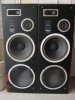
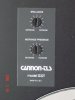
Could these be the ones? I googled looking for pics of mine but the ones below are the Cannon TLS 1232T which are tower versions of mine.

Mine look like the top part with just the one 12" woofer with inverted surround.
 

Attachments

  • Canon1.JPG
    Canon1.JPG
    21.9 KB · Views: 178
  • CanonFront.JPG
    CanonFront.JPG
    12.2 KB · Views: 34
  • CanonGrill.JPG
    CanonGrill.JPG
    36.8 KB · Views: 54
  • CanonControls.JPG
    CanonControls.JPG
    16.4 KB · Views: 57
  • CanonWood.JPG
    CanonWood.JPG
    20.1 KB · Views: 39
the Polk Audio S-10 isn't a very high quality speakers.. cheap-ish looks and build compared to other speakers they built in that same era.. where passive radiators were common on Polk speakers. As you move up the food chain on Polk speakers.. with the double or larger passives.. the bass becomes better and fuller.

high current amps work best to bring out the best in the vintage polk speakers. as I'm sure it could be said for any speaker really. :)
 
My mom has a pair of Vintage Canon Tower Speakers from 1979 that utilize a passive radiator with a reverse foamed woofer. Let me tell you the many years I and my sister partied to those sweet sweet sounding speakers. They are among the Meanest speakers I have ever heard in my life! Such strong bass that the 7500 square foot house shakes on it's solid slab cement foundation!! YES, they are CANON'S, the company that is famous for their Cameras:) I have not been to my mom's vacation house in Nevada for many years and you can bet that the next time I go I will take pictures of them for al to see one of the most rarest, meanest speakers on the planet!:nutz:

IIRC, those were actually made by ESS, not the camera company . Excellent speakers, IMO.
 
A properly designed speaker using passive radiators is quite capable of producing extremely deep, clean and natural bass. In fact, good speakers using PR's will measure less bass distortion than ported designs. Some tips for getting the best from them would include a high current amp and speaker distance to the rear wall. The closer they are, the more bass they produce, but too close and it'll get muddy. The better designs fire forward.

I would like to flip around Paul C.'s comment, if I may, and say that ports are a poor substitute for a good PR designed speaker.
 
PRs have very slightly steeper rolloff than standard ports, but negligibly so. they also have less port noise and are your only real option when you have a small box you want to tune to deep freq. I wouldn't ever consider then significantly different enough than a port to say that either one is a poor substitute for the other.
 
Kef used 'em in the Cadenza - a passive version of the B139. Works very well as it allows the B200 to go a bit lower in that cabinet.
 
What Paul, Dave, and Ray (elsewhere) said.

PRs also sound somewhat different from equivalent vented systems.

According to Dickason, they exhibit "degraded transient response."

Notable vintage JBL examples - S7R and S8R in C50 Olympus and C60 Sovereign enclosures, S70 Alpha, Lancer 44, L54 Trimline, L59 Festival, Lancer 77, L80 Caprice, L150 Millenium, L220 Oracle, and L222 Disco.

In common current practice, the prime purpose for using them is an alignment and box size which will not accommodate a conventional vent, or to deceive the consumer.

See Loudspeaker Design Cookbook Chapter 3.
 
or to deceive the consumer.

I believe there must be a set of Boston HD9 or HD10 speakers somewhere in Vance's past.

:D

This is where I've found PR's to be the most effective -

PSB-HD10,-HD8-Subwoofers.jpg
 
I've been reading about subs and passive radiator implementations for bass extension, and one funny thing I've found in Wikipedia is:
In technical support circles, it has long been known that some owners of speaker cabinets featuring a passive radiator have taken the cabinet apart, and have come to the conclusion that someone (the manufacturer or salesperson) has taken advantage of them, by leaving out much of one of the drivers. They misconstrue the technology, and sometimes think the manufacturer put a fake speaker in the cabinet (since there is no magnet or wire) just to give the appearance of a larger more powerful speaker.

Retrieved from "http://en.wikipedia.org/wiki/Passive_radiator_%28speaker%29"
 
I was discussing this same topic with Howard Rogers (Rogersound Labs) last month.

According to Howard, the passive radiator is used to effectively increase the bass cone area while eliminating the turbulence and reduce motion compression that would be caused by high velocity airflow with a vented port, as well as eliminating vent pipe resonances. PR's also give the designer the ability to tune the small volume and driver for better low frequency performance. Low frequency rolloff in PR designs will usually be steeper than that of ported cabs and will have a notch in the frequency response. The PR design of the RSL Nevada increases the effective cone area of its 12" bass driver to a diameter of over 18"
 
Sounds like a good recap of what everyone has been saying.

EDIT: either i missed the increasing the effective area of the bass driver, or it was added later. This would be a poor analogy for what a PR does.
 
Gave away a pair of the Cannons some years ago -- I believe they were made by ESS, like tarior said. My buddy still has them, and is still happy with them.
 
Off topic, I know, but the Cannons seemed to have better tonal balance than most of the Heil based ESS. Too bad they didn't combine the best of both worlds.
 
Back
Top Bottom