• The move to the new server is done. There are some software and database maintenance updates in process. This has us passing the hat around to help out. We appreciate any donations. Seriously, even a dollar helps. The payment page may be found here - https://www.audiokarma.org/support.html

How important is transistor gain (HFE) in an amplifier?

CalvinBeck

Member
Without going into calculus, how important a role does the gain of BJTs play in the performance of an amplifier? I ask because I’m in the process of restoring a Harmon Kardon 330c and I’ve read in other threads that there may be “noisy” transistors in it. I don’t have golden ears, more like bronze. I understand the importance of gain matching in the differential pairs, but what about the other ones? It seems like the modern “replacements,” the Ksas and Kscs, all show significantly less HFE on their datasheets than those for the vintage BJTs. In a nutshell, if the receiver sounds fine to my ears, should I even worry about noisy transistors? If it ain’t broke, don’t fix it?
 
Register to hide this ad
in most circuits there is so much feedback that variations in gain get compensated for and you won't know it. So long as the replacement part at least meets the minimum number on the old part, it will work fine. Too low and you might start running into problems, depending where it is and what its actually doing.

the other trick, are those old transistors still within spec? I've pulled some that had hfe way below what the datasheet says they ought to be, and the thing was still working. In most cases when a replacement goes in I've not really noticed much difference. Did change a pair that were HFE = 0 in something. That made a major difference.

as for whether you should change them or not, if it doesn't bother you, it sure don't bother me :)
 
I’m leaning towards leaving them alone. Regardless, I can’t find modern substitutes for some of these old BJTs that come close to their gain. Just for fun I pulled one off of the amp board and measured 605 hFE with my Peak Atlas DCA55. It was a C1345E.
 
In a nutshell, if the receiver sounds fine to my ears, should I even worry about noisy transistors? If it ain’t broke, don’t fix it?

I'm certainly not an expert but I've been replacing transistors in my projects, even if the old ones sound ok, for preventive measure, since they have been amps or receivers that I plan to keep or give away to someone I care about and I want them to sound great for another 50 yrs. I keep the old transistors in case I ever want to change back but so far I never have. To me there is nothing more frustrating than an intermittently failing or noisy transistor and I figure the new ones are much more reliable. Might as well replace them while I'm at it to save frustrating problem-solving later. Just my opinion. Here on AK there are those who leave them and those who replace, or replace as fail. I just like the idea of having an amp that's as completely restored and bullet-proof as possible.
 
Whenever I near the end of a project I ask myself, “Is there anything else I can do to improve this unit?” I’m not trying to reinvent the wheel, but I do agree with your sentiment, fromnowon, about making a receiver/amplifier “bullet-proof.” It’s been my experience that the “golden-age” receivers were bullet-proof as built. Maybe we should say we’re making them “bomb-proof.” In his thread on recapping/restoring a Harman Kardon 330c, dlucy pointed out two transistors on the main amp board that are known to go noisy. I was on the fence about replacing them, but I have a touch of that ocd bug and I know it’s going to bug me if I leave them in there. It’s like a plumber telling you your pipes are fine for now but they’ll probably start leaking in the next few years. So all that said, if I can replace these transistors with modern equivalents that have 300-400 gain instead of 600, that’s what I’ll do.
 
In all the solid state stuff I have serviced/maintained/repaired, both professionally and at home, I have never replaced transistors if the piece of equipment has been working after the necessary work.

It is unnecessary. The present day obsession with replacing good components has gone a bit overboard.

Doug
 
Thanks, Doug. I appreciate your insight. I started this thread asking about gain, specifically as it relates to replacing “known noisy transistors.” So far I can see there are different opinions out there. I don’t even know the definition of “noisy.” Noisy to a piece of test equipment? Noisy to the ears? Both? To me, the receiver sounds good. Everything works. I’m not planning to sell it or give it away. So why am I worrying about “known noisy transistors?”
 
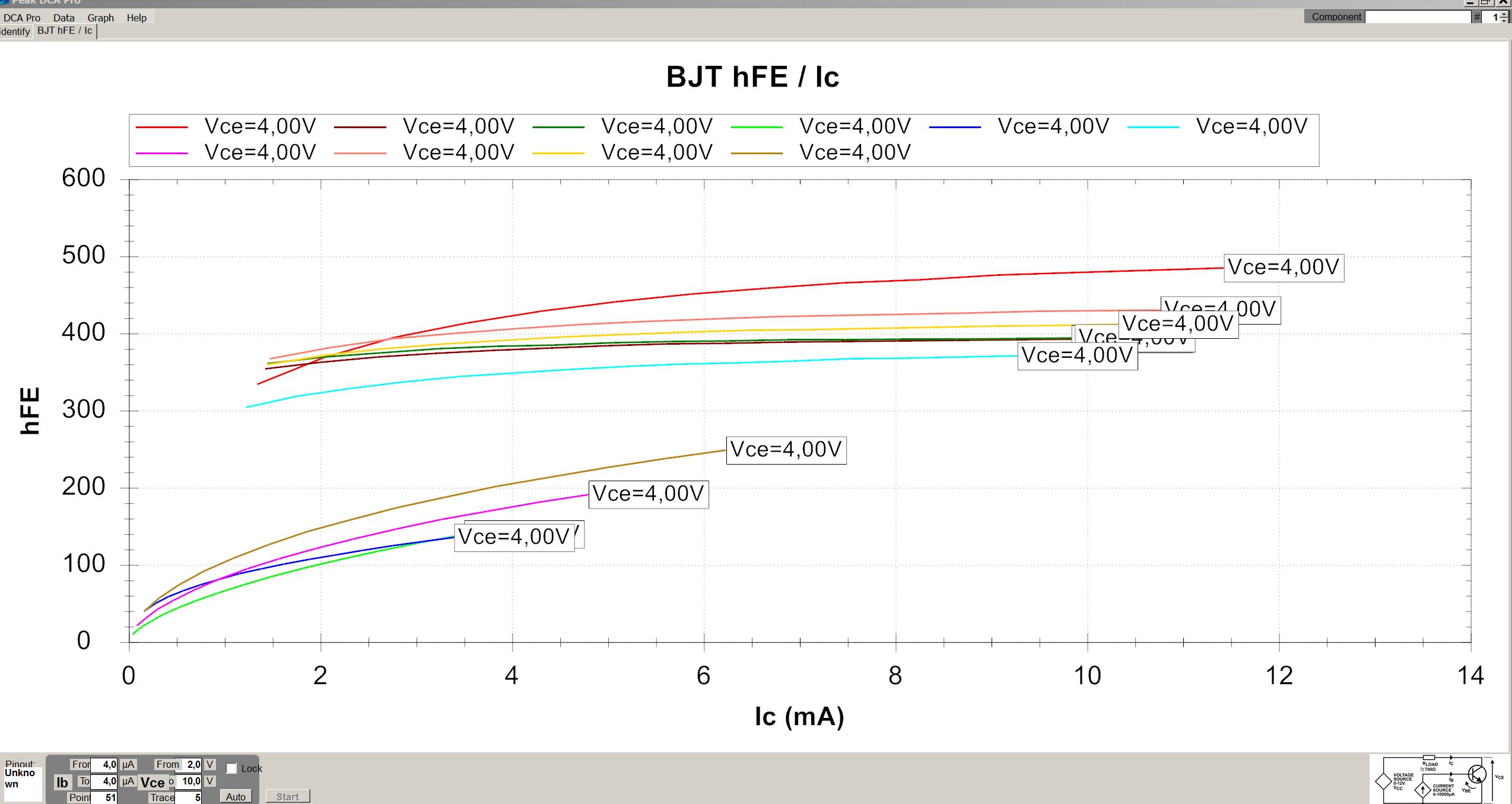
Out of 16 small Hitachi transistors 2SC1345 out of a Luxman R1500 (this picture graph has 10 of them 16) there were four having serious HFE issues. (other six not in the graph were around 550 IIRC)

At least one of those four transistors was operated way below half a milliamp in the real, so HFE was so low it probably did cause audible problems. (opinion).

This is 25% of those pieces being seriously below spec.


Not opinion, just putting them on the DCA75 tester makes opinions obsolete.

Among other types, the mentioned 2SC1345 is not exactly the best example of a reliable transistor....


luxman-r1500-mmm-old-5.jpg
 
Last edited:
I mis-typed that transistor I was looking at. It was actually a C1335. Don’t know how much different it is. That’s a very revealing graph. I’ve had my eye on the DCA75. I plan on selling my old DCA55 to help defray some of the cost. How do you decide what transistors to test? Is there something, some symptom that gives you a clue about which ones to pull? I’m interested in learning more about the DCA75.
 
In all the solid state stuff I have serviced/maintained/repaired, both professionally and at home, I have never replaced transistors if the piece of equipment has been working after the necessary work.

I think that's a good point and I respect Doug's opinion a lot. Maybe the strategy depends on what your goal is: service/maintenance/repair (based on what's necessary to fix it) vs. trying to restore or renew a piece of gear (replacing more than necessary intentionally hoping it might go another 50 yrs. without another repair).

Noisy to the ears?
Yes - pops, ticks, static, crackling, fuzzy background noise, hiss etc. Failing transistors can cause weird, random annoying sounds and in some cases do catastrophic damage to other parts!
 
I had a couple in a Sherwood 9500a tone control circuit that were making crackle noises. It was pretty obnoxious. Had one dying in a Pioneer mute circuit that caused the tuner to cut in and out. Others just have a general hiss noise.
 
I mis-typed that transistor I was looking at. It was actually a C1335. Don’t know how much different it is. That’s a very revealing graph. I’ve had my eye on the DCA75. I plan on selling my old DCA55 to help defray some of the cost. How do you decide what transistors to test? Is there something, some symptom that gives you a clue about which ones to pull? I’m interested in learning more about the DCA75.
Any Hitachi transistor looking the same as the old 2SC458 "rectangular-package-usually-having-black-corroded-leads" just goes in the garbage, regardless its partnumber.

Myself, I like "usable good tools" and the DCA75 is definately one of them.

Apart from reading on the manufacturers website, just google "DCA75 graph" or alike pictures , too find all kinds of websites, graphs and comparisons people made using this device. You will like it, I presume.
 
@gslikker I have been considering looking into one of the Peak testers. The graph you posted is impressive. :thumbsup:

I am curious what steps were involved in making the graph created by your DCA75 into a jpg that you are able to post here? Does the DCA75 have a USB jack? Does the DCA75 create an exportable jpg? Did you take a picture with a camera of the DCA75 screen? Some other method?
 
Almost every transistor in this Harman Kardon 330c is of the Hitachi black rectangular style with black corroded leads. At first I thought the black was some kind of paint. But it also looks suspiciously like oxidation, like the way a black-oxide drill bit looks. There are 2sc458s, 2sc1335s, 2sc1775s, 2sc1345s, etc.
 
I went to Peak’s website yesterday. In addition to reading the product description, you can download the product manual. It talks a little bit about the graphing function. You can also export test data into a spreadsheet. Dca75 connects to computer (windows only) via usb port. It comes with a thumb drive with the software pre-loaded on it.
 
I've seen lots of old transistors with black leads. Doesn't seem to bother anything. I always figured they were silver plated, and the black is just silver oxide or silver sulphate, whichever one turns silver dark. It scrapes off with no fuss.
 
I’d like to circle back to my original question. Suppose I pull the two differential pairs, which are Hitachi C1345s, hFE 600, test them with a Dca75 and find one or more of them to be out of spec—will replacing them with Ksc945CYTAs, hFE 240, affect the operation of the amp or will it just be a wash? Sorry for the run-on sentence and I realize this is a bit of a hypothetical stretch.
 
@gslikker I have been considering looking into one of the Peak testers. The graph you posted is impressive. :thumbsup:

I am curious what steps were involved in making the graph created by your DCA75 into a jpg that you are able to post here? Does the DCA75 have a USB jack? Does the DCA75 create an exportable jpg? Did you take a picture with a camera of the DCA75 screen? Some other method?
Just search on EEVBLOG DCA75 and you will find a video, I did not watch it but I presume it will all be covered in there.
 
Back
Top Bottom