
• The move to the new server is done. There are some software and database maintenance updates in process. This has us passing the hat around to help out. We appreciate any donations. Seriously, even a dollar helps. The payment page may be found here - https://www.audiokarma.org/support.html

How many WIMA films can you stuff on a Tone Board?

Steven Tate

CEO Flat Forehead Soc.
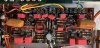
I'm restoring a 2230, and got around to the P400 board today. I usually don't replace every electrolytic cap with WIMA films, but I discovered I had a few 0.33μF WIMAs and some 10μF WIMAs, so I just replaced them all except for the local filter at C409, where I used a 270μF 50V electrolytic per @Leestereo 's 2270 thread. Looks kind of weird, but it sounds really great -- very quiet background. I didn't replace any transistors this time because the unit sounded very good to start with. Just wondering if anyone knows of a reason NOT to use WIMAs in all of these spots? I found where Ben used the 0.33μF WIMAs at C401 and C402 on his 2270 thread. But I wasn't sure about the big ones at C405 and C406. What do you think?
I also did the cap upgrades on the P450 Tone Control Board that Leestereo outlined in his 2270 thread. I replaced the green mylar films with WIMA films, and most of the ceramic caps with C0G versions of the same value. Again, just doing these two boards resulted in a very quiet background.
IMG_0001 (21).JPG
 
Last edited:
Register to hide this ad
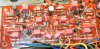
0.33uF? :eek: There are only 3.3uF I think. My last 2230 tone rebuild is below. For the "big" ones I used Panasonic 0.47uF at 450V polypropylenes, Mouser 667-ECW-FD2W474K
View attachment 2244718
C401 and C402 were replaced with Mouser 505-MKP2D033301M00JO - 0.33μF 100V. Looks like they are Polypropylene instead of PET, like the MKS2 series. I've only listened for a few minutes, but it sounded really good. I don't know why I had a bag full of 10μF big boys. This is the first time I remember using them. I hope switching to non-polar won't cause a problem. I guess that's my main question.
 
But for the rookies (including me), what's the rule for when/when not to replace electrolytics with film? My limited understanding is if it's in the signal path it's cool, but there's probably more to it than that.
All power circuits get electros, except 4.7uf and under and only when there is little current to worry about. The 10uf you used are probably sufficient for where they are since they were small electros to begin with.
 
But for the rookies (including me), what's the rule for when/when not to replace electrolytics with film? My limited understanding is if it's in the signal path it's cool, but there's probably more to it than that.
One of my rules is to not replace them on the AM tuner board and not FM unless it's the honking big green ones on the stereo multiplex board on earlier models (0.22uF) and only because the ones I use are 10mm lead spacing and have a much smaller body. They're Wima's and not polypropylene quite. I can post what they are if there's interest.
 
One of my rules is to not replace them on the AM tuner board and not FM unless it's the honking big green ones on the stereo multiplex board on earlier models (0.22uF) and only because the ones I use are 10mm lead spacing and have a much smaller body. They're Wima's and not polypropylene quite. I can post what they are if there's interest.

rBuckner, how did you come to that decision?
 
One of my rules is to not replace them on the AM tuner board and not FM unless it's the honking big green ones on the stereo multiplex board on earlier models (0.22uF) and only because the ones I use are 10mm lead spacing and have a much smaller body. They're Wima's and not polypropylene quite. I can post what they are if there's interest.
The big "honking" green ones are Mylar caps. I never replace those on a tuner unless I know they are an issue, which they rarely are. All electros get replaced along with tantalum caps. Film if small values and I have them. I spread the leads to fit if necessary.
 
So boards where it would be beneficial to use film caps would be Tone, Phono, maybe FM Tuner Boards? Not, or less likely on AM Tuner (unless perfectionist), Power or Amp boards? In general, caps filtering power supply should be electrolytic.

Leads me to another somewhat related question. When is it ok to use MUSE bi-polar electrolytic caps? The question is really when is it alright to use bi-polar caps?
 
So boards where it would be beneficial to use film caps would be Tone, Phono, maybe FM Tuner Boards? Not, or less likely on AM Tuner (unless perfectionist), Power or Amp boards? In general, caps filtering power supply should be electrolytic.

Leads me to another somewhat related question. When is it ok to use MUSE bi-polar electrolytic caps? The question is really when is it alright to use bi-polar caps?
You can generally use bi-polar caps when in a pinch to replace polar, and use the short lead as the negative lead (outside foil). But they are more expensive. MUSE are made for bi-polar use in the signal path more than anything, or when reverse polarity above a volt or so can happen, a bi-polar is chosen. A polarized cap can withstand a small reverse polarity without damage. The Sansui F-2624 is a perfect example where the 470uf/6.3v polar cap can be installed either way, and has come from the factory in both directions. The actual voltage is so low it doesn't matter.
 
Thought I would post up this pic of the Tone Control Board with Leestereo's upgrades. Four WIMAs and a handful of C0G caps. I didn't do any critical listening before I started work -- just checked to see what worked or not. But it definitely has a very quiet background now.
Marantz 2230 Tone Control.jpg
 
Back
Top Bottom