• The move to the new server is done. There are some software and database maintenance updates in process. This has us passing the hat around to help out. We appreciate any donations. Seriously, even a dollar helps. The payment page may be found here - https://www.audiokarma.org/support.html

How to bypass tone controls without a schematic?

Ohhh, Ok, I didn't realize it was related to the "Loudness" switch as well. I guess I can see some merits to such a thing, I sometimes use the loudness on my Pioneer as my speakers get kinda thin at low volumes without it... But, I won't feel too bad about removing it from this amp if it is, in fact, there.
 
Loudness is an attempt to compensate for the human ear's inability to hear really low and really high frequencies at lower volumes. Yamaha stuff is variable, most other gear isn't.

It does come in handy for quiet listening but if you remove it and decide you can't live without it, it'd just mean a new project when you add the improved version.
 
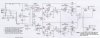
FWIW here is a schematic of the sx-550 volume/loudeness control.
 

Attachments

  • sx-650-loud.jpg
    sx-650-loud.jpg
    40.6 KB · Views: 30
Is it an 83 model?

Is your a 83-XX-XX model? The little EL84SE with a 6EU7 tube and a 6CA4 rectifier? If so, mine sounded awful until I removed all the controls. I removed volume too (I now use volume from my CDplayer). I am attaching a pic with the direction for this easy mod (a knowledgeable friend made it for me).
 

Attachments

  • Magnavox SE no-tones description mod.jpg
    Magnavox SE no-tones description mod.jpg
    60.8 KB · Views: 44
Last edited:
I'm not sure about the model number, mine doesn't have any visible markings on it, but the circuit in the picture looks pretty close, if not exact.

So it *is* just a case of cutting out the unwanted controls... I don't have the option of running it without a volume control, as none of my source components have their own controls, but the one pot without anything tied to it shouldn't hurt the sound too much. Thanks for all the help, I'll report back how it does once I get the old bumblebee caps replaced with something that works...
 
Am I too late?

I was looking at this schematic and noticed one of the worst tone control circuits I have seen. It is very simple which is good for saving money, AND it is probably compensating for the characteristics of that "original" ceramic phono cartridge. It's probably completely wrong for any other input source.

I would get rid of the tone control circuitry and connect directly into the L/R volume controls. The balance control is in a negative feedback loop for both channels, so I would keep it to adjust for differences in circuit gain, input signals, etc. Maybe a new 50K linear pot, or 2 x 25K fixed resistors if you must remove the balance pot.

I have a single channel test amp like this that I had to add a transistor gain stage to get the sensitivity high enough. If you have too much gain, I can give you some attenuator values to put at the input.
 
There's nothing I can add about the tone controls that hasn't already been said, but I do have some input on the balance control.

As you know, most resistors and capacitors have around a +/- 20% tolerance from the stated value, and all the tubes in the signal path have their own differences. This will result in the two channels not being identical. In addition, unless your listening room is completely symmetrical in both directions, you will have subtle differences in acoustic response from the left and right sides of your room. The balance control allows you to compensate for this, and keep the stereo image centered.

If you remove the balance control, you may find that the singer's voice (or whatever) is "off to one side" when you listen, and you might find it a bit distracting, and you won't be able to recenter it.

Minor point, I know.

 
Well, the 50k value on the balance pot in the schematic is an approximation I think... it measured 47k in the center, which seems like a pretty standard value and that's what I replaced it with. It may not be absolutely perfect, but it seems pretty well centered from just preliminary listening and it works a hell of a lot better than the flaky pot that was there. If I'm not satisfied with it in the future, I can easily throw a new pot in there.

I've already clipped out all the tone controls and when I can focus a little better I'm going to put the old treble pot, which is a 1 meg and the only high-value one I have that's still any good, in place as a volue control and see what happens. It should work pretty well, though I may indeed have to adjust attenuation depending on how much it changes the gain...
 
Nick - if you need to "pad" it down a little, just keep R5 & R12 and tie their common connection to signal ground. That would present a little bit of a load to modern electronics. 50K ohm might be better for R5 & R12, and a voltage divider network to the volume controls.
 
Back
Top Bottom