• The move to the new server is done. There are some software and database maintenance updates in process. This has us passing the hat around to help out. We appreciate any donations. Seriously, even a dollar helps. The payment page may be found here - https://www.audiokarma.org/support.html

How to Connect This Marantz Setup?

ok so I just came back from the tech with a brand new and fully functional power switch. luckily the unit wasn't turning on when he sat it on his bench. he tested the switch and it was not working on one side of the switch and the other side of the with was fully open. he was perplexed at getting voltages whether the power button was engaged or not also. he said thats pretty rare for a switch to fail in that way.

he did everything right on the spot so im all good to go now.

have a great and safe 4th everybody. tomorrow I will be replacing the 14 guage speaker wire to 16 gauge, going to the 250. I will hook everything up and finally give it a proper listen. pretty excited as the power im sure is going to be a noticeable difference being that im coming from the 85wpc pioneer sx850 that I have been using.

Glad it's figured out.

Since you're going to a different gauge wire, be sure to put some spades on the ends.
 
Glad it's figured out.

Since you're going to a different gauge wire, be sure to put some spades on the ends.

Thanks for the reminder. I will order some. Forgot to do that. If Home Depot has them I might just go tomorrow. If I remember correctly. The wire should be tinned and then soldered to the spade right?
 
Good to know you got this figured out. It was a conundrum for sure.

I think you will like the 250/3300 combo. I really like my 240/7T combo.
 
he was perplexed at getting voltages whether the power button was engaged or not also.

It's really simple; the switch only switches one pole of the convenience outlet. And if the active and neutral are reversed (ie the plug rotated) you are not switching the active. You are switching the neutral which means there is permanent live (active) to ground all the time.

The single pole switched convenience sockets on US delivered/made gear back in the 70s with your two pin rotatable plugs were a massive safety fail. By the time gear got to Australia and got rewired and set to 240V, many of the convenience outlets were death traps. They were banned here as the socket was US, most were only rated to 120V, and many were poorly wired or switched. Many brands initially put steel plates over the installed sockets until they stopped putting them on Aus delivered gear altogether.

That's not to say they weren't useful. Safety however was not a consideration.
 
Getting ready to drop the stylus on a record with my wife now everyone. I currently have all 3 pieces of gear hooked up and ready to roll. Tested everything out earlier and no issues at all.

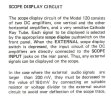
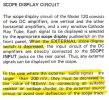
Does anyone know if it's possible to have my 120 tuners scope oscillate with my turn table or does it only do that with am or fm? There's an external function on the tuner but I haven't found the manual yet, only a service manual.

Cheers
 
Getting ready to drop the stylus on a record with my wife now everyone. I currently have all 3 pieces of gear hooked up and ready to roll. Tested everything out earlier and no issues at all.

Does anyone know if it's possible to have my 120 tuners scope oscillate with my turn table or does it only do that with am or fm? There's an external function on the tuner but I haven't found the manual yet, only a service manual.

Cheers

Manual here:
http://akdatabase.com/AKview/albums/userpics/10007/Marantz 120 Tuner Owners Manual.pdf

Screenshot (352).jpg
 

ok so im gonna have to look into this a bit more because im not sure how I would hook up my turntable to the scope input jacks. and as far as the external audio signal range, im not sure what the turntables ranges are. I have a pioneer pl518.

im guessing that something from the 3300 has to be connected to the 120 scope input jacks.

by the way, listened to dark side of the moon with my wife last night (her pick) and holy cow does this setup crank. I actually got a bit to excited with the volume and forgot that I have dynaco a35's which are max 60wpc so it looks like I will have to upgrade my speakers for this setup. anyone have suggestions for a good speaker pairing?
 
The amplifiers in all of my systems are capable of putting out more power than my speakers can handle on a sustained basis. This means that I have power to spare (aka headroom), which is a good thing.

A good recording will have peaks of 12-15dB, or more, over its average (aka continuous) signal level. So, your amp needs to be capable of producing enough power to a) achieve the volume you want, and b) fully reproduce those peaks without clipping them.

For example, if you need 5 watts on a continuous (aka RMS) basis to achieve desired loudness, you would need an amp capable of 80 watts to handle 12dB peaks without clipping. Or 160 watts for 15dB peaks. Each 3dB increase in sound pressure (SPL) requires a doubling of power!

If you were putting a steady 60 watts into the Dynacos, which is unlikely, two things would be happening:

  1. They would be painfully loud. Around 105dB!!! OUCH. Your ears would be hurting, and the neighbors would be calling.
  2. Your Marantz amp would be clipping (distorting) the signal because it would have just 65 watts of headroom left for the peaks This sounds like a lot, but is only a bit over 3dB of gain versus the 60 watts already going to the speakers. BTW, 3dB is considered to be the smallest change in loudness that can be easily discerned by someone with average hearing.

Running an amp past a steady 5-10% of its rated output to drive a music signal will almost assuredly result in clipping; beyond that level there's not enough output capability remaining for the peaks.

Clipping occurs when the amp doesn't have enough power (voltage) to fully reproduce those peaks. As a result, the signal gets distorted and your sound quality is degraded. Clipping can also lead to damage of your speakers, your amp, or both.

In any case, even though they can ostensibly handle 60 watt on a steady (continuous) basis, their sound quality likely degrades as you push them towards their limits. Generally, as speakers get closer to their max, they lose linearity; some frequencies get more exaggerated, while others become attenuated.

If you want to be able to play music louder than you can with the Dynacos, the variables include:

Speaker sensitivity: a speaker's sensitivity tells you how loud it will get at a specified distance (usually 3 feet or 1 meter) and with a specified input level (normally 1 watt, or 2.83V...which is 1 watt if the speakers are 8 ohms, and 2 watts if they are 4 ohms). Your Dynacos have a sensitivity of around 87dB w/ 1 watt of input. If instead their sensitivity was - for example - 93dB, they would need only 1/4 the power to achieve the same volume. Stated another way, with the same input power they would be 6dB louder. 6dB = a 50% change in perceived loudness.

Amplifier power - the more power you have, the louder you can play the speakers, within their mechanical limits (power handling ability).

Distance - in an typical room, you will lose around 4dB for each doubling of distance from the speaker. A bit less in a small room. The closer you are to your speakers, the exponentially louder they will be.

My first thought is that you might find adding a powered subwoofer (or two) scratches your itch for more volume/impact than you are getting from the Dynacos alone. Subs will increase the overall volume level, and because they have less loss at the very lowest frequencies than most main speakers, you will get not only a boost in lower frequency loudness, but also some amount of extension into the lower frequencies that the Dynacos just can't deliver. Powered subs don't put any additional stress on your main amplifier, and some of them even give you the option of filtering out the lowest frequencies from your main speakers. Effectively, this increases their sensitivity...which will have the effect of having more power in reserve for peaks.

If you do decide to pursue different speakers, I would strongly recommend that you don't consider anything rated below 6 ohms. The Marantz 250 is not really designed to handle more difficult loads. I would also suggest taking a look at the actual impedance curves of speakers you are considering, if you can find them. While there is a clear IEC standard for speaker impedance ratings, many manufacturers do no adhere to it. For instance, I was looking at a review of some speakers just the other day. The manufacturer rated them at 8 ohms, but they drop all the way down to 3.5 ohms at one point on their impedance curve. The standard says that a speaker's lowest impedance should be no less than 80% of its rated impedance!

On a related note, you can download a free decibel meter app for you phone to get a sense of how loud you are pushing your system. They are not as accurate as a calibrated, purpose-built dB meter, but fairly close.

Also, as you collect suggestions for specific speakers, keep in mind that they are often based on the sonic preferences of their owners....which may or may not match your own sonic preferences.

Choosing speakers is a 2 step process. First, make sure they are appropriate from a technical/objective perspective (sensitivity, impedance curve, power handling, frequency response). Second comes the more subjective aspects; of these, how they sound to your ears in your space is by far the most important.

 
Last edited:
How big is your room and how much do you want to spend? My 240 is currently powering either my Altec 19s or JBL L19. Those two speakers are not even in the same league, but they both sound great.
 
ok so im gonna have to look into this a bit more because im not sure how I would hook up my turntable to the scope input jacks. and as far as the external audio signal range, im not sure what the turntables ranges are. I have a pioneer pl518.
Your turntable does not connect to the scope input jacks, it is too low a signal level and need equalization.
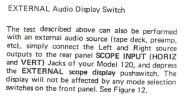
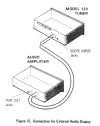
  • Connect your Pioneer PL-518 turntable to the 3300 phono jacks as you normally have it connected and set your selector for phono
  • Connect one set of the Tape Out jacks on the 3300 to the Scope Input jacks of the Model 120
  • Press the External scope display switch on the 120 to select the scope to show audio on the scope input jacks
  • You should be able to see the "scrambled eggs" pattern on the scope when you play anything on the 3300
Screenshot 2025-07-06 155607.jpg
Screenshot 2025-07-06 155624.jpg
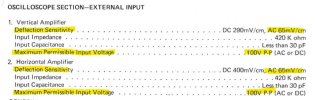
What I am not sure about is the maximum signal level to the 120 scope input jacks? Also, I don't see a max voltage on the Tape Mon outputs on the 3300.
  • The SM shows this:
Screenshot 2025-07-06 155944.jpg
  • But, in another paragraph (as @kwayde points out) the OM shows this:
  • Screenshot 2025-07-06 160310.jpg
 
Last edited:
I may have jumped to the conclusion that your concern was based on the speakers not getting loud enough to satisfy you.

If instead you are simply concerned about your amp having a greater output capability than your speakers are rated to handle, then I would say don't worry about it.

Just be judicious with the volume control. It determines how much power is going to the speakers. If the speakers start sounding notably different, instead of just louder, or start distorting or bottoming out, turn down the volume. The speakers are telling you that they are getting close to their limits (or close to the limits of your amp). Either way, this will almost assuredly occur well before you are pushing 60 watts on a sustained basis.

You only need different speakers if they begin to have such problems before you've achieved the volume you desire. In that case, you need either a) speakers with significantly greater power handling capability, b) speakers with a significantly greater sensitivity, or c) both. Or, alternatively, try the subwoofer route.
 
Last edited:
The amplifiers in all of my systems are capable of putting out more power than my speakers can handle on a sustained basis. This means that I have power to spare (aka headroom), which is a good thing.

A good recording will have peaks of 12-15dB, or more, over its average (aka continuous) signal level. So, your amp needs to be capable of producing enough power to a) achieve the volume you want, and b) fully reproduce those peaks without clipping them.

For example, if you need 5 watts on a continuous (aka RMS) basis to achieve desired loudness, you would need an amp capable of 80 watts to handle 12dB peaks without clipping. Or 160 watts for 15dB peaks. Each 3dB increase in sound pressure (SPL) requires a doubling of power!

If you were putting a steady 60 watts into the Dynacos, which is unlikely, two things would be happening:

  1. They would be painfully loud. Around 105dB!!! OUCH. Your ears would be hurting, and the neighbors would be calling.
  2. Your Marantz amp would be clipping (distorting) the signal because it would have just 65 watts of headroom left for the peaks This sounds like a lot, but is only a bit over 3dB of gain versus the 60 watts already going to the speakers. BTW, 3dB is considered to be the smallest change in loudness that can be easily discerned by someone with average hearing.

Running an amp past a steady 5-10% of its rated output to drive a music signal will almost assuredly result in clipping; beyond that level there's not enough output capability remaining for the peaks.

Clipping occurs when the amp doesn't have enough power (voltage) to fully reproduce those peaks. As a result, the signal gets distorted and your sound quality is degraded. Clipping can also lead to damage of your speakers, your amp, or both.

In any case, even though they can ostensibly handle 60 watt on a steady (continuous) basis, their sound quality likely degrades as you push them towards their limits. Generally, as speakers get closer to their max, they lose linearity; some frequencies get more exaggerated, while others become attenuated.

If you want to be able to play music louder than you can with the Dynacos, the variables include:

Speaker sensitivity: a speaker's sensitivity tells you how loud it will get at a specified distance (usually 3 feet or 1 meter) and with a specified input level (normally 1 watt, or 2.83V...which is 1 watt if the speakers are 8 ohms, and 2 watts if they are 4 ohms). Your Dynacos have a sensitivity of around 87dB w/ 1 watt of input. If instead their sensitivity was - for example - 93dB, they would need only 1/4 the power to achieve the same volume. Stated another way, with the same input power they would be 6dB louder. 6dB = a 50% change in perceived loudness.

Amplifier power - the more power you have, the louder you can play the speakers, within their mechanical limits (power handling ability).

Distance - in an typical room, you will lose around 4dB for each doubling of distance from the speaker. A bit less in a small room. The closer you are to your speakers, the exponentially louder they will be.

My first thought is that you might find adding a powered subwoofer (or two) scratches your itch for more volume/impact than you are getting from the Dynacos alone. Subs will increase the overall volume level, and because they have less loss at the very lowest frequencies than most main speakers, you will get not only a boost in lower frequency loudness, but also some amount of extension into the lower frequencies that the Dynacos just can't deliver. Powered subs don't put any additional stress on your main amplifier, and some of them even give you the option of filtering out the lowest frequencies from your main speakers. Effectively, this increases their sensitivity...which will have the effect of having more power in reserve for peaks.

If you do decide to pursue different speakers, I would strongly recommend that you don't consider anything rated below 6 ohms. The Marantz 250 is not really designed to handle more difficult loads. I would also suggest taking a look at the actual impedance curves of speakers you are considering, if you can find them. While there is a clear IEC standard for speaker impedance ratings, many manufacturers do no adhere to it. For instance, I was looking at a review of some speakers just the other day. The manufacturer rated them at 8 ohms, but they drop all the way down to 3.5 ohms at one point on their impedance curve. The standard says that a speaker's lowest impedance should be no less than 80% of its rated impedance!

On a related note, you can download a free decibel meter app for you phone to get a sense of how loud you are pushing your system. They are not as accurate as a calibrated, purpose-built dB meter, but fairly close.

Also, as you collect suggestions for specific speakers, keep in mind that they are often based on the sonic preferences of their owners....which may or may not match your own sonic preferences.

Choosing speakers is a 2 step process. First, make sure they are appropriate from a technical/objective perspective (sensitivity, impedance curve, power handling, frequency response). Second comes the more subjective aspects; of these, how they sound to your ears in your space is by far the most important.
so there's a lot to take in here for me. im not quite following some of the numbers here, how did you come up with an 80watt requirement for an amp if you only need 5watts of continuous input? I understood the doubling of power for each 3db increase though. I am also surprised at clipping being an issue when only running an amp at 5-10% of its rated output. The speaker sensitivity that you explained was very interesting. Basically it seems that the higher the sensitivity rating, the les power you need from an amp?

I will be downloading a db reader, that will be cool to check out. I had a friend over yesterday who wanted to hear the Marantz setup and I had the volume knob maybe around 1-2 o'clock on the 3300 and the meters on the 250 amp were at the end of their range, as soon as the meters bounced past that(thats the 12-15db peaks you were talking about I assume?) the sound became really bassy/distorted so I backed it off immediately. Surprisingly though, it wasn't super loud though. The room isn't super large either as you can see from the picture below. I do think my speaker placement being in front of windows is an issue though.
How big is your room and how much do you want to spend? My 240 is currently powering either my Altec 19s or JBL L19. Those two speakers are not even in the same league, but they both sound great.
My front room (frontch room as we say here in Chicago lol) is roughly about 15x20. Not the most ideal placement but we tried the couch in front of the windows and the audio gear on the wall where the couch is but it just didn't work. I really don't want to spend anything at the moment if I don't have to. I won't be using this Marantz gear as my main setup here, im just trying it out and going back to the pioneer 850 very soon.
How big is your room and how much do you want to spend? My 240 is currently powering either my Altec 19s or JBL L19. Those two speakers are not even in the same league, but they both sound great.tempImage0nAOX0.png
 
so there's a lot to take in here for me. im not quite following some of the numbers here, how did you come up with an 80watt requirement for an amp if you only need 5watts of continuous input? I understood the doubling of power for each 3db increase though. I am also surprised at clipping being an issue when only running an amp at 5-10% of its rated output. The speaker sensitivity that you explained was very interesting. Basically it seems that the higher the sensitivity rating, the les power you need from an amp?

I will be downloading a db reader, that will be cool to check out. I had a friend over yesterday who wanted to hear the Marantz setup and I had the volume knob maybe around 1-2 o'clock on the 3300 and the meters on the 250 amp were at the end of their range, as soon as the meters bounced past that(thats the 12-15db peaks you were talking about I assume?) the sound became really bassy/distorted so I backed it off immediately. Surprisingly though, it wasn't super loud though. The room isn't super large either as you can see from the picture below. I do think my speaker placement being in front of windows is an issue though.

My front room (frontch room as we say here in Chicago lol) is roughly about 15x20. Not the most ideal placement but we tried the couch in front of the windows and the audio gear on the wall where the couch is but it just didn't work. I really don't want to spend anything at the moment if I don't have to. I won't be using this Marantz gear as my main setup here, im just trying it out and going back to the pioneer 850 very soon.
How big is your room and how much do you want to spend? My 240 is currently powering either my Altec 19s or JBL L19. Those two speakers are not even in the same league, but they both sound great.View attachment 3548198

You're using 5 watts. 3dB peak above that would demand 10W. You say you understand that each 3dB change requires double the power. So how many watts would you need for a 6dB peak? Answer: 20W.

Carry out the same math to a 12dB peak. Answer: 80W.

Regarding sensitivity: the higher the speaker's sensitivity, the less power it needs to achieve a given loudness.
 
Last edited:
You're using 5 watts. 3dB peak above that would demand 10W. You say you understand that each 3dB change requires double the power. So how many watts would you need for a 6dB peak? Answer: 20W.

Carry out the same math to a 12dB peak. Answer: 80W.

Regarding sensitivity: the higher the speaker's sensitivity, the less power it needs to achieve a given loudness.

for the record, I did the db test on my phone last night and being roughly 10' away from my speakers I was picking up around 100db.

so I was watching a video on YouTube this morning about speaker sensitivity and it was explained that with the higher percentage of sensitivity you lose bass. what's your thoughts on this? I know you were recommending a subwoofer, my speakers aren't in the high range of sensitivity it seems anyways. I won't be getting a subwoofer for this setup but im curious if anyone that has high sensitivity rated speakers, also has a subwoofer to make up for the loss of bass.
 
for the record, I did the db test on my phone last night and being roughly 10' away from my speakers I was picking up around 100db.

so I was watching a video on YouTube this morning about speaker sensitivity and it was explained that with the higher percentage of sensitivity you lose bass. what's your thoughts on this? I know you were recommending a subwoofer, my speakers aren't in the high range of sensitivity it seems anyways. I won't be getting a subwoofer for this setup but im curious if anyone that has high sensitivity rated speakers, also has a subwoofer to make up for the loss of bass.

I would guess that you are describing 100dB peaks. My app shows both ongoing average SPL and peak SPL.

100dB at 10 feet with your speakers in a medium sized room = somewhere around 50-55 watts.

You don't necessarily trade-off bass extension for sensitivity. A compensating variable is speaker size.

You can't have small speaker, high sensitivity and extended bass response. Pick two.

In your case, I would say you have enough power to not be overly concerned with sensitivity, unless you are trying to get to concert hall levels. But of course everyone has their own sense of how loud they want their system to be able to play.
 
Back
Top Bottom