• The move to the new server is done. There are some software and database maintenance updates in process. This has us passing the hat around to help out. We appreciate any donations. Seriously, even a dollar helps. The payment page may be found here - https://www.audiokarma.org/support.html

How to Measure Power of Amp's Headphone Jack

tlite

Active Member
Specifically trying to figure out what the power output is of my Marantz 2235's headphone out, and what headphones is can reasonably drive without additional amplification.

I understand I can just buy headphones plug them in and if they sound good, then it is good, but I'm curious as to how to actually measure this. My multimeter is ready to go...

This information does not appear to be available in the manual or online (and I've searched Google for like 5 minutes).

Thanks for the help!
 
Register to hide this ad
I have had questions about this for a long time!
This seems like the perfect opportunity to ask my question.

For speakers, the lower the speaker impedance, the heavier load for the amplifier.
With headphones it appears the greater the impedance, the harder it is for the amplifier to drive them!

This makes no sense to me, but I'm sure there's a good explanation!

Don
 
Most today headphones have low impedance, and amplifier designed for low impedance headphones simply have not enough voltage for high impedance phones.
Marantz receiver from first post is another type, power amp have voltage divider at output for phones and that can be easy calculated.
 
Most headphone outputs are simply a resistor between the speaker level output and the headphone jack. The cans themselves complete the circuit to ground, and you end up with a voltage divider formed by the resistor in the amp and the impedance of the cans. Too low of an impedance on the cans and the resistor drops too much, leaving you with feeble output. Nothing says you can't change that resistor if you run into that problem.
 
Whoa- I missed a lot of good replies! I'm a C- level schematics reader but will give it a shot. From what my ears are telling me my 2235 is pretty solid, but the geeky side of me likes to figure stuff out as well. What I'm learning about headphones/amps is that ironically more power is important for how headphones sound at lower volumes, right? At louder volume I feel like most of my gear does a good job. Anyway, I'll dig into my schematic and see if I can puzzle this out.
 
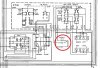
Okie Doke. So... here's the schematic taken from pg 21 of the service manual for the PT01 board that feeds the headphones within the 2235.

If I am correct, RT05 (330 Ohm) and RT07 (150 Ohm) are the voltage divider that sends the reduced voltage out to the headphone jack (outlined in red).

I've got my trusty voltage divider formula ready to go, but I'm a bit lost as to where/how to find/calculate the voltage going into the divider? (V in)?

Here's a link to the full service manual should anyone be feeling charitable...
 

Attachments

  • PT01_SchemHP.jpg
    PT01_SchemHP.jpg
    104.8 KB · Views: 17
Last edited:
IIRC output voltage swing is the usual standard for calculating the actual power a parallel circuit conveys to the jack.
 
So it looks like 330 ohm 2w resistors unless I'm reading it wrong. The output is probably around 1 watt max. Matching headphone impedance does make a difference. The headphone Amp I'm using is switchable between 16, 32, 62, 300 and 600 ohms. My headphones are rated at 50ohm. The further I switch up or down from 62 ohms makes a very noticable difference. Either less or more bass or high end depending on which way I turn the switch knob.
 
Last edited:
Slightly off topic as I was mostly trying to figure out how to measure, but in practice - I do find the Marantz 2235 powers headphones really well. I do use the Marantz EQ to some degree or another depending upon the recording and headphones, but generally speaking I like how headphones sound with the Marantz.

One side note- I love the loudness button with my speakers at lower volumes, but with headphones to my ear music sounds super muddy with loudness engaged. The EQ knobs do plenty on their own, and the effect is more noticeable with headphones than my speakers. It doesn't take much.
 
Slightly off topic as I was mostly trying to figure out how to measure, but in practice - I do find the Marantz 2235 powers headphones really well. I do use the Marantz EQ to some degree or another depending upon the recording and headphones, but generally speaking I like how headphones sound with the Marantz.

What's really handy with parallel-wired circuitry (like most 70's receivers were designed with) is that in a direct-coupled output if you have a device the sound of which you like, on decent speakers, you can roughly tell how decent phones will sound with it.

One side note- I love the loudness button with my speakers at lower volumes, but with headphones to my ear music sounds super muddy with loudness engaged. The EQ knobs do plenty on their own, and the effect is more noticeable with headphones than my speakers. It doesn't take much.

In my nearly half a century collecting headphones I have found that taking well to EQ, be it analog or DSP, is one of the most important factors when choosing cans that will spend more time resting on your head than on a shelf. This applies to all but the very BOTL products that will sound woofy or tinny regardless of tweaking. On the other end of the spectrum I have reference-class headphones that sound only so-so unless you use them with a very specific, entirely dedicated and horribly expensive stack. Or you can EQ yourself out of this situation. I favor the latter, been down the rabbit hole enough times to know that I don't like being tied to a particular headphone just because it only sounds good with a specific amp. Good EQ (in my case mostly via DSP but proper analog will do the trick as well) delivers the goods at a fraction of the cost. I want it to be about the music not (entirely) the gear upstream. :music:
 
Back
Top Bottom