• The move to the new server is done. There are some software and database maintenance updates in process. This has us passing the hat around to help out. We appreciate any donations. Seriously, even a dollar helps. The payment page may be found here - https://www.audiokarma.org/support.html

I am going to play all my RCA Living Stereo LPs...

We are now entering the LSC-2XXX series...

....although not exactly starting off with a bang. Here is LSC-2028:

LSC-2028.jpg


This is a very pleasant record, with good solid sound and performances. Very nice string tone, highly polished, professional, but not exactly the ultimate. It is certainly not highly regarded, and you won't see any reissues. If you find a NM copy in a thrift store, of course, you should buy it....which is what I did.
 
Love the RCA Living Stereo album covers! First class all the way, great photography!

So far only have one that you have. Keep checking to see if I have more. Great comments also on each album.:thmbsp:
 
Fantastic thread Vinyl1. Though I can't follow along with you regarding the stereo versions as I have very few, I will attempt to do so with the mono LM RCA versions. As you and I discussed several years ago in email (via RCG), most of the ones in my possession are 1S/1S pressings....which does'nt mean much sonically in many cases, but are fun to recognize as the early ones nonetheless.

I recently purchased an RCM and am looking forward to bringing some of these back to life. There is something really special about the quality of the vinyl and the professional pressings of the RCA Shaded Dog's. As you mentioned earlier in the thread, the strings really come alive whether low level or booming in dynamics. They really had a great formula back then for recording in my opinion, even if my opinion is one channel short. :D

Mike
 
Last edited:
Question for you Vinyl1: was every mono version (LM) Shaded Dog also produced in LSC stereo? If not, do you know what the criteria was to produce the stereo versions after issuing the mono?
 
I got a little busy, but am still listening.

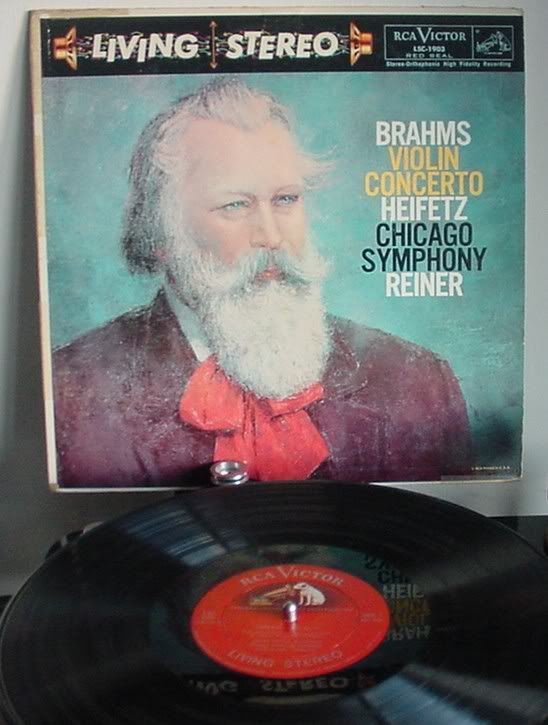
Here is the next up, the Brahms Violin Concerto with Heifetz, LSC-1903:

LSC-1903.jpg


Like most of the Heifetz RCAs, this remained in print for a long time and sold many copies. What you see in the picture is an early pressing; a 7S/7S record in the first cover. The later shaded dog issues had the same cover without the 'Living Stereo' band at the top, while the white dogs and later had a hideous olive-green box with a picture of Heifetz.

This is a fine recording with playing that is typical of Heifetz, well-suited to this type of music. I do have about 25 other LPs of this piece, and there are many good ones. Of the ones with top sonic quality, it is between the RCA and Kogan/Kondrashin and the Oistrakh/Klemperer, both on EMI. The RCA is certainly cheaper and easier to acquire in the US than early EMI pressings, although the earliest pressings are still highly sought after.

That is one of my favorite performances of that piece. I have had several versions of that album including one on 8-track.
 
LSC-1934.jpg

I admit, I never cared for Bartok, and even this splendid recording really doesn't do it for me. The performance is all you could ask, and the sound is quite good, but after listening to it twice I have to say not my type of music. But your tastes may differ, and it's an excellent RCA.

I absolutely adore Bartok and that one might be quite rare since his music did not have as wide of an audiences as some of the more "pop classical" like Offenbach or Johann Strauss.
 
Question for you Vinyl1: was every mono version (LM) Shaded Dog also produced in LSC stereo? If not, do you know what the criteria was to produce the stereo versions after issuing the mono?

The early LPs in the LSC-18XX and LSC-19XX series were recorded quite early, long before the stereo record was developed. RCA started recording selected performances in stereo in 1954. The first use they made of these recordings was to issue two-track stereo tapes. These tapes were sold in tiny quantities to wealthy hobbyists - I believe they cost $25 in 1956, so you can just imagine how few were sold.

Of course, all these performances were issued in mono as they were recorded. LM-1806 and LM-1817 came out in 1954, along with all the numbers in between.

RCA's purpose in doing this was their belief that eventually stereo records would be sold, and they wanted to have a backlog of exciting stereo material that they could issue immediately. They also wanted to get experience with stereo technology, and figure out the best way of recording and mixing stereo so that they would be ready to sell to the mass market.

So when the industry agreed on a standard for stereo records in 1958, they were ready to go. They were able to issue their very first batch of stereo LPs for Christmas 1958, although availability was spotty until mid-1959.

As I said, they only recorded selected performances in stereo during the 1954-9 period. It was very expensive, and they picked sessions that they thought would sell in stereo. Nearly all of these tapes were issued on early LSC records, although a few were not. The most famous of these is the Berlioz Symphonie Fantastique with Munch, and the Reiner Heldenleben. Either they weren't satisfied with the quality of the tape, or they didn't think it would sell.

Meanwhile, of course, the mono division rolled along. Nearly every number in the LM series was issued as it was recorded throughout the 50s. When the stereo record came out, they started doing more sessions in stereo, but the mono-only session lasted well into the 60s.

An interesting byproduct of this strategy was that the earliest recordings were very short-lived. RCA decided to re-record the Reiner Zarathrustra, the Fiedler Gaite Parisienne, and the Munch Daphnis and Chloe in the early 60s. Consequently, the great early recordings were deleted from the catalog after only a tiny number had been sold. Needless to say, the new recordings were NOT as good as the original 1954 material.

 
I absolutely adore Bartok and that one might be quite rare since his music did not have as wide of an audiences as some of the more "pop classical" like Offenbach or Johann Strauss.

It is not as rare as LSC-1806 or LSC-1817. The key was that it stayed in print throughout the shaded dog era, and had several lacquers cut. Remember, demand for classical stereo records increased dramatically between 1960 and 1964, as many listeners bought stereo equipment for the first time. A record that was only in print until 1960 was likely to sell very few copies.

The replacement re-recordings for LSC-1806 and LSC-1817, LSC-2609 and LSC-2267 respectively, are indeed very common.
 
Now here's a Fiedler that does have great sound!

LSC-2052: this album is not much sought-after by collectors, but it does deliver the good sonically and musically.

LSC-2052.jpg


The sound is typified by wonderfully captured woodwind and brass playing, with a deep bass foundation. It is remarkable that they were able to get this sort of immediacy without spot-miking the individual instruments, but I think the recording is too early for that.

This fine LP has, as far as I know, never been reissued by any of the audiophile labels. Fiedler and the Nutcracker just do not command much respect. But it is quite easy to find an original, and the prices are low. This example is a 9S/8S pressing from around 1961.
 
Have that one!

attachment.php


Mine has A4 in the deadwax not 9S/8S. It says Radio Corporation America 1958 on the back cover.

Thanks for playing this. I knew I had "The Nutcracker" somewhere. You made it easy for me to find, it's in my "RCA Living Stereo" record case. Always liked to hear this during the Holiday Season.:thmbsp:
 

Attachments

  • The Nutcracker.jpg
    The Nutcracker.jpg
    48.1 KB · Views: 371
Last edited:
A4 is the mother/stamper number: first mother, fourth stamper. Look 120 degrees away from this mark for the pressing plant (I = Indianapolis, R = Rockway, H = Hollywood) and the full matrix number. The lacquer number is at the end of the matrix number.
 
A4 is the mother/stamper number: first mother, fourth stamper. Look 120 degrees away from this mark for the pressing plant (I = Indianapolis, R = Rockway, H = Hollywood) and the full matrix number. The lacquer number is at the end of the matrix number.

It's stamped J2 RY1996-16S
 
G'day all, a great thread! I don't think that I have any 'Living Stereo' releases in my collection, and I don't think they pop up much in the charity stores here in far away North Queensland. A real shame, actually. Regards, Felix aka catman.
 
G'day all, a great thread! I don't think that I have any 'Living Stereo' releases in my collection, and I don't think they pop up much in the charity stores here in far away North Queensland. A real shame, actually. Regards, Felix aka catman.

Well, Felix, many early English EMI and Decca stereos were exported to Australia, before they started pressing them there. Unfortunately, greedy eBay sellers scoured the country for them and sold every one they could get their hands on to wealthy collectors.

So your chances are not as good any more, but you never know. You may spot a $1000 record sitting in a charity store bin.
 
Here's another great-sounding one...

...with more serious music this time, LSC-2068:

LSC-2068.jpg


What you see is the original pressing, with only the Rachmaninoff Concerto #2. With such a short piece spread out over two side, this LP has great dynamics and deep, powerful bass. Reiner conducts a performance that is well-controlled but vast, and of course the piano is larger than life, as was typical of Rubinstein's recordings.

My copy is a 1S/2S, and there were very few pressings of this original version. Around 1962, RCA came out with an LSC-2068 with a different cover that included the Liszt Concerto #1, and that is the version that is most often found. The cover of the second version shows Rubinstein playing indoors, with a dark green background. This stayed in print for quite a while, up into the block letter era I believe.
 
LSC 2068
I don't think the original pressing is all that rare, my copy is 8S/9S.
Very nice sounding.

Kim
 
I'm going to try to step up this thread a little

I was at a fellow collector's place yesterday, a man who part of the original circle that started collecting RCA Living Stereos around 1980. Another member of this circle was Sid Marks, and it was his subsequent articles in The Absolute Sound that sent all the audiophiles looking for them.

Anyway, since he has a complete set in numerical order on his shelves, he pointed out to me that I had barely started, and had played on about two inches out of six feet. So,yes, this might take a very long time if I don't play more than one or two a week.

OK, then, I may have to step it up. Here is the next one, LSC-2077:

LSC-2077-1.jpg


This was the first record made as part of RCA's deal with Decca. It was recorded in Vienna using Decca equipment and engineers, as well as Decca's contract with the Vienna Philharmonic.

I will state frankly I don't care that much for this record. It has all the Decca characteristics, like huge dynamics, a bib soundstage, and deep bass, but it doesn't quite come off. The microdynamics are very slow, and the hall is so big that some of the instruments are muddied through reverberations, particularly the bass drums. Maybe Decca could have master this sort of tape better. The performance is OK, but nothing special, a professional conductor leading a highly skilled orchestra.
 
Here is one I do like....

....although I would have to say it is very good, but not great, LSC-2080:

LSC-2080-1.jpg


A mixture of Sousa and original Gould compositions, this LP is a lot of fun. It has the very fast RCA microdynamics and articulation that make these records enjoyable and lifelike. Where it is lacking is in the huge dynamics and deep bass that Mercury specialized in. The performance matches the sound, good but not in-your-face snappy.

I have three more in the 20xx series to go, and have already photographed the 21xx series. I have 20 out of the 23 LPs in that set, and only one of the missing ones is consequential. I will point out the omissions as we go along.
 
Back
Top Bottom