• The move to the new server is done. There are some software and database maintenance updates in process. This has us passing the hat around to help out. We appreciate any donations. Seriously, even a dollar helps. The payment page may be found here - https://www.audiokarma.org/support.html

I got Myself a "REAL" condenser tester

transmaster

AK Subscriber
Subscriber
They are having a discussion over at the Antique Radio forum about Chinese Capacitor testers, of which I just ordered a couple. It was pointed out that while they do basic quick and dirty tests of capacitor they don't really "test" as if the capacitors where in an active circuit, and they where of questionable value testing capacitors used in tube type equipment. They started to mention vintage condenser testers, which do test a condenser in a simulated circuit. I have never used condenser as a search term, and here I found all kind of condenser testers. I was told the Heathkit testers where good ones. I purchased a very clean and tested Heathkit Model C-3 it is considered one of the good ones and very simple to operate. Interestingly the the units left side see the knob that says "power Factor" that is what they used to call ESR. It uses a 1626 triode, and a 1629 "magic eye" tube. It also tests resistors, a secondary function for me because I have other things that can test them. The prices on these instruments are very reasonable.

Heathkit_C3_Salerno.jpg
 
Last edited:
Register to hide this ad
The "ESR", (so to speak), of that unit is testing the cap under different parameters than a modern ESR tester does.

Essentially, not the same.
 
Its an approximation though, and useful enough for the purposes it was designed for. It tests at 60 or 120hz, which is what power supply filter caps see anyway. A tube rectifier could give a hoot about ESR at higher frequencies, but that may not fly with a switch mode supply.

Power factor is a somewhat different measurement. In an ideal capacitor, voltage lags the current by 90 degrees. Power factor is essentially the difference between reality and ideal. The more power factor, the less ideal. The manual for this should have a chart equating capacitor efficiency percentage to power factor reading. Effectively, this is caused by internal resistance that makes the capacitor less effective. Its more or less ESR, but an indirect measurement of it. ESR is measured directly at higher frequencies that just weren't practical to generate and measure reliably with portable tube gear. PF though, that was definitely do-able.


Most of the cap testers worked about the same. Make sure your scaling capacitors are good. If they aren't, the ranges will be noticeably off. My Solar uses a 0.002, a 0.02 and a 0.2uf cap for the 3 ranges. Those need to be those particular values, subbing modern ones will throw it off. I made the 0.2uf for mine out of a pair of 0.1uf in parallel.
 
The nice thing about the old-school capacitor testers is that they use high voltages to test -- much more relevant for P/S capacitors in vacuum tube equipment or other HV capacitor applications.
 
As I said above I have a couple of the Cheap Chinese instruments that test ESR coming so I figure I can have my cake and eat it too.
 
The nice thing about the old-school capacitor testers is that they use high voltages to test -- much more relevant for P/S capacitors in vacuum tube equipment or other HV capacitor applications.

Exactly, I feel a lot better about giving a guitar guy a black beauty that I tested at 500v. :yes:
 
Most of the cap testers worked about the same. Make sure your scaling capacitors are good. If they aren't, the ranges will be noticeably off. My Solar uses a 0.002, a 0.02 and a 0.2uf cap for the 3 ranges. Those need to be those particular values, subbing modern ones will throw it off. I made the 0.2uf for mine out of a pair of 0.1uf in parallel.

What would be your favorite brand to replace the ones this Heathkit should they need replacing.
 
Last edited:
whatever film cap is handy. I buy lots of cheap yellow caps from whoever has them the cheapest when I happen to need some. Last batch I think came from Mark Oppat at oldradioparts. Stuff like this isn't real particular, and anything you can get today will be better than the paper capacitors its probably got in there now. I use those for old radio rebuilds using the same logic. If you have another tester on hand, you can probably go through a handful of them and hand-pick some that are very close to marked value. I bought bags of 100 each in a pile of different values a year or so back, so I had selection on hand to find good ones.
 
you get a Sprague tester with the extra ranges :) Most of these serviceman grade testers wouldn't do under 0.001uf. The Spragues were a couple steps up in terms of cost, accuracy, and complexity. These will test most caps in a radio, tv, or amplifier well enough to know if its usable or not. The Sprague testers will give you a more precise value, specific leakage info, and will test much smaller and larger caps.
 
That's a very decent tester and will give you exactly what you need to know to have confidence in HV and other caps. I love eye-tube bridges. Eye-tubes never have friction, get sticky, bend their needles or burn out from over range.

Losses can be expressed as Dissipation Factor, Power Factor, ESR or various other things. Any one can be calculated from any other; they have nothing to do with the actual measurement technique, just how the knob is marked. Power Factor isn't used much today, but it's similar to Dissipation Factor at low values. ESR only became popular with switching supplies and was rarely mentioned back in the day. The other forms are more useful from a design standpoint. More on understanding losses here.
 
Last edited:
Thank you ConradH you r link has helped answer a question I have had for years. Why is a vacuum variable capacitor so good in high powered RF equipment. The devices themselves are expensive and the equipment they are used in is even more out of reach. Because of this I have never taken the time to answer it. I remember a home brew antenna tuner I once looked at it was a L network tuner with a single vacuum variable, and a large roller inductor next to it enclosed by copper mesh enclosure. I had no appreciation for the work of functional art I was looking at. With what I just learned even more I sorry I didn't purchase it.
 
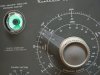
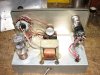
Here are pictures of this Heathkit Model C-3 insides, and in use.
 

Attachments

  • ;'lasmoppkjftg0e0gbpocc,bv.lrtghp[s.jpg
    ;'lasmoppkjftg0e0gbpocc,bv.lrtghp[s.jpg
    107.5 KB · Views: 35
  • pokpdokipsaokifporekipokqapogkjpokgbpae.jpg
    pokpdokipsaokifporekipokqapogkjpokgbpae.jpg
    89.8 KB · Views: 40
  • kkfkooof;l.jpg
    kkfkooof;l.jpg
    46 KB · Views: 31
  • lkfkf[pklk.jpg
    lkfkf[pklk.jpg
    58.2 KB · Views: 34
Last edited:
I have a Sprague TO-4 which I rebuilt and it's remarkably accurate considering it uses an eye tube to pinpoint cap value. It does what I need it to do which is to check if my vintage PIO caps are leaking voltage. I just read the side of the cap for the value. :D

IIRC you can use them to check transformer windings too.

you get a Sprague tester with the extra ranges :) Most of these serviceman grade testers wouldn't do under 0.001uf. The Spragues were a couple steps up in terms of cost, accuracy, and complexity. These will test most caps in a radio, tv, or amplifier well enough to know if its usable or not. The Sprague testers will give you a more precise value, specific leakage info, and will test much smaller and larger caps.
 
I have a TO6 so i'm not familiar with this model. If it doesn't have a discharge switch on it, I'd recommend one strongly. The TO uses a 3 watt 5k I think, I just had to replace it the other day. Don't ask how i found out the R had gone open.
 
I have a Sprague TO-4 which I rebuilt and it's remarkably accurate considering it uses an eye tube to pinpoint cap value. It does what I need it to do which is to check if my vintage PIO caps are leaking voltage. I just read the side of the cap for the value. :D

IIRC you can use them to check transformer windings too.

Now that is interesting being able to test transformer windings is huge for me. Many vintage tube type AM transmitters from the 1950's where very unforgiving with someone who did not tune them up correctly, Johnson Viking transmitter are infamous for roasting filament, and modulation transformers. It isn't always easy to test one with a DVM.
 
I think the TO-6 will too. I had Tom's here for a bit and it had the hipot test positions on it, or at least it described how to do it in the manual.

I think my Solar can actually do insulation testing too, but you have to read the manual for proper setup.
 
I also have the Sprague TO-4 and I love it. It's nice because you can put up to 600 vdc on the cap and check for leakage. I like to check value and leakage of new caps before installing them.:scratch2:
 
Back
Top Bottom