• The move to the new server is done. There are some software and database maintenance updates in process. This has us passing the hat around to help out. We appreciate any donations. Seriously, even a dollar helps. The payment page may be found here - https://www.audiokarma.org/support.html

I now own a router

I just built a 30x60 garage/shop/mancave. A 38x60 portion of it is garage shop and the rest is mancave and covered porch. I'm retiring "any day"* and am building up a standing power tool collection. A table router is on my list of must haves. I plan on doing woodworking "side gigs" in that place and this is one tool that I expect will get used a lot.

*"Any day" means that the day they lay me off or the day they end "work from home" - whichever comes first - is the day I retire. :)
 
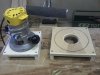
I made a couple of these "router sitters".

After using a router and shutting it off, the bit spins for a while.
The temptation is to set it upside down or on its side on the bench while it spins down.

These enable you to shut OFF the router, keep 2 hands on it and set it down, right side up. No danger of contacting a spinning bit.

3" hole allows for not having to perfectly center the router, and I traced the router bottom plate to give me kind of a target for set-down.1214201040.jpg
 
Its amazing how much cheap quarter round you can make from a 1 by 6
 
Don't forget: you can use woodworking routers and bits on plastics and aluminum, too.

Used jig saws are plentiful and cheap. A jig saw is a good companion to a router, because it lets you create router jigs/templates freehand.
 
I made a couple of these "router sitters".

After using a router and shutting it off, the bit spins for a while.
The temptation is to set it upside down or on its side on the bench while it spins down.

These enable you to shut OFF the router, keep 2 hands on it and set it down, right side up. No danger of contacting a spinning bit.

3" hole allows for not having to perfectly center the router, and I traced the router bottom plate to give me kind of a target for set-down.View attachment 2065316

Very nice, I really should make a couple of those!

I made a circle jig for doing speaker cutouts and counter-bores, so I think I'll counter-bore the baseplate diameter. That way I can just drop it in and it will be automatically centered. And that way it can't go walkabout, either:confused:

I really don't understand why modern routers still have the uncontrolled rundown, especially the variable speed models that already incorporate a fair degree of circuitry for soft start, speed and load control. Adding braking would be neither difficult or expensive. Of all of the most dangerous things to have exposed while in motion, a router bit has to be one of the worst.

My Skilsaw, even though it has an automatic blade guard, still has an electric blade brake.

Edit: Hey, did you nick one of my routers!?!?! That little guy looks awfully familiar...;)
 
my radial arm saw technically has a blade brake, but its a good 30 seconds before it winds down. Probably has a bit of wear on the band but its not much of a brake, so I doubt it was ever all that quick. It used to slow down a lot quicker with the bad bearings, but it also sounded like someone was auditioning for a cheap horror movie any time I had to butcher a tree carcass.
 
@arts:
" Hey, did you nick one of my routers!?!?! That little guy looks awfully familiar...;)"

The old tried and true Black & Decker/DeWalt/Craftsman. Made in the USA (or North America, to include you, Arts.)

I have several, picked them up whenever I saw them at garage sales and flea markets, before Covid.
If needed, easily fixable by replacing bearings and brushes.

I really like using a router, hate circular saws and their 7-1/4" spinning wheel of potential injury.
Plus, if you are right-handed the blade is on the "wrong" side.
I do have an antique Skil worm-drive though with the blade on the "correct" side.

I always go to my radial arm saw, power miter box, table saw or Shark-Bite hand saw before resorting to them.
Just me, I know, but it seems like every carpenter/framer has a horror story of some kind involving a circular saw.

I do have an inexpensive track saw that I like a lot because it is a controlled cut.
I've tried every circular saw guide trick in the book but prefer the control of the track saw.
 
Last edited:
track saws are nice. I don't do nearly enough woodworking to justify one though. I had a plywood saw guide for my old circular but that saw grew legs. The current one I haven't gotten around to making a guide for yet. Its an old home owner grade Rockwell. Nothing amazing but it will cut wood, its a cool green color, and I have a nice metal saw box for it. I got it nearly-new looking for about 25 bucks.
 
power wood tools scare the hell out of me. Sharp bits at insane speeds. Even chisels will ruin your day if you have a good one and aren't careful with it.
To me the inherent danger of power tools makes me aware of the need to use caution and the appropriate safety measures. If I'm not comfortable using a specific procedure, I stop and re-think what I'm doing. I've never had an injury from a power tool.

Hand tools are a different story. I've got a scar across the knuckle of my left thumb from a wood chisel. To this day, I still have to remind myself to keep both hand behind the cutting edge when using it.
 
Last edited:
track saws are nice. I don't do nearly enough woodworking to justify one though. I had a plywood saw guide for my old circular but that saw grew legs. The current one I haven't gotten around to making a guide for yet. Its an old home owner grade Rockwell. Nothing amazing but it will cut wood, its a cool green color, and I have a nice metal saw box for it. I got it nearly-new looking for about 25 bucks.

Mine is a 4-12" Master Craft from Menards, $100.
https://www.menards.com/main/tools/...7277164163.htm?tid=8563548659102068989&ipos=4

It's not a Festool but it does the job.
Unfortunately, the depth is just short of being able to cut off doors.
Handy little thing, though, I like the plunge cut feature.

They also stock one with a 6-1/2" blade @ $200.
 
@arts:
" Hey, did you nick one of my routers!?!?! That little guy looks awfully familiar...;)"

The old tried and true Black & Decker/DeWalt/Craftsman. Made in the USA (or North America, to include you, Arts.)

I have several, picked them up whenever I saw them at garage sales and flea markets, before Covid.
If needed, easily fixable by replacing bearings and brushes.

I really like the small B&D routers, especially that model. They seem to have come in several different colours; the top of mine is dark grey. Short, low center of gravity and light weight (sounds like me, right up till the light weight part..) really make them easy to handle. And you're right, they really never need anything other than (if even!) brushes and bearings.

Over the years I have had a bunch of B&D power tools that were made in Canada. I believe that they once had a plant in Ontario, but I'm not sure. Did B&D make Craftsman? I always thought they were made by Ryobi, and most of those were crap.

Oh, and if you're willing to spend the dosh, Skil makes a lefty Sidewinder. I have been considering one myself:)

https://www.skilsaw.com/sidewinder-southpaw-circular-saw-spt67m8-01/
 
Unfortunately, the depth is just short of being able to cut off doors.

thats probably what I'd use it for the most. All of the doors in my house are funky sizes so replacing one is sort of a challenge. Last one I did needed to be shortened, narrowed, and shaved in one spot to account for the not-square door frame.
 
I bought a real wood 6 panel door specifically to avoid drama. Hollow and "solid" doors that are all particle board in the middle are a huge pain in the neck to modify.
 
Don't forget: you can use woodworking routers and bits on plastics and aluminum, too.

Just to add to this, you can really save a few bucks using machine-shop tooling in place of the usual router bits.
Carbide end mills are (generally) spiral up cut, come in two, three and four flute varieties, and usually cost peanuts compared to similar "router bits".

Virtually all of my cabinet work is done using Baltic Birch (the real stuff, not that phony-baloney crap that many suppliers/distributors are trying to pass off as "Russian" Birch) and the glue used is really hard on cutting edges.

For my speaker cutouts, I use a 1/4" two flute carbide end mill. Four flute gives a finer, smoother cut, but you cannot plunge with them, so if it is a visible opening and you really want a four flute quality cut, you will have to pre-drill.

For other needs, I have a couple of sets of Imperial & Metric end mills that have 3/8" or 1/2" diameter shanks, and I use commonly available Bosch collet chucks that also fit many other routers, including my Hitachi's and Makita's. The Metric sizes are used mostly for slotting baffles or other dado work, as the Russian plywood comes in 12mm, 15mm & 18mm thicknesses.
 
Just to add to this, you can really save a few bucks using machine-shop tooling in place of the usual router bits.
Carbide end mills are (generally) spiral up cut, come in two, three and four flute varieties, and usually cost peanuts compared to similar "router bits".

You use spiral *upcut* bits on plywood?

I do a lot of work with (big box store grade) veneer plywood, and I use solid carbide 2-flute spiral *downcut* bits for cutouts. Come to think of it, I haven't had much problem with the cheap Chinese straight-flute brazed bits. Seems others prefer straight flutes as well, might save a little money on bits, or more importantly, clear the chips out better. I'm not sure I have any directly compatible end mills on hand, or out of curiosity I'd see how well upcuts fare on veneer. I just can't imagine it would end well, though!

BTW, you *can* plunge cut with non-centercutting mills/bits - so long as you keep the cutter moving sideways during the process!
 
You use spiral *upcut* bits on plywood?

Why wouldn't I?

I do a lot of work with (big box store grade) veneer plywood, and I use solid carbide 2-flute spiral *downcut* bits for cutouts. Come to think of it, I haven't had much problem with the cheap Chinese straight-flute brazed bits. Seems others prefer straight flutes as well, might save a little money on bits, or more importantly, clear the chips out better. I'm not sure I have any directly compatible end mills on hand, or out of curiosity I'd see how well upcuts fare on veneer. I just can't imagine it would end well, though!

Why would upcuts not fare well with veneer? Why would straight flutes clear chips better?

BTW, you *can* plunge cut with non-centercutting mills/bits - so long as you keep the cutter moving sideways during the process!

Try that in a machine shop and see how fast you get shown to the door. Just because you "can" does not mean that you should.
 
Why would upcuts not fare well with veneer?

Maybe there's a difference in our methodologies? I clamp the work down so it sits on a sacrificial backing board. That way it doesn't tear-out the veneer on the through cut on the final pass. If you are clamping a backing board on *top* of the workpiece, I could see that preventing tear-out on top with an upcut bit. But then it requires a longer bit, with more tool stick-out.

Otherwise, it seems obvious to me that upcut bits pull the work towards the spindle, encouraging delamination at the top surface of the cut, while downcut bits keep the work pushed away and all its layers in compression:

spiral2.jpg

Why would straight flutes clear chips better?

Better than downcut bits, which direct chips down into the channel being cut. With a 1/4" carbide bit in 3/4" plywood, I take three passes. That means the groove is full of chips for the last two passes. Having the chips ejected sideways is at least a *little* better than blasting them all straight down. Yes, air or suction makes it irrelevant...

Try that in a machine shop and see how fast you get shown to the door. Just because you "can" does not mean that you should.

Metal is a different story, but I have plunge cut in steel with non-centercutting slot drills for keyways. Works fine for a very shallow plunge, so long as you don't bottom out the end mill. And I saw much shadier stuff done when I worked in machine shops! Like other places, whatever works, works...

It's all about the angle of approach:

 
As was said, free hand using is tricky.

Using a router freehand would be like juggling running chainsaws while standing up in a hammock IMO. :confused:

For other needs, I have a couple of sets of Imperial & Metric end mills that have 3/8" or 1/2" diameter shanks, and I use commonly available Bosch collet chucks that also fit many other routers, including my Hitachi's and Makita's.

After a lot of searching and experimenting, I found these, they are the bomb for using a half inch router with bits with different shank sizes. I don't use those crappy adapters that came with my router, these are so easy to use and grip like the fitted collet. I got the 6mm, 1/4" and 8mm ones.

7974501-3.jpg
 
Last edited:
Back
Top Bottom