• The move to the new server is done. There are some software and database maintenance updates in process. This has us passing the hat around to help out. We appreciate any donations. Seriously, even a dollar helps. The payment page may be found here - https://www.audiokarma.org/support.html

Identifying Telefunken tubes

Eric Brandon

New Member
Hi all!

I've almost always bought known, identified, tested tubes from reputable buyers, and avoided the lure of the "huge box of mystery tubes".

But yesterday, I came across a giant collection of tubes which seemed NOT to come from a TV repairman, or Soviet MIG engineer, but a guy who collected audio tubes! So I bought them all -- THOUSANDS of them.

I've started going through them and one of the first things I've come across are some Telefunken tubes that could be ECC81/ECC82/ECC83 tubes, but have all the writing rubbed off.

I'm hoping you can help me identify these, and in general help me figure out:
1) How do you know when a tube is an ECC81/ECC82/ECC83?
2) How can you tell (without a tube tester) which of those it is?

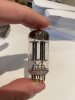
Type #1
Four tubes all alike:
- Halo getter
- Smooth plates
- 2 mica
- Diamond with one or two numbers stamped into the bottom

Telefunken - 3.jpg

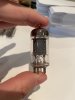
Type #2 - Same as type #1, but almost clear top
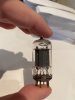
Telefunken - 4.jpg

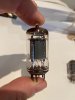
Type #3 - Same as type #1, but ribbed plates
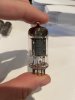
Telefunken - 5.jpg

Telefunken - 6.jpg

Telefunken - 7.jpg

Telefunken - 8.jpg

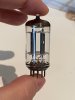
Type #4 - An oddball short plates & elaborate structure above the plates. Probably not an ECC81/82/83

Telefunken - 9.jpg

Thank you!
 

Attachments

  • image.jpeg
    image.jpeg
    54.1 KB · Views: 6
Register to hide this ad

Thank you for the link. I watched the Cantonese video and it helped because I can now put my mystery Telefunken tubes in two batches -- the "first pin getter support tubes" and the "second pin getter support tubes".
I still have some questions:
1) Can I be sure these are ECC81/82/83 tubes at all, before I try them in an amp?
2) None my tubes matched the orientation in the video, so still not sure which they are
3) The thread talks about 1st pin / 3rd pin, and my tubes are 1st pin / 2nd pin.

So could still use help IDing them!
 
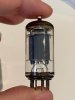
Just to be clear, this is what I'm calling a "1st pin getter support tube":
Telegettersupport - 1.jpg

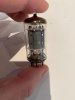
And this is what I'm calling a "2nd pin getter support tube":

Telegettersupport - 2.jpg
 
Thank you for the link. I watched the Cantonese video and it helped because I can now put my mystery Telefunken tubes in two batches -- the "first pin getter support tubes" and the "second pin getter support tubes".
I still have some questions:
1) Can I be sure these are ECC81/82/83 tubes at all, before I try them in an amp?
2) None my tubes matched the orientation in the video, so still not sure which they are
3) The thread talks about 1st pin / 3rd pin, and my tubes are 1st pin / 2nd pin.

So could still use help IDing them!

The only other way to tell is to have a tube tester handy and test them as 12AU7s and 12AX7s and see which comes come closest in which test. I'm pretty sure the ribbed-plates are 12AX7s. I've never seen a ribbed-plate 12AU7 but I could be wrong. The smooth plates could go either way. And yes they are either ECC82 or ECC83. Tele ECC81's always have very short, winged plates.

It unlikely to hurt anything to try them in an amp. You'll either get too much gain or too little gain. ;-) If they're in a phase-splitter position you'll have to check the plate voltages to see if the come out close to what they should be.
 
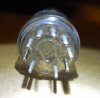
Are you sure they are Teles's? are there diamonds in the base at the bottom such as this?

Yes, I pulled out all the ones with diamonds on the bottom, and that's the only ones I've mentioned in this post.

I have a whole other box full of marks-rubbed-off 12A*7 tubes, and I worry that there Mullards or who knows what in there!
 
The only other way to tell is to have a tube tester handy and test them as 12AU7s and 12AX7s and see which comes come closest in which test. I'm pretty sure the ribbed-plates are 12AX7s. I've never seen a ribbed-plate 12AU7 but I could be wrong. The smooth plates could go either way. And yes they are either ECC82 or ECC83. Tele ECC81's always have very short, winged plates.

It unlikely to hurt anything to try them in an amp. You'll either get too much gain or too little gain. ;-) If they're in a phase-splitter position you'll have to check the plate voltages to see if the come out close to what they should be.

Thank you, very helpful. I think I will try them in an amp later today and report back!
 
This is the box of tubes that have all their markings rubbed off. I'm worried that there are precious, wonderful, Mullards in there, and that I don't know it.

Mullards and Amperex are pretty distinctive, take a look on eBay at the pictures. American 12AX/AU7's are generally quite different. Just familiarize yourself with the various brands and you'll be able to pick a lot of them out. You can also go to some of the spcielaty tube sellers' web sites, like Brent Jesse, where they have pictures of the most well-known and desirable brands.
 
I'm worried that there are precious, wonderful, Mullards in there, and that I don't know it.

Are there etch codes or not?

The Telefunkens are known for having their logo & codes being easily rubbed off.

The Mullard etch codes should not be rubbed off easily if so someone would have had to make a serious effort to do so.

Here's an example of what you should be looking for and where

DSCN0853.JPG
 
Those smooth plates look a lot like Ei tubes. They were also very good. These all look like pulls so there's no pot of gold but it will be nice to have some for personal use. I sell tubes like that for $20 a pop to guys that want to try them in guitar amps.

Enjoy the tube rolling. By the time you get through that lot you'll be an expert.
 
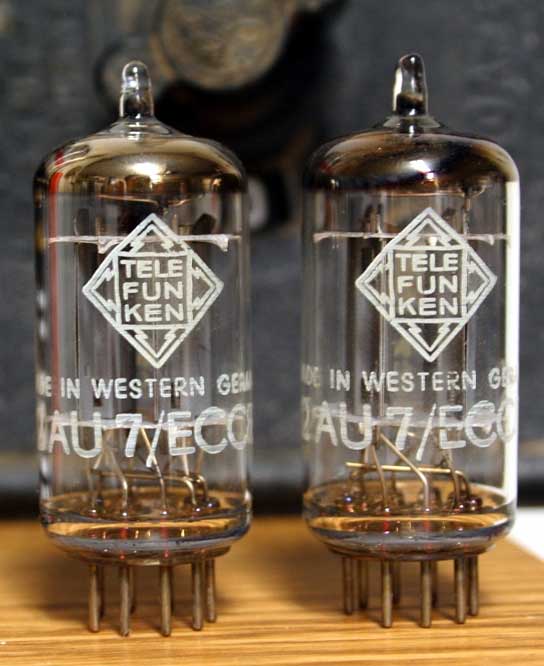
Problem with Telly tubes is the label turns to powder if you just look at em cross-eyed ...

These look almost virgin ... so they're probably counterfeit ... ;-}

telefunken-12au7.jpg


They sound good though, so I can live with that.
 
Thank you all for your help. This thread gave the general guidance and confidence I needed to try the tubes in amps, and I have results.

Type #1 & 2
- The smooth plate tubes had 4 tubes with the "getter strut" on pin #1 (counting counter-clockwise, with the gap in the 9 pins at the bottom facing me). These were all ECC83/12AX7.
- There was one smooth plate tube with the "getter strut" on pin #2, and it was an ECC82/12AU7.

Type #3 - The ribbed plate tubes both had the "getter strut" on pin #2, and both were 12AU7 (they sound FANTASTIC, by the way)

Type #4 - the short plate tube was correctly identified by several here as an ECC88/6922

And finally, the threads people linked to taught me that many Mullard/Philips/Amperex tubes had two or four "seams" on top, and this allowed me to find two sets of Mullard/Philips/Amperex ECC88's that also sound FANTASTIC.

Hope this helps some people in the future trying to ID tubes.
 
Problem with Telly tubes is the label turns to powder if you just look at em cross-eyed ...

These look almost virgin ... so they're probably counterfeit ... ;-}

telefunken-12au7.jpg


They sound good though, so I can live with that.
Problem with Telly tubes is the label turns to powder if you just look at em cross-eyed ...

These look almost virgin ... so they're probably counterfeit ... ;-}

I'm told that genuine TF's do not have a perfectly round getter, they have a little 'bend or notch' where they attach to the getter post. Fake ones do have a full round getter. Not sure if that's true but interesting.
IMG_5695.JPG IMG_5696.JPG
 
I'm told that genuine TF's do not have a perfectly round getter, they have a little 'bend or notch' where they attach to the getter post. Fake ones do have a full round getter. Not sure if that's true but interesting.

Mine have the notch, so they're either genuine ... or a really good fake ... ;-}

Some of these counterfeits are pretty good though. I got some "Bourns" pots for an insanely good price a while back that would probably stand up to microscopic examination, and they even track properly. They included the graduated 10 turn knob, which normally sells for about what just the knob usually sells for.
 
For tubes where you can see the grid, you can easily tell the difference between a 12AX7 and 12AU7. The 12AX7 grid wires are much more closely spaced than the 12AU7.
 
Back
Top Bottom