• The move to the new server is done. There are some software and database maintenance updates in process. This has us passing the hat around to help out. We appreciate any donations. Seriously, even a dollar helps. The payment page may be found here - https://www.audiokarma.org/support.html

If Dual Concentric speakers are so good why doesn't everyone use them?

Kef seems to have put a lot of their dual concentric speakers into various models they have. I tried the KEF LS50 wireless at one time and they imaged incredibly well. I just don't like smaller bookshelf speakers as much and like vintage speakers too.

I also had one of the first (maybe the first?) dual concentric speakers the RCA LC1. That speaker had an amazing midrange and realistic reproduction of sound for certain things, but as Gordon mentioned they fell in to the category of having a tweeter that could go high enough for me; they were a bit rolled off sadly. They really do sound great for certain things though.

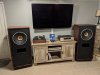
Those Tannoy's look fantastic by the way, Physicist!
 
Concentric is different than coaxial.......unless a whizzer cone add on, most coaxials are their own waveguide or horn, not the waveguide or horn, created by the larger cone.

As for the OP's question, speaker companies are often like fashion designers, someone comes out with something that sells the other pile on.

Think of all the speaker fads over the years.......some based on actual engineering needs like exceptionally high efficency for small tube amps and others that are just me too fads.
 

Hey Tom, I have recapped them both with Jantzen caps for the highs/mids and placed them side by side in the same room and driven by the same Electronics now. Basically heavily modded Conrad Johnson PV6 (basically with Mundorf Supreme Silver Oil coupling caps) and a combination of Tube and high current SS amps. They fire into the 25' length of my brother's basement so no problems generation low frequency waves. They both sound amazing but surprising different. The Tannoy M1000 SRM15Xs have the big warm coherent sound that is very very hard to beat. Interestingly I was recently at an audio meet where the host loaded a Tannoy K series driver similar to mine into a Jensen Imperial style cabinet with a BLH and custom crossovers. The bass was more solid but the imaging and the warmth was not there (however, driven by 70s Soundcraftsman separates), I just might try the Imperial cabs but with Tannoy crossovers for fun down the road....

I read earlier in the thread about the RCA LC1s. In the same meeting, the host had a set of LC1s loaded in another Jensen Imperial style cabinet. I actually spend a lot of time listening to them. They are bandwidth limited to be sure, even with the BLH, the did not produced must bass and there are no highs. I prefer the Tannoys.

The crossover recap did magic with the UREIs too.... In their current cabinets the UREI definitely delivers tighter bass. They can both ear splitting loud with less than 100W/Ch. Being coaxial/dual concentric, they can image like crazy but I give a slight edge to the Tannoys. I would say the UREIs sound more "in your face" sound. They are fun and I have way too much stuff but I cannot part with either one of these babies (along with by A5s).
 
Last edited:
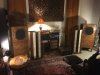
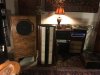
Photos of the RCA LC1 in Jensen Imperial cabinets, and the Tannoy K3828 dual concentric drivers in Jensen Imperial Cabinets. To the right of the Tannoy is a ALTEC 416/806A based horn system. There is also a modified Altec Valencia with a raised bass horn/port that sounded promising. I am also including a closer look of the RCA LC1 drivers. All courtesy of Stephen M of the Chicago Audio Society, who did a great job building these and hosting the meeting.
 

Attachments

  • IMG_4450.JPG
    IMG_4450.JPG
    100.8 KB · Views: 120
  • IMG_4454.JPG
    IMG_4454.JPG
    138.2 KB · Views: 119
  • IMG_4435.JPG
    IMG_4435.JPG
    79.5 KB · Views: 116
  • IMG_4436.JPG
    IMG_4436.JPG
    74.2 KB · Views: 109
  • IMG_4437.JPG
    IMG_4437.JPG
    94.5 KB · Views: 113
  • IMG_4447.JPG
    IMG_4447.JPG
    131.3 KB · Views: 115
Concentric is different than coaxial.......unless a whizzer cone add on, most coaxials are their own waveguide or horn, not the waveguide or horn, created by the larger cone.
Although this is true, Tannoy has the copy right on the term concentric and other manufacturers use the term coaxial even though they are concentric. And, I don't believe that using the cone as a continuation of the waved guide is a necessary qualification, but that's just me...
 
I am still a little fuzzy on the terminology - need to stop being lazy and do more research - but at one point I had THREE different 15" dual concentric/full-range driver speakers in my home...I had never heard one PERIOD until February 2019, and then suddenly I had 3 pairs in my house within 5 months.

The ones I had were:

Tannoy Arden
IMG_20191020_164322.jpg

RCA LC-1A
IMG_20191004_090106 (1).jpg

Lii Audio F15
IMG_20200221_191051.jpg

They all had that big, wide coherent sound. They are not as dynamic as my Legacy Focus or KEF 107 speakers (most speakers aren't), but there is something addictive about that point-source sound!

Out of the group above, I think the Tannoy Ardens will be my keepers, but they all have their strengths and I could see an individual choosing any one over the others.

As for those Tannoy DC-10A speakers...they are really tempting me. I'm really curious how a $16,000, 10" driver would sound vs. my current 15" Tannoy Ardens...

Unfortunately, there's usually only one way to find out...buy them! LOL!

I hope they are legit. A $16k speaker, for $2k shipped...even refurbished...seems almost too good to be true...

Anyone heard from the seller? Let me know please!
 
Hawkeye, I have not heard all Tannoys. My listening experience mainly based on Autographs, Westministers, Churchills, King Royals and my own SRM15X M1000s.... but your "big coherent sound" pretty much nails it. In terms of dynamics, I am pretty confident my M1000s can match the KEF 107s.
In my view, for max benefits, you need the 15" Tannoys.
 
It appears a patent was asigned to a Hungarian company in 2017..... I thought it would have been assigned decades earlier.
 
Never fooled with Tannoy concentrics but wanted to. Should have paid closer attention when I was in Germany in late 1970s at the Wiesbaden AFEES audio shop.
I don't have room for any more large speakers now, nor for the DQ-20i I still can't use.
 
As for those Tannoy DC-10A speakers...they are really tempting me. I'm really curious how a $16,000, 10" driver would sound vs. my current 15" Tannoy Ardens...

Unfortunately, there's usually only one way to find out...buy them! LOL!

I hope they are legit. A $16k speaker, for $2k shipped...even refurbished...seems almost too good to be true...

Anyone heard from the seller? Let me know please!

If an AK'ER grabs a set, I would certainly like to read a review of them also.
 
Andrew Jones favors concentric drivers in some of the Elac models he designed. I have them in my UB5 speakers.

Here is a Q & A from the Elac web site with some background:

Q1. What are the main differences between the Uni-Fi and the Debut Series?

A1. The Uni-Fi is intended as a step up in performance compared to the Debut series. As such it is both a three way system and incorporates our concentric driver technology, named Uni-Fi. In addition, as a three way, the drivers can be better optimized for their particular frequency range and so the cone materials are chosen for this purpose (aluminum for the bass and midrange drivers, cloth dome for the tweeter).

Q2. What are the main advantages of a concentric driver?

A2. First, what is a concentric driver? In general, it is a driver where the tweeter and bass/midrange driver have been combined into one compound unit. The tweeter is mounted at the apex of the cone, sitting directly on top of the bass driver pole piece, where the dust-cap would normally be found. The result of this is to match the off-axis characteristics of both drivers so that the sound is more even across the frequency range. The imaging will then be better, the sound character will be more consistent throughout the listening area, and will be less influenced by the acoustics of the listening space.

Q3. What are the main advantages of a 3-Way speaker vs. a 2-Way speakers?

A3. The principal advantage is that the drivers are operating over a narrower frequency range. As a result they can be better optimized for their intended purpose. In particular, the bass/midrange driver is no longer required to reproduce both bass ad mid frequencies simultaneously. This reduces the total amount of power going into each driver, reduces distortion and produces a clearer midrange and more dynamic bass performance.

Q4. What are the advantages of the aluminum drivers compared to other materials?

A4. The best choice of cone materials is governed by the intended application. Not all materials are ideal for all applications. The advantage of aluminum for the bass driver is its good balance between performance and cost. It is easily formed, consistent in production and has a good ratio of stiffness to weight. More exotic materials have very little further advantage in this size of bass driver. With the midrange driver, we generally find ourselves working with materials that are not rigid over their operating range. For example in the Debut speaker range, we use Aramid fiber. This gives us the capability of carefully controlling the cone flexing to get the best performance. This difficulty in design is somewhat ameliorated by having a three way speaker, and also now allows us to change to an approach that eliminates flexing within the operating range. Aluminum, as optimized in the Uni-Fi midrange, has its first flexure mode at a high 8kHz which results in excellent performance.

UB5

UB5.jpg
​
 
Dual Concentric is a marketing term, like Altec using Duplex or Ford using Mustang.

I think that the basic patents on coaxial drivers like the Altec 604, Tannoys, Stephens, Jensen etc. expired well over 60 years ago.

The main differences between a 604 and a classic Tannoy are the Tannoy, which came a few years after the Altec, uses the woofer cone as the high frequency horn, uses a pepper pot phasing plug rather than a concentric one and has the woofer and tweeter share a common magnet. Some later Tannoys use seperate woofer and tweeter magnets and concentric phase plugs.
 
The main differences between a 604 and a classic Tannoy are the Tannoy, which came a few years after the Altec, uses the woofer cone as the high frequency horn, uses a pepper pot phasing plug rather than a concentric one and has the woofer and tweeter share a common magnet. Some later Tannoys use seperate woofer and tweeter magnets and concentric phase plugs.

Interesting, I didn’t know that about about the classic Tannoys. Stephens coaxials also share a common magnet and have a pepper shaker phase plug. I would imagine that the concentric phase plug on the Altecs had to have been more difficult to make. I’m going to have to research phase plug types a little more, now that I have some extra time.

I remember reading something Steve Schell wrote a few years back that Robert Stephens thought the holes really should be chamfered. I believe they are chamfered more on my older set of compression drivers.


Stephens coaxial phase plug.

702871D1-00A9-4F91-83EF-8C01BC83E881.jpeg
 
Tannoy depends a lot on cabinet design to get the extended bass UREI and Altec Coax speakers can't reach, and you have to pay for that extended response with big bucks. And yes its only been recently Great Plains audio adopting some of JBL's improvements have made the 604 flat to 20,000 HZ, where earlier ,models all failed or tried to use supplemental crossover modifications to get the response at the cost of efficiency. Yes the crossover is a bit higher but if designed properly, as with Urei versions, has little effect on the sound. The throat issue JBL corrected was a bigger issue. The big Tannoy's are flat, two flat for me I prefer a little roll off above 4 kHz. Not a large amount but just a bit that I can return to flat with tone controls. Tannoy imaging and staging have like the 604 have been always great. Thats why the 604 was the most popular studio monitor in the world. With the Tannoy depending on very sophisticated cabinets to reach full potential they were shunned in the US for the professional market and out priced themselves in the consumer market. B&W takes more horse power to create the same levels but do it at a lower cost and with lower distortion than a Tannoy. But if you want a semi efficient speaker that will sound great with a MC 275 the Big Westminter Tannoy is the speaker to choose. Gordon Gows son Frank who worked at Audio Classics with Steve Rowell Always wanted a pair of Westminsters to mate with a 275. We were old buddies from back when and we talked about the pros and cons of Tannoy all the time. He was always right in this case, but I wanted to give something to talk about when we could. He never got his Westminsters, but it was his dream. I couldn't fault him for that.
 
Tannoy depends a lot on cabinet design to get the extended bass UREI and Altec Coax speakers can't reach, and you have to pay for that extended response with big bucks. And yes its only been recently Great Plains audio adopting some of JBL's improvements have made the 604 flat to 20,000 HZ, where earlier ,models all failed or tried to use supplemental crossover modifications to get the response at the cost of efficiency. Yes the crossover is a bit higher but if designed properly, as with Urei versions, has little effect on the sound. The throat issue JBL corrected was a bigger issue. The big Tannoy's are flat, two flat for me I prefer a little roll off above 4 kHz. Not a large amount but just a bit that I can return to flat with tone controls. Tannoy imaging and staging have like the 604 have been always great. Thats why the 604 was the most popular studio monitor in the world. With the Tannoy depending on very sophisticated cabinets to reach full potential they were shunned in the US for the professional market and out priced themselves in the consumer market. B&W takes more horse power to create the same levels but do it at a lower cost and with lower distortion than a Tannoy. But if you want a semi efficient speaker that will sound great with a MC 275 the Big Westminter Tannoy is the speaker to choose. Gordon Gows son Frank who worked at Audio Classics with Steve Rowell Always wanted a pair of Westminsters to mate with a 275. We were old buddies from back when and we talked about the pros and cons of Tannoy all the time. He was always right in this case, but I wanted to give something to talk about when we could. He never got his Westminsters, but it was his dream. I couldn't fault him for that.

Twiii, excellent analysis. I have heard commercial and DIY versions of the Westminsters, they are LARGE and COMPLEX but if you have the space and the pocket book: DO it! Its the speaker that made me fall for Tannoys.

I have an neat story, me, the wife and her sister were in a department store in Hong Kong decades ago. There was a dedicated audio room in which there was a set of Tannoy Westminsters driven by Convergent Audio Technologies electronics and a fancy analog setup. The salesman and I were able to convince the women to enter the room to listen to the big boxes. The women are not audio people and no idea what any of the stuff was. But they managed to stop shopping and sat in the room for an hour listening to song after song. As the store close, they asked me "how do we get that sound into our home" .... they were that impressed.
 
Back
Top Bottom