• The move to the new server is done. There are some software and database maintenance updates in process. This has us passing the hat around to help out. We appreciate any donations. Seriously, even a dollar helps. The payment page may be found here - https://www.audiokarma.org/support.html

If Dual Concentric speakers are so good why doesn't everyone use them?

There is a difference between coaxial and Concentric drivers. Coaxials are easy to make, concentric are not, why? It is due to the alignment of the of the voicecoils. Concentric are time aligned, coaxials are not. This means the tweeter has to be mounted in the magnet pole of the woofer using the woofer cone as a wave guide.

It is easy to mount a tweeter in front of the woofer but it is not a concentric driver.

This is the definition to use that I find very helpful for discussions of these type of speakers.

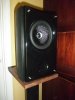
My understanding of the definition, is that a dual concentric uses the cone of the woofer as part of a deliberately-designed waveguide, to provide pattern control of the treble.

A coaxial just has the tweeter in the middle, firing out into space- it's not necessarily designed to interact with the woofer cone at all.

Time-alignment can be done in multiple ways, too. Just because a treble driver is mounted behind the magnet of the woofer (firing out of a throat/waveguide in the center of the woofer voice coil), doesn't mean it can't be pretty well time-aligned, using the correct crossover network design (tailoring the phase delay of the crossover, to cancel out the delay of the treble driver behind the woofer). In fact, that's how many of the upper-end Tannoy systems are configured.

Regards,
Gordon.
 
yes my question was due to the fact that i didnt know what the word "coax" means so i found that statement confusing. thanks for the reference.

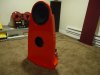
edit: im glad that I brought this thread up if nothing for the awesome red EP speakers. those are good lookin, I'd take 'em out, wine 'em and dine 'em, show 'em a good time.
 
Last edited:
Coaxial simply means sharing a common axis. Thus there are several types of coaxial speakers--those that have a compression driver behind the woofer cone that fires through the woofer pole piece such as the Altec Duplex and Tannoy Dual Concentric, those that mount a tweeter on a frame in front of the woofer such as the Bozak B207, and those that mount a cone or dome tweeter at the base of the woofer cone such as the RCA LC1. All are types of coaxial drivers.
 
Found this definition:

"A term used to characterize certain loudspeakers. The word concentric indicates a common center. Loudspeakers where the woofer and tweeter share a common center point are known as dual concentric (sometimes called coaxial, though this is not as specifically precise). Dual concentric speakers have the advantage of all sound emanating from one point (they are also called “point source monitors, which eliminates certain frequency interference problems near the crossover point that occur in monitors where a woofer and tweeter are some distance apart. These anomalies occur because around the crossover point the same frequencies are being reproduced by both drivers, however, they are generally slightly different distances from the listener’s ear (in addition to having slightly different surroundings on the face of the speaker cabinet), which creates arrival time differences and the accompanying comb filtering characteristics. The phenomenon is generally not nearly as severe as a word like “comb filter” implies, however, because at the frequencies relating to a typical crossover point the time delays involved are minute enough that the phase cancellation is somewhat minimal."
 
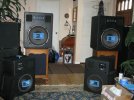
Still like the UREIs ...

UREI-911C&908s_Resized_9319.jpg

The larger 911s went away - didn't work for us at the time

We only kept the smaller 809s - tho we have 2 pair of them now in the multimedia system downstairs, and a JBL 460 (18") for the sub.
works pretty well together, with a pair of TF600s behind us for the rare 7.1 source.
When Raffi cat is sleeping in my lap, side channel sounds spook her, especially outdoor scenes. Door knocks trick us too ...

UREI809A-B460_Resized_3252.jpg
 
Stereo phile did a test on the GR or GRF 90 as I remember years ago. If you see the HF response of the tweeter it will make you cringe. It reminds me of the response of the early Bullet tweeter JBL used for the Paragon and later for the Hartsfield. So Ill take a smooth slightly rolled off response of a 604E any day of the week. The Urei version of the 604 used in the 811, and 813 were my favorite versions. The sectorial horn was much better than the small multi-cell horn. I have suddenly for gotten but I think James Lansing himself designed the 604 for Altec while he worked for them.
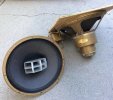
 
. I have suddenly for gotten but I think James Lansing himself designed the 604 for Altec while he worked for them.

Lansing's role in the development of the 604 is unclear, some claiming it was his baby, some Lansing and Hilliard together and some that it was Carrington, the head of the company and an engineer himself. If nothing else the directive to develop it came from Carrington. Hilliard was keen on the use of Alnico, having worked with it doing his war related work.
 
According to Don McRitchie the idea for a coaxial monitoring system came from Art Crawford. https://www.audioheritage.org/html/profiles/altec/duplex.htm

It's unclear to me exactly who Art Crawford was. In McRitchie's write up he says Crawford was an Altec dealer, and other accounts credit him as a radio broadcaster. Perhaps he was both. Research i've done in the past evidenced that he was a high end furniture dealer in the Los Angeles area.

I'm aware of the B and C version(Crawford Dimensitone) 604's that were marketed by Crawford, they're uncommon to say the least.

crawford 604.jpg
 
Last edited:
Back
Top Bottom