• The move to the new server is done. There are some software and database maintenance updates in process. This has us passing the hat around to help out. We appreciate any donations. Seriously, even a dollar helps. The payment page may be found here - https://www.audiokarma.org/support.html

If the horror that is a thunderstorm and an open window happens

ev13wt

Super Member
How long should I let everything dry out? I got home just minutes later, a storm came through with 80 mph winds driving rain. I was caught outside and only went home to change.
Trees everywhere, debris, cats flying through the air type storm.

I got home, opened the door and thought: "I guess we got lucky." Then I walked into to living room which was a complete catastrophe. Water on and over all the equipment (exactly under the window), soaked a driver and covered the TV even. Water all over the floor. Rug destroyed.

So a big sigh, pulled out all the towels we have and started unscrewing all covers and tops.
It's not that bad, somehow I got sort of lucky. Looks cleaner than before too.

Been waiting for 3 days now. What do you guys think, fire it up?

 

Attachments

  • technics-pro_854105.jpg
    technics-pro_854105.jpg
    131.6 KB · Views: 347
Register to hide this ad
My company actually pressure washers motor generators and associated electronics all the time. You should be good after 3 days if the humidity is low. If components got wet I would open and do a visual (how clean was the rain). We dry for 3 days with 250f forced air but we are forcing water in, your was probably deflected and not directly into anything I am guessing?

Good luck

Edit: if you see any residue distilled water and q-tips then dry again
 
Been waiting for 3 days now. What do you guys think, fire it up?
I'd open it and check for any signs of damp before launching.

Fortunately, clean water is non-conductive and harmless to electronics, given the majority of components are sealed. Water with dissolved salts and minerals may be conductive, and that's to be avoided, as is getting it inside transformers (rust) and potentiometers (rust) or on some vintage tuning dials and the like (the markings dissolve). Rain on the outside of the gear and some drizzles through the vent holes is unlikely to soak transformers and pots, but standing pools across conductors with dissolved salts can cause current flowing where it shouldn't. Even that usually causes temporary misbehaviour rather than outright failure; should be fine once dry.

The test equipment manufacturer Tektronix used to hose down the outside and inside oscilloscopes received for repair or recalibration, then gently bake them in an industrial oven until dry.
 
Thank Dave! I feel better now. Yes, nothing was really soaked. The top component (pre) and the reel to reel where the worst.
Since the R2R is currently open, I did take the time to relube the counter "gear" for the counter. It's knows to squeal like a pig on a spike if not lubed. At least something!

Even though I have run populated boards through the "dishwasher" myself, I need some AK verification! It does (did) use distilled water.


A bit more relieved now.
 
If you think the rain water brought in dirty water, you might want to carefully flush the main boards with Ethanol or Isopropanol alcohol, as they help evaporate water. Then, you could let the equipment air dry, or place them in a barely warm oven to dry overnight. Otherwise, water won't damage the PC boards. Where I work, we wash boards all the time, and rinse them in alcohol. Thirty seconds on a hot plate, and they're good to go.
 
You have a beautiful system and the floor layout is easy on the eyes.

See if you can borrow a dehumidifier and fan then run them for a day or so.

Those with basements can certainly appreciate the use of a dehumidifier (cheap and effective) to take the moisture out.
 
I agree, that's a lovely room. Hope everything is okay, be sure to watch for any signs of mold, and maybe use a dehumidifier as others suggested for a few days, really dry that room out.
 
Yeah, back in the Eighties, when R-390As became popular & plentiful, thanks to Uncle Sugar releasing SCADS of 'em, a lot of 'em were covered in filth, dried grease, mouse houses, you name it. The general consensus was to take 'em outside, put a reducing nozzle on the garden hose, & Have At It.. They are made w/stainless steel, brass, aluminum, a few steel springs, but nothing that would be too adversely impacted by a Bath. Some guys would take the separate modules, & run 'em thru Mama's Dishwasher, & if you lived in the desert, leave 'em outside for 3-4 days, let 'em bake & you were Good To Go... Didn't say how long it took to Cool Mama off, however...
 
You talking about the skylight? I added a louvered blind to mine - does a nice job of controlling the wind, and also helps to divert any water if I do something stoopid like leaving it open in a storm ...

(no offense intended - we all have our daze) ;-}

I'm thinking you'd still get some drips though. You might want to upgrade that window with a motorized version that has a rain sensor? I know Velux makes em - not sure if you can retrofit to an existing skylight, but worth checking.
 
Was there live AC at the time? If so the power supplies were energized.

Build a dim bulb tester before attempting power on any of them is what I do.
 
You have a beautiful system and the floor layout is easy on the eyes.

See if you can borrow a dehumidifier and fan then run them for a day or so.

Those with basements can certainly appreciate the use of a dehumidifier (cheap and effective) to take the moisture out.

Running the AC full time.


Was there live AC at the time? If so the power supplies were energized.

Build a dim bulb tester before attempting power on any of them is what I do.

Yes. Maybe. Maybe I'll just fire it up. :)
 
Crazy video!

Looks like a Deracho,...a fairly recent weather term here in the States for these types of quick moving storms.
 
That’s why they made something called a dry-vac to suck up and remove water from where it doesn’t belong. Then of course there are hurricane shutters installed on hinges to close in front of the windows so the don’t break. With the increase of severe weather people need to be more prepared to deal with nature before hand and not after the fact.
 
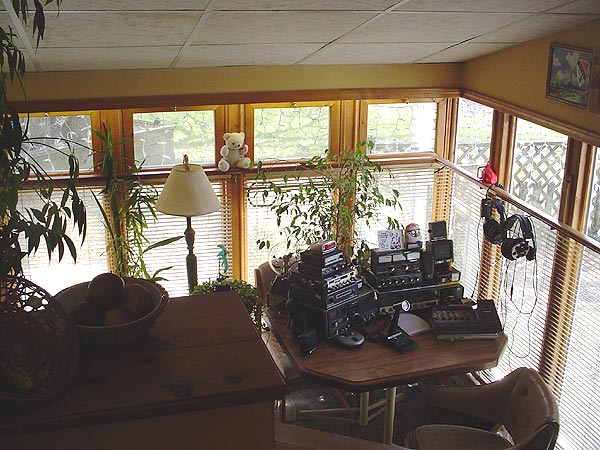
Built a sunroom on the back of the house that has the old school house type windows at the top of a glass wall.

sunroom_lites.jpg


Eaves are also extended, so it would take more or less hurricane force winds to drive any rain inside. Any water that does get past the openings hit the glass and rolls down outside. No worries about the radio equipment getting wet. Great ventilation too - I'll leave those open when I'm gone for a while and close everything else. Well, not everything - I also have a skylight in the shower, but water isn't much of a problem there ... <G>
 
^^^Cool little operating position.

@sKiZo You don't want that Turner Super Side Kick +2 getting wet. ;)

(Can't tell if that's a Swan, Heath, Cobra or Dosy in there too.)
 
Back
Top Bottom