• The move to the new server is done. There are some software and database maintenance updates in process. This has us passing the hat around to help out. We appreciate any donations. Seriously, even a dollar helps. The payment page may be found here - https://www.audiokarma.org/support.html

Infinity 2000A Restoration

My first speaker was a pair of Rectilinear IIIs (which I sold, and which are the only pair of speakers I have sold). My second speaker was the first Infinity product I could afford: the Infinity 2000. The first product, the Servo Statik 1 was a bit out of my price range as a college student. The Infinity 2000 was the precursor to the 2000A, having just two electrostatic tweeters per side, instead of four. But both used electrostatic tweeters from about 1,800Hz on up, just like their big brother, the Servo Statik 1.

I still have the 2000s, but they haven't been played for about a decade, and something is wrong with one of the high voltage supplies. I had been intending to fix them, as an homage to my audiophile history, but I never seemed to get around to it. But then fate and eBay intervened. I saw a pair of 2000As listed, and although the cabinets looked good, and all the drivers were there, they were described as having non-operational tweeters, sold as-is and local pick-up only. They were repeatedly re-listed for a lower and lower price, and finally I made an even lower offer which was accepted. Picking them up involved a 500 mile round trip, but I visited Jocko's Steakhouse, and Hearst Castle during the trip, both things I had been meaning to do for quite a while. I figured that between the 2000s and the 2000As, I should be able to get a good working pair of some very early Infinity speakers.

I got them home, and just as described, no sound from the tweeters.
View attachment 1253969

So I took them apart.
View attachment 1253970

Here's what the first crossover board looked like (after I removed the blown fuse):
View attachment 1253974

Hmmm, the vinyl tubing around the diodes is discolored, and the capacitors in the crossover are very modern looking polarized electrolytics. Somebody has been in here before. I also measured a few of the carbon composition high voltage bias resistors and they read 28Meg to 30Meg instead of the specified 22Meg. I decided to replace everything that was outdated, or out of spec. I planned on replacing the diodes and the capacitor in the HV supply, all (8) of the 22M carbon composition resistors with metal film ones, and replacing the electrolytic crossover caps with modern metalized film capacitors. Infinity-Classics.de had a scan of a drawing of the 2000A circuitry (attached below along with my schematic drawn from the Infinity assembly drawing), so I scoped out what I needed and ordered parts from DigiKey and Parts Express.

After I replace the fuses and the HV supply components, there was sound from one set of tweeters, but not the other. In the second speaker, someone had once replaced the diodes and then connected the tweeter wires to the wrong terminals. After re-wiring things correctly, the second speaker's tweeters also started working. But we weren't out of the woods yet. There is an inductor in the tweeter crossover, and in the second speaker, it was not connected, as the wire had broken. I took it out of the cabinet to check it out, and found this:
View attachment 1254310

I think I need a new inductor. Maybe two. The Infinity drawing showed the inductor in series with a 2.5 ohm 10 watt resistor going to ground. My speakers had the inductor but no resistors. I measured the DCR of the roasted inductor, and got 2.5 ohms. Aha! Someone at Infinity had the bright idea to wind the inductor with really thin higher resistance wire so they didn't have to bother with the resistor. We'll save 50 cents in every speaker! What could go wrong? If you have a big amplifier and you play these speakers really loud, that inductor gets hot enough to melt its winding form. That had happened in both of my speakers. The same inductor in the 2000s crossover was the required 0.19mH value, but it had a DCR of 0.2 ohms. So I replaced the tweeter inductors in the 2000As with those from my 2000s and added some 5 ohm resistors in parallel to get the 2.5 ohm shunt to ground.

When I was done replacing things, everything circled on this schematic was new:
View attachment 1253988
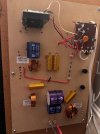
Here is what the rewired crossover board looks like:
View attachment 1253989
Although the tweeter circuitry was now fully operational, two tweeters in each speaker were dead. Fortunately, I had bought a box of Infinity 2000A parts from eBay about 15 years ago. The box contained four working blue RTR electrostatic tweeters. I swapped out the dead tweeters for working ones, and now had a fully restored set of Infinity 2000As. I also have the original optional stands ($5 in 1970), and after I sand, prime and repaint them, I'm going to call this restoration project complete.

I have a pair of 2000A that need some work. I am in Northern California. Any suggestions of who can work on them? Reading your post convinces me that fixing them myself is beyond what I know.
 
I have a pair of 2000A that need some work. I am in Northern California. Any suggestions of who can work on them? Reading your post convinces me that fixing them myself is beyond what I know.
Maybe MCI Audio and I may know a private party that might be interested.
 
Russ dropped his 2000A speakers off with me (MCIaudio). I wanted to share the results for others who had damaged woofers.

All the electrostatic tweeters worked fine, the crossovers, although all original from the 70’s, worked. The midrange drivers were shot, one woofer was missing the mass ring and had several small punctures in its surround and the other had a loose mass ring.

Russ was able to locate used, original midrange drivers which worked fine. The question was what to do with the woofers. Finding originals was not proving easy. We could reglue the loose mass ring but what about the missing ring on the other? I read about using Blu-Tac but didn't feel comfortable trying to duplicate the original mass ring, plus, that woofer had small punctures in the surround which would surely grow with use.

I started looking for replacements. Without using BassBox software, I tried to locate one that would meet the efficiency, impedance to work properly with the crossover and the correct size to fit the recess of the cabinet. Cabinet size and porting couldn’t be perfect but I could get close. I settled on the Dayton Audio DC300-8 (Yes, the 2000A is rated at 4 ohms but the original woofer was an 8.)

After installing the new woofers and having a listen, I felt the bass was lacking and muddy. I read here or maybe another forum, about another 2000A rebuild that resulted in removing some of the insulation in the cabinet that lead to better bass. Out can the woofers and I began pulling foam. There is enough insulation in these cabinets to stuff a futon, it’s ridiculous. I have no idea how a ported cabinet is to function with this much foam stuffed into the box. Before removing anything, I did put my ear to the port while listening and could barely hear any bass.

What worked best for us was 1 layer of the foam at the top, back and bottom of the cabinet. What a difference, much better bass. I’ll comment on the limited dispersion of the tweeter array. Speaker placement and the angle of the speakers is critical. Move 2’ in one direction or the other and the highs change.

Russ is going to try the speakers for a while with the replacement mids and new woofers before deciding if he wants to rebuild the crossovers.
 
I’m very pleased with Eric’s work. The speakers sound great. Eric checked in with me at each step and provided useful advice and recommendations. The project was completed quicker than I anticipated and for a very reasonable cost.
 
Russ dropped his 2000A speakers off with me (MCIaudio). I wanted to share the results for others who had damaged woofers.

All the electrostatic tweeters worked fine, the crossovers, although all original from the 70’s, worked. The midrange drivers were shot, one woofer was missing the mass ring and had several small punctures in its surround and the other had a loose mass ring.

Russ was able to locate used, original midrange drivers which worked fine. The question was what to do with the woofers. Finding originals was not proving easy. We could reglue the loose mass ring but what about the missing ring on the other? I read about using Blu-Tac but didn't feel comfortable trying to duplicate the original mass ring, plus, that woofer had small punctures in the surround which would surely grow with use.

I started looking for replacements. Without using BassBox software, I tried to locate one that would meet the efficiency, impedance to work properly with the crossover and the correct size to fit the recess of the cabinet. Cabinet size and porting couldn’t be perfect but I could get close. I settled on the Dayton Audio DC300-8 (Yes, the 2000A is rated at 4 ohms but the original woofer was an 8.)

After installing the new woofers and having a listen, I felt the bass was lacking and muddy. I read here or maybe another forum, about another 2000A rebuild that resulted in removing some of the insulation in the cabinet that lead to better bass. Out can the woofers and I began pulling foam. There is enough insulation in these cabinets to stuff a futon, it’s ridiculous. I have no idea how a ported cabinet is to function with this much foam stuffed into the box. Before removing anything, I did put my ear to the port while listening and could barely hear any bass.

What worked best for us was 1 layer of the foam at the top, back and bottom of the cabinet. What a difference, much better bass. I’ll comment on the limited dispersion of the tweeter array. Speaker placement and the angle of the speakers is critical. Move 2’ in one direction or the other and the highs change.

Russ is going to try the speakers for a while with the replacement mids and new woofers before deciding if he wants to rebuild the crossovers.
I have a spare pair of original woofers.
 
My first speaker was a pair of Rectilinear IIIs (which I sold, and which are the only pair of speakers I have sold). My second speaker was the first Infinity product I could afford: the Infinity 2000. The first product, the Servo Statik 1 was a bit out of my price range as a college student. The Infinity 2000 was the precursor to the 2000A, having just two electrostatic tweeters per side, instead of four. But both used electrostatic tweeters from about 1,800Hz on up, just like their big brother, the Servo Statik 1.

I still have the 2000s, but they haven't been played for about a decade, and something is wrong with one of the high voltage supplies. I had been intending to fix them, as an homage to my audiophile history, but I never seemed to get around to it. But then fate and eBay intervened. I saw a pair of 2000As listed, and although the cabinets looked good, and all the drivers were there, they were described as having non-operational tweeters, sold as-is and local pick-up only. They were repeatedly re-listed for a lower and lower price, and finally I made an even lower offer which was accepted. Picking them up involved a 500 mile round trip, but I visited Jocko's Steakhouse, and Hearst Castle during the trip, both things I had been meaning to do for quite a while. I figured that between the 2000s and the 2000As, I should be able to get a good working pair of some very early Infinity speakers.

I got them home, and just as described, no sound from the tweeters.
View attachment 1253969

So I took them apart.
View attachment 1253970

Here's what the first crossover board looked like (after I removed the blown fuse):
View attachment 1253974

Hmmm, the vinyl tubing around the diodes is discolored, and the capacitors in the crossover are very modern looking polarized electrolytics. Somebody has been in here before. I also measured a few of the carbon composition high voltage bias resistors and they read 28Meg to 30Meg instead of the specified 22Meg. I decided to replace everything that was outdated, or out of spec. I planned on replacing the diodes and the capacitor in the HV supply, all (8) of the 22M carbon composition resistors with metal film ones, and replacing the electrolytic crossover caps with modern metalized film capacitors. Infinity-Classics.de had a scan of a drawing of the 2000A circuitry (attached below along with my schematic drawn from the Infinity assembly drawing), so I scoped out what I needed and ordered parts from DigiKey and Parts Express.

After I replace the fuses and the HV supply components, there was sound from one set of tweeters, but not the other. In the second speaker, someone had once replaced the diodes and then connected the tweeter wires to the wrong terminals. After re-wiring things correctly, the second speaker's tweeters also started working. But we weren't out of the woods yet. There is an inductor in the tweeter crossover, and in the second speaker, it was not connected, as the wire had broken. I took it out of the cabinet to check it out, and found this:
View attachment 1254310

I think I need a new inductor. Maybe two. The Infinity drawing showed the inductor in series with a 2.5 ohm 10 watt resistor going to ground. My speakers had the inductor but no resistors. I measured the DCR of the roasted inductor, and got 2.5 ohms. Aha! Someone at Infinity had the bright idea to wind the inductor with really thin higher resistance wire so they didn't have to bother with the resistor. We'll save 50 cents in every speaker! What could go wrong? If you have a big amplifier and you play these speakers really loud, that inductor gets hot enough to melt its winding form. That had happened in both of my speakers. The same inductor in the 2000s crossover was the required 0.19mH value, but it had a DCR of 0.2 ohms. So I replaced the tweeter inductors in the 2000As with those from my 2000s and added some 5 ohm resistors in parallel to get the 2.5 ohm shunt to ground.

When I was done replacing things, everything circled on this schematic was new:
View attachment 1253988
Here is what the rewired crossover board looks like:
View attachment 1253989
Although the tweeter circuitry was now fully operational, two tweeters in each speaker were dead. Fortunately, I had bought a box of Infinity 2000A parts from eBay about 15 years ago. The box contained four working blue RTR electrostatic tweeters. I swapped out the dead tweeters for working ones, and now had a fully restored set of Infinity 2000As. I also have the original optional stands ($5 in 1970), and after I sand, prime and repaint them, I'm going to call this restoration project complete.
I have been working on my pair of these great speakers, just rebuilt the crossovers; ill try including a picture.

Question for you though: in the original crossover schematic and the new one differ slightly in the orientation of the 3 diodes.
I built my new crossovers with the diodes in the orientation of the “new” schematic and all seems to work, but wanted to know your thoughts.
Aaron
 

Attachments

  • IMG_5338.jpeg
    IMG_5338.jpeg
    186.6 KB · Views: 9
I have been working on my pair of these great speakers, just rebuilt the crossovers; ill try including a picture.

Question for you though: in the original crossover schematic and the new one differ slightly in the orientation of the 3 diodes.
I built my new crossovers with the diodes in the orientation of the “new” schematic and all seems to work, but wanted to know your thoughts.
Aaron
Reversing the orientation of the diodes will just reverse polarity of the bias voltage. It shouldn’t change anything. (It will reverse the phase of the tweeters. But I doubt very much if anybody could hear the difference.)
 
After installing the new woofers and having a listen, I felt the bass was lacking and muddy. I read here or maybe another forum, about another 2000A rebuild that resulted in removing some of the insulation in the cabinet that lead to better bass. Out can the woofers and I began pulling foam. There is enough insulation in these cabinets to stuff a futon, it’s ridiculous. I have no idea how a ported cabinet is to function with this much foam stuffed into the box. Before removing anything, I did put my ear to the port while listening and could barely hear any bass.
When these speakers were built, transmission line bass was all the rage. No one really knew the math to design a correct transmission line, and the theory was, if you have a tapered line behind the woofer which is filled with absorptive material it will absorb the back wave without loading the woofer or allowing cabinet reflections back through the driver cone. (A. R. Bailey — “Non-resonant Loudspeaker Enclosure Design” Wireless World, October 1965). Arnie Nudell had built speakers based on Bailey’s article, and referred to the 2000/2000A design as an absorptive transmission line. They were never intended to behave like a ported speaker, all of that Dacron stuffing was supposed to absorb the back wave. This may sound far-fetched, but I was there and I’m not making this up.
 
Reversing the orientation of the diodes will just reverse polarity of the bias voltage. It shouldn’t change anything. (It will reverse the phase of the tweeters. But I doubt very much if anybody could hear the difference.)
Thanks for the information. While i can follow the schematics, I’m not advanced in electronics. Still learning here the reasons behind why certain components are where they are and what they are doing.
In the end, the diode orientatIon i used was as is printed on the “updated” schematic and all sounds great.
 
Back
Top Bottom