


bennattj
New Member
I'll put my question up front and backstory is below the schematic.
Do you think I'd get an improvement if I were to install a proper crossover into all eight of these speakers? (not really asking about is it "worth it" since I think I know the answer to that based on the cost and labor)
There was a previous thread on this back in 2008: pioneer s-hf21-lr crossover mod? which I believe was simply asking about the varistor in the "crossover". Which someone finally concluded "We might know what it is, but we don't currently know what it does."
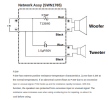
Well the schematic answers the question: it's a varistor--basically a circuit breaker for the driver (when it gets too much current the temperature rises and the resistance spikes to effectively cutoff the driver). In other words there is no low-pass filter for the woofer. So the woofer is full range with a super tweeter crossed over at ~13kHz (the near inaudible range).
Looking at Parts Express, and my need for 8 of these, I'm basically pinned to a combination of: 3.3 micro-farad cap (~6kHz) and 0.20 mH inductor (closer to 6.5kHz).
Questions:
1. Can these tweeters, originally crossed over at 13kHz, even handle that low of frequencies?
2. How might that change the impedance of the speaker? (could it drop to 4-ohms, which would be a problem for me)
3. Could this improve sound clarity?
4. Any measurements I could (try to) take to quantify the change before and after if I do try?
Back story:
I recently got a really wild idea when I got my two pairs of Pioneer HF21's back from a friend who couldn't use them (turns out two had the tweeter broken off, two cabinets weren't in great shape, and one woofer was dead).
After pairing up two of them with some old (super cheap) Aiwa speakers from a 90s stereo and being super impressed with the sound, I decided to at least try two pairs of the Pioneers. That was actually quite impressive on its own so naturally, I thought to myself, what if I could double it?
So here it is, doubled (took me a bit to find all of these on ebay, but was able to keep the total speaker cost under $200):
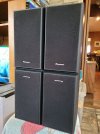 right set, then another set of 4 on the left
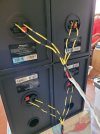 two pairs, each pair wired in parallel (theoretically making a 4-ohm load) <-- with my custom made speaker wire
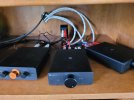 Fosi P4 into an RCA splitter, then each amp handles two of each channel
Do you think I'd get an improvement if I were to install a proper crossover into all eight of these speakers? (not really asking about is it "worth it" since I think I know the answer to that based on the cost and labor)
There was a previous thread on this back in 2008: pioneer s-hf21-lr crossover mod? which I believe was simply asking about the varistor in the "crossover". Which someone finally concluded "We might know what it is, but we don't currently know what it does."
Well the schematic answers the question: it's a varistor--basically a circuit breaker for the driver (when it gets too much current the temperature rises and the resistance spikes to effectively cutoff the driver). In other words there is no low-pass filter for the woofer. So the woofer is full range with a super tweeter crossed over at ~13kHz (the near inaudible range).
Looking at Parts Express, and my need for 8 of these, I'm basically pinned to a combination of: 3.3 micro-farad cap (~6kHz) and 0.20 mH inductor (closer to 6.5kHz).
Questions:
1. Can these tweeters, originally crossed over at 13kHz, even handle that low of frequencies?
2. How might that change the impedance of the speaker? (could it drop to 4-ohms, which would be a problem for me)
3. Could this improve sound clarity?
4. Any measurements I could (try to) take to quantify the change before and after if I do try?
Back story:
I recently got a really wild idea when I got my two pairs of Pioneer HF21's back from a friend who couldn't use them (turns out two had the tweeter broken off, two cabinets weren't in great shape, and one woofer was dead).
After pairing up two of them with some old (super cheap) Aiwa speakers from a 90s stereo and being super impressed with the sound, I decided to at least try two pairs of the Pioneers. That was actually quite impressive on its own so naturally, I thought to myself, what if I could double it?
So here it is, doubled (took me a bit to find all of these on ebay, but was able to keep the total speaker cost under $200):
right set, then another set of 4 on the lefttwo pairs, each pair wired in parallel (theoretically making a 4-ohm load) <-- with my custom made speaker wireFosi P4 into an RCA splitter, then each amp handles two of each channel
Last edited:


