• The move to the new server is done. There are some software and database maintenance updates in process. This has us passing the hat around to help out. We appreciate any donations. Seriously, even a dollar helps. The payment page may be found here - https://www.audiokarma.org/support.html

Is this motorboating and how do I control it

Don -- If you will, I think it is best at this point to describe:

1. How EXACTLY is the power supply -- IN TOTAL -- any different -- IN ANY DETAIL --from that shown on the schematic?

2. Have you installed an inrush current limiter on this unit that is possibly undersized and is periodically caving under the higher current demand of this particular unit?

Also, if you pull all the output tubes, will the B+ stabilize? If not, that should help in getting to the bottom of things real quick.

Also, if I may, it is quite harmful to the output tubes to remove JUST the plate voltage by disconnecting the CT of the OPT in a pentode based design. Doing so leaves the screens to try and pass not only the current they normally draw, but also that which WAS being attracted to the plate. Without any plate voltage present then, the screens take the full brunt of the current flow within the tube, which can damage them quite quickly. Just some FYI!

Dave
 
Thanks Dave. When I pulled the CT of the opt, it motorboated well before those tubes could have heated up. I bet it wasn't on three seconds. I'll keep that thought for future reference though.

I actually added a CL-80 thermister on the other leg of the primary when I changed the transformers yesterday. The other one's a CL-70. I've got a CL-80 left on the bench that I intend to put in next attempt to fix. If I recall from the specs, the current limit on the CL70 is even higher than the current limit on the CL-80.

I did not change anything in the power supply before this motorboating occurred.

Will chronolog all power supply differences.
 
I have dummy 8 ohm resistors installed on the 8 ohm outputs now. When the woofers were oscillating before, my Fluke 77 DMM wouldn't read DC voltage. It "pulses" and won't read a voltage. Now I've disconnected the speakers and have just been using the DMM and load resistors to save the speakers. When I run the voltage up on a variac, which is how I've been doing it, the DMM will read proper DC up to 325VDC (and the music output seemed Ok) when the probes are connected to the chassis ground and B+ side of the diode bridge. I noticed that the DMM pulsing coordinated with the woofers oscillating and figured that the symptoms were related.

I'll try it again tonight with the physical speakers connected.
Also, the B+ gets to 325 Vdc (should go up to about 412) at about 100-105VAC on the variac.

This is one reason why I've been so surprised that I see this DMM pulsing right after the diode bridge reaches 325VDC, even with the first downstream power supply capacitors and resistors disconnected.

I'll have to rethink the way I describe this and consider whether I've been assuming something that's not a logical assumption.
 
Last edited:
Don...have you tried measuring your circuit with a good old fashioned analog voltmeter? This seems totally farfetched, but maybe there's something wonky about your digital voltmeter that is sending your Fisher into the oscillation.

I don't have that specific model, but I do have an older Fluke 70 series unit. Every now and then when I use it to test trannies for continuity it goes into oscillation so I switch to my Simpson 260 for an occasional adult measurement. You are welcome to borrow it if you wish.

Good luck!
 
I don't have an analog meter Dadbar. I have a few things in the basement though. Let me rummage around tonite.
I will say that I've read B+ on dozens of amps, integrateds, and receivers before and never had a problem like this.
 
Last edited:
You might also try relocating your voltmeter + probe away from the diode bridge...back a cap or two so there is at least a resistor between the tranny and your + probe. See if that makes a difference.

I know what you mean about never having a problem..until now. The first time I experienced the weird oscillation with my Fluke it took me for a loop. I almost tossed a perfectly good Fisher output tranny.
 
Last edited:
Check for open bleader resistors or add a couple of them to the first couple caps in the power supply to bring the voltage down slightly , more than likely there is a poor ground somewere thats going to be very dificult to find . I hate to say it but sometimes you have to cure the the symtom when the problem is eluding you .

Newer diodes have less forward drop , if some you are using are fast switching lower noise they may have brought the B+ up a few percent .
 
I do wish to thank everyone for your suggestions and experience. I don't believe I've ever been stumped to this level on a problem with tube gear.

I keep hoping for that embarrassing "Oh, why didn't I think of that" moment and I'm trying not to get frustrated.
 
Same question: Are you telling me that from a cold turn on, the woofers start oscillating in just a couple of seconds or so -- AND CERTAINLY WELL BEFORE THE OUTPUT TUBES START TO CONDUCT ANY CURRENT?????

Dave
 
motorboating

Caps will do it to you every time.
The weakest link to any good audiophile are old value changed caps.
By all means do a cap job.

Paul
 
Well, he says . . . looking sheepishly for forgiveness . . . I've had that "Why didn't I think of that" moment. Biggest time wasting boneheaded move in quite a while.

What put me on the right track:

1. dcgillespie mentioned the woofers going in and out. I realized I hadn't even tested that in over a dozen hours of troubleshooting and I was living on the meter display's results.
2. dadbar mentioned that he'd had trouble with his Fluke meter and made some suggestions.
3. I realized that, while I'd changed all my thermostat batteries and smoke alarm batteries when Daylight Savings Time ended, I hadn't changed my Fluke 77 meter battery in quite a while.
So, I changed the meter battery, hooked up the speakers again, ran up the variac to the point where it used to motorboat, beyond that point . . . and Voila! Everything worked perfectly.
B+ reads correctly, sound comes out normally, and life seems better.
The problem had been the meter for some time. I've only had it die completely on me, not when measurement went into another digital range on the meter.

Other things I'd tried that I hadn't listed:
1. Shorting out the thermisters.
2. Pulling all output tubes.

Because of all the noodling, I'm not sure exactly which thing I did fixed the woofer chuffing, but I suspect that it was when I replaced the can cap. The value between B+ and the next level down from was only a few volts off and it should have been 14 volts off.

It has been running trouble-free for at least three hours, even when I ran the input AC up to 130. I have seen it at over 127.0 here.

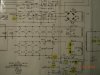
So, here are some pictures of the power supplies of two X-1000 schematics. The first is a later generation one with values printed in.
attachment.php


The second is a picture of the earlier style, like this one, with the brass faceplate and with my measurement letter codes written in.
attachment.php


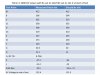
The third is a table with what happens in the power supply when I set the AC on a variac so that B+ reads exactly as it should on the schematic.

attachment.php
 

Attachments

  • schematicwithvalues.jpg
    schematicwithvalues.jpg
    68.9 KB · Views: 244
  • schematicwithcodes.jpg
    schematicwithcodes.jpg
    66.9 KB · Views: 61
  • Slide1.jpg
    Slide1.jpg
    68.6 KB · Views: 61
Last edited:
What! All this whining, all this help, and NOW you can't tell us what fixed it???????

NO SOUP FOR YOU!!:):)

(Glad you got it straightened out!)

Dave
 
:tears: I'll miss the soup.

I'd seriously begun to doubt my own abilities there. I hated the thought of sidelining this amp again because I'd like to use it.
Tonight I'll take out the test EL-34s and bias it up with some Mullards and let it run on the bench for the four days plus four hours (4x24 + 4 = 100) for the hundred hour continuous test. Then, barring problems, it'll go into regular service.

Ok SoCal Sam, it's your turn. Strike while the iron is hot man!
 
Wow...who doesn't love a happy ending. Congrads on "fixing" your unit. I never fully trust any test data that I can't verify with a second piece of gear.
 
Well, I've changed out a few more parts, done the final button up and overnight test.
Updated, See figure 1, C68 and C69 on the right. It had some old green micamold .01ufs I didn't like the look of.

I also changed some coupling caps between the front end and the tone control section. They're 1uf caps and I pulled out a pair of paralleled Panasonics and put in a pair of 1uf Auricaps I have. Whoa. What a difference.
 
Last edited:
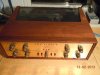
Now that I've learned what motorboating is, the other motorboating that is, all I can say is that this one's face has been slapped clean and this Fisher X-1000 has been put into service.

it had me going there for a while . . . thinking that the HK hot rod might top it, but it's got a depth of sonic image that sets it apart.

attachment.php
 

Attachments

  • X1000finaltop.jpg
    X1000finaltop.jpg
    72.6 KB · Views: 643
Back
Top Bottom