• The move to the new server is done. There are some software and database maintenance updates in process. This has us passing the hat around to help out. We appreciate any donations. Seriously, even a dollar helps. The payment page may be found here - https://www.audiokarma.org/support.html

Issues with Parasound HCA-1000A

David_NC

Super Member
I recently acquired a HCA-1000A amp from a friend. The amp hasn't been used in a while, but I was told it worked last time it was used. It powers on fine (protection relay clicks, the Normal LED illuminates, etc. The right channel sounds good, but the left channel is really distorted, and the sound level is maybe 5% of the right channel.
Caps look good, though I know that doesn't mean that they are. A buddy said that he had to replace the main caps in an older amp that had the same issues, so maybe that's what's wrong with this one. Nothing looks out of place, burned, fuses are good, etc. Where is a good place to start troubleshooting and repairing this unit? Thanks for any help!
 
Register to hide this ad
Hello

The amp hasn't been used in a while, but I was told it worked last time it was used. It powers on fine (protection relay clicks, the Normal LED illuminates, etc.

yes and I will strongly recommend this : don't replace the main capacitors ! this is not possible that your problem is coming from there
I will suspect the speakers relays , nothing more
If you want to be sure before to touch anything inside , just knock your relay with the "handle" of your screw driver and you will probably hear what you have to hear : the problem is coming from there
 
Hello

The amp hasn't been used in a while, but I was told it worked last time it was used. It powers on fine (protection relay clicks, the Normal LED illuminates, etc.

yes and I will strongly recommend this : don't replace the main capacitors ! this is not possible that your problem is coming from there
I will suspect the speakers relays , nothing more
If you want to be sure before to touch anything inside , just knock your relay with the "handle" of your screw driver and you will probably hear what you have to hear : the problem is coming from there
That's actually what I was thinking, though who knows the condition of the main caps. I'd rather solve a problem before upgrades that might easily introduce other issues. I did tap on the relay yesterday, but nothing changed. It was a pretty lame tap, so I'll try it again. Thanks!

Check/clean (DeoxIT) the input level controls on the back panel would be my first step.

HTH

Bret P.
That will be my next step. I know there's a bit of static in the right (working) channel's pot, so it stands to reason that the left (non-working) channel is at least as bad. I'd have attempted that last night, but my DeoxIT was at work where I'm doing a couple things on my old Teac C-3RX.
 
Check/clean (DeoxIT) the input level controls on the back panel would be my first step.

HTH

Bret P.
Sadly, there is no change after a DeoxIt treatment, other than the bit of static in the right channel is now gone! ;)

Hello

The amp hasn't been used in a while, but I was told it worked last time it was used. It powers on fine (protection relay clicks, the Normal LED illuminates, etc.

yes and I will strongly recommend this : don't replace the main capacitors ! this is not possible that your problem is coming from there
I will suspect the speakers relays , nothing more
If you want to be sure before to touch anything inside , just knock your relay with the "handle" of your screw driver and you will probably hear what you have to hear : the problem is coming from there
That seemed to have no effect. I'm measuring 5mV DC at the speaker jacks (with no input and no speakers connected)... could that tiny bit of voltage make it past bad relay contacts on both channels if a normal amplified signal can't make it through? I'm not sure of what the next step should be.

Thanks!
 
Last edited:
I'm going to try to remove the cover from the relay to check the contacts. Other than that, I'm stumped!
 
Hello

The amp hasn't been used in a while, but I was told it worked last time it was used. It powers on fine (protection relay clicks, the Normal LED illuminates, etc.

yes and I will strongly recommend this : don't replace the main capacitors ! this is not possible that your problem is coming from there
I will suspect the speakers relays , nothing more
If you want to be sure before to touch anything inside , just knock your relay with the "handle" of your screw driver and you will probably hear what you have to hear : the problem is coming from there

Check all your fuses with a multimeter.

Fuses check out good. I cannot get to the relay without completely disassembling the amp. The only resource I have is a schematic, which is handy, but many of the components cover their labels on the board, and I cannot find alternate locations to check the outputs pre relay. A board diagram or service manual would be really handy, but they don't seem to be available.
One thing I noticed, though, is the stereo / mono bridge switch is stuck in stereo. Previously, the one time I flipped it, it moved but it didn't feel quite right like a normal toggle switch, if that makes sense. This made me wonder if it's actually stuck in mono. If so, what would the symptoms be if speakers were connected to both L and R outputs? The right input is used on this amp. So, I treated it as if it was in mono - I connected the input and speaker correctly for bridged mono operation, fired it up, and turned up the right input pot. It sounded fine, but the right channel sounded fine anyway.
This brings up more questions. How would an amp behave in bridged mono if one channel has output issues? If an amp is bridged and speakers are connected to both outputs, how would they sound? The manual states "If you accidentally leave the Mono Bridge switch in the Mono (up) position, you will find stereo output will be weak and distorted." Weak and distorted is exactly what I hear, but I'm not sure if this would be in one or both channels. Is there a definitive way to tell if the amp is operating in bridged mono via meter, etc? I could unsolder the switch and jumper it to stereo I suppose, but I'm curious if there's another way with a multimeter or similar.
 
Bridge switch in the Mono (up) position, you will find stereo output will be weak and distorted." Weak and distorted is exactly what I hear, but I'm not sure if this would be in one or both channels. Is there a definitive way to tell if the amp is operating in bridged mono via meter, etc? I could unsolder the switch and jumper it to stereo I suppose, but I'm curious if there's another way with a multimeter or similar.
The switch probably needs a good disassembly and cleaning regardless.
 
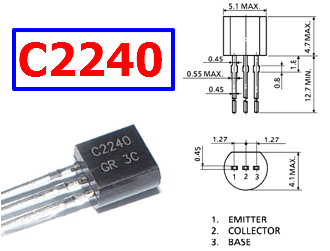
Can you find two Q123's ? One for the left channel and one for the right. They are 2SC2240 TO-92 transistors. Pin out is ECB. Measure the voltage at there emitter leads. This is a good test point for the amplifier output before the relay contacts.
 
The switch probably needs a good disassembly and cleaning regardless.
It's one of those miniature toggle switches with the metal sort of crimped around the plastic switch body. I'll likely destroy it taking it apart, so I may try taking it off the board and jumper the stereo position. If that works, I'll try disassembling or replacing it.

Can you find two Q123's ? One for the left channel and one for the right. They are 2SC2240 TO-92 transistors. Pin out is ECB. Measure the voltage at there emitter leads. This is a good test point for the amplifier output before the relay contacts.
I'll have to look. First, I'll have to find out what they even look like! From what I remember, I couldn't find any test points on the amp that corresponded to the schematic, if that makes sense. I'll try again fresh this weekend.

Thanks!
 
C2240-transistor.gif
2SC2240
 
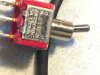
Sometimes, things just seem to work out! Considering that the stereo / mono switch was stuck in stereo, and the symptoms I had (weak and distorted sound in one channel) were mentioned in the manual, I decided to focus on that. I removed the switch from the input board, opened it, and found the toggle see-saw parts were loose inside. I reassembled it, tested it with a meter, and reinstalled it. Sure enough, the symptoms were back... and the switch was stuck in one position again. I removed it and disassembled it. After flipping it a few times, it became stuck again. I soldered a couple pieces of wire jumpers to the board in the switch's stereo position. This time, the right channel sounded good as ever on my test speaker, mono connection between the two positives sounded weird, as it should (when in stereo mode), and the left channel sounded similar to the right. I connected a real pair of speakers, turned on the amp, and finally - good sound from both channels with no distortion!
Besides being pleased that the amp is now working and sounding really good, I'm happy that I was able to troubleshoot it and get it working. Oddly enough, reading the owners manual gave me the clue as to what was wrong. The clue was right there: "If you accidentally leave the Mono Bridge switch in the Mono (up) position, you will find stereo output will be weak and distorted." Even though the switch's toggle was in the stereo position, internally it was not. I suppose I should read owner's manuals more often...
Switch - Board.JPG Switch - Removed.JPG Switch.JPG
 
This is a common problem with old C&K switches. The lighter components of the original lubricant evaporate over time and the residue either seizes the switch or coats the switch contacts, insulating them. Some C&K switches are not very rugged and the moving parts can wear out or break. I know this from over 30 years experience replacing hundreds of defective C&K switches in lab instruments. In spite of these well known issues, C&K switches are used in high end equipment such as Bryston, Moon Audio and of course Parasound. My advice would be to replace the switch with jumper wires. If you need the mono function at some point in the future, just move the jumpers.
 
Sometimes, things just seem to work out! Considering that the stereo / mono switch was stuck in stereo, and the symptoms I had (weak and distorted sound in one channel) were mentioned in the manual, I decided to focus on that. I removed the switch from the input board, opened it, and found the toggle see-saw parts were loose inside. I reassembled it, tested it with a meter, and reinstalled it. Sure enough, the symptoms were back... and the switch was stuck in one position again. I removed it and disassembled it. After flipping it a few times, it became stuck again. I soldered a couple pieces of wire jumpers to the board in the switch's stereo position. This time, the right channel sounded good as ever on my test speaker, mono connection between the two positives sounded weird, as it should (when in stereo mode), and the left channel sounded similar to the right. I connected a real pair of speakers, turned on the amp, and finally - good sound from both channels with no distortion!
Besides being pleased that the amp is now working and sounding really good, I'm happy that I was able to troubleshoot it and get it working. Oddly enough, reading the owners manual gave me the clue as to what was wrong. The clue was right there: "If you accidentally leave the Mono Bridge switch in the Mono (up) position, you will find stereo output will be weak and distorted." Even though the switch's toggle was in the stereo position, internally it was not. I suppose I should read owner's manuals more often...
View attachment 1632084 View attachment 1632085 View attachment 1632086
I am having similar problems with my HCA-1000A. The switch is bad and I removed it. There are six pins on the switch. Did you jumper the two middle points and the bottom 2?
 
I am having similar problems with my HCA-1000A. The switch is bad and I removed it. There are six pins on the switch. Did you jumper the two middle points and the bottom 2?
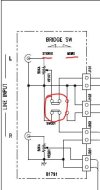
It's been over 5 years since I worked on that, and I don't actually remember. I made the note below, a screenshot of the schematic actually, that might help. Looking at that pic again makes me think that I did connect the bottom two points to the middle ones. Basically, I removed the switch and determined which way the contacts would be positioned when in stereo mode. I put the jumpers in the points that corresponded to that position. If your switch works at all, you should be able to determine that with a multi-meter or continuity tester. Also, an exact replacement was available from Parasound for not much money. I was just impatient and wanted to know if my amp to worked so I could close the eBay case.
Good luck. This has been a good amp, and I still use it daily on a pair of 4 ohm ADS M12's, which give it a workout for sure!

Schematic - Switch.JPG
 
Thanks so much for getting back with me David. Parasound no longer sells parts and the person people mentioned, Tony, doesn't have a valid email. I ordered a miniature toggle switch from Mouser but it wouldn't fit. I was unsure if I was to solder the middle together and the bottom together. It sounds like I'm supposed to put a jumper from the bottom pins to the middle pins. I just checked continuity from middle to bottom with the switch pushed to the other side. I'm going to put the jumpers in tomorrow and let you know. Thanks for the help.
 
Take a look on amazon. Seriously.....they have a bunch of switches. I think that's where I got the one for my HCA-2200.
 
Back
Top Bottom