• The move to the new server is done. There are some software and database maintenance updates in process. This has us passing the hat around to help out. We appreciate any donations. Seriously, even a dollar helps. The payment page may be found here - https://www.audiokarma.org/support.html

Issues with start and stop functionality on my Denon DP-47F

pastasource

New Member
I've recently imported a Denon DP-47F from Japan to the UK, the seller assured me that at the time of shipping, all functions worked as they should. However, upon testing it after receiving it, it appears that both the start and stop buttons are not functioning correctly. Pressing start will start the platter spinning, and it correctly identifies that I've put a 12" record on and selects the 33rpm mode, but fails to move the arm and place the stylus on the record. I can manually move it using the location buttons, and then drop it manually with the arm lift button. However, if I press the stop button, nothing happens. The platter continues to spin, and the arm does not move at all.

I've checked that the counterweight is setup correctly, so the arm is floating parallel to the platter. But, apart from this, I'm unsure of what other basic things I can check.
 
Register to hide this ad
These things can have problems with failing electrolytic capacitors, they should all be replaced sooner than later, if not you may get bad internal voltages and logic failing . Also if your transformer does not give the correct voltage control logic may fail, Japan has both 100 and 110V , are you sure you have the correct transformer . Also the Cds photoresistort cam wear out and need replacement, they control the arm
 
These things can have problems with failing electrolytic capacitors, they should all be replaced sooner than later, if not you may get bad internal voltages and logic failing . Also if your transformer does not give the correct voltage control logic may fail, Japan has both 100 and 110V , are you sure you have the correct transformer . Also the Cds photoresistort cam wear out and need replacement, they control the arm
Thank you for the response! My transformer is meant to output 100v, but it measures 116-118v, even with load. My power here is meant to be 230v (UK), however it measures 244v. Do you think this might be my issue? My transformer is the Kashimura NTI-34, so it's not a particularly high end transformer.
 
Did the seller have a warranty with the unit? Before you start working on it, I would email him or her and see if you can get the answer to your problems. Re: power supply transformers and why the turntable is acting weird.

Good luck! :thumbsup:
 
My transformer is meant to output 100v, but it measures 116-118v, even with load. My power here is meant to be 230v (UK), however it measures 244v

That's about like running the 100 volt Japanese turntable in the USA completely without a step down transformer, which in my opinion is totally unacceptable. I would consider the transformer to be defective.
 
Thank you for the response! My transformer is meant to output 100v, but it measures 116-118v, even with load. My power here is meant to be 230v (UK), however it measures 244v. Do you think this might be my issue? My transformer is the Kashimura NTI-34, so it's not a particularly high end transformer.
I am not an expert, but it may be an explaination if It worked OK in Japan. These unites are vey complex electronically. See the schematic and service manual at Audiocircuit.dk
 
I think Sleiven is right. In this turntable, three photoresistors act as optical position sensors for the automatic mechanism. They detect the various positions of the mechanism, including the start position, the end-of-record position, and the position used for record size selection.

Whenever I had problems with the automatic mechanism in this model, I usually replaced those photoresistors.

There is also a metal shutter and some LEDs inside. They should be cleaned as well. Sometimes they are covered with dust, so the photoresistors do not receive the light properly and cannot detect the position of the mechanism.

The photoresistors are not expensive, but replacing them can be a little difficult. You have to partially disassemble the tonearm mechanism, and afterward the metal shutter must be adjusted correctly.

I do not think the 240/110 V transformer is the problem. Manufacturers usually allowed some voltage margin in the original transformer in case of mains voltage fluctuations. The mains voltage itself also has a certain tolerance.

Here in Poland, I use 230/110 V transformers with Japanese turntables. The output voltage is also usually around 115–120 V, but it has never caused any problems. The transformer inside the turntable is simply under slightly more load, but that is all. It should not affect the operation of the automatic mechanism.

Also, check and adjust the stylus tracking force again. If the tracking force is not set correctly, the automatic mechanism may not work properly.
 
That's about like running the 100 volt Japanese turntable in the USA completely without a step down transformer, which in my opinion is totally unacceptable. I would consider the transformer to be defective.
My transformer seems to output higher voltages at lower loads. So, if I connect an extension lead and connect a few devices to it, I can get the voltage it outputs closer to 106-108. Unfortunately, even at these lower voltages the issue remains the same.

I am not an expert, but it may be an explaination if It worked OK in Japan. These unites are vey complex electronically. See the schematic and service manual at Audiocircuit.dk
I've managed to reduce the voltage further, and unfortunately no dice, same issue.

I think Sleiven is right. In this turntable, three photoresistors act as optical position sensors for the automatic mechanism. They detect the various positions of the mechanism, including the start position, the end-of-record position, and the position used for record size selection.

Whenever I had problems with the automatic mechanism in this model, I usually replaced those photoresistors.

There is also a metal shutter and some LEDs inside. They should be cleaned as well. Sometimes they are covered with dust, so the photoresistors do not receive the light properly and cannot detect the position of the mechanism.

The photoresistors are not expensive, but replacing them can be a little difficult. You have to partially disassemble the tonearm mechanism, and afterward the metal shutter must be adjusted correctly.

I do not think the 240/110 V transformer is the problem. Manufacturers usually allowed some voltage margin in the original transformer in case of mains voltage fluctuations. The mains voltage itself also has a certain tolerance.

Here in Poland, I use 230/110 V transformers with Japanese turntables. The output voltage is also usually around 115–120 V, but it has never caused any problems. The transformer inside the turntable is simply under slightly more load, but that is all. It should not affect the operation of the automatic mechanism.

Also, check and adjust the stylus tracking force again. If the tracking force is not set correctly, the automatic mechanism may not work properly.
The mechinism to detect the correct record size seems to be functioning correctly. If I put a 12" record on it selects 33rpm, if I put a 7" it selects 45rpm. However, it wouldn't hurt to give the LEDs a bit of a clean, just in case.

After further testing, the main issue seems to be that the expected behaviour upon powering on the turntable is for the magnets in the tonearm to engage, temporarily lifting it, before then lowering it into the tonearm rest. In my turntable the magnets engage, lifting the tonearm, but it never drops into the rest. If I manually move the tonearm onto a record, and press the stop button, it will actually bring the tonearm back to the rest, but again, it doesn't drop into the rest, and the record doesn't stop spinning.

After studying the service manual, I wonder if I could potentially adjust VR3 (lifter offset voltage) and correct the behaviour like that? The service manual mentions using an oscilloscope to adjust, but seeing as I don't have one, I'll just have to use trial and error. I've minimal soldering experience, and am not super keen on recapping myself, so would really like the avoid doing so if possible.
 
My transformer seems to output higher voltages at lower loads. So, if I connect an extension lead and connect a few devices to it, I can get the voltage it outputs closer to 106-108. Unfortunately, even at these lower voltages the issue remains the same.


I've managed to reduce the voltage further, and unfortunately no dice, same issue.


The mechinism to detect the correct record size seems to be functioning correctly. If I put a 12" record on it selects 33rpm, if I put a 7" it selects 45rpm. However, it wouldn't hurt to give the LEDs a bit of a clean, just in case.

After further testing, the main issue seems to be that the expected behaviour upon powering on the turntable is for the magnets in the tonearm to engage, temporarily lifting it, before then lowering it into the tonearm rest. In my turntable the magnets engage, lifting the tonearm, but it never drops into the rest. If I manually move the tonearm onto a record, and press the stop button, it will actually bring the tonearm back to the rest, but again, it doesn't drop into the rest, and the record doesn't stop spinning.

After studying the service manual, I wonder if I could potentially adjust VR3 (lifter offset voltage) and correct the behaviour like that? The service manual mentions using an oscilloscope to adjust, but seeing as I don't have one, I'll just have to use trial and error. I've minimal soldering experience, and am not super keen on recapping myself, so would really like the avoid doing so if possible.
No, if the tonearm reaches the rest position but does not lower, do not adjust the VR potentiometers.

One of these photoresistors is responsible for detecting the tonearm’s rest/home position. The tonearm does not lower because the turntable’s electronics do not detect that it is in the rest position.

There are two possible causes. If you adjusted the metal shutter earlier, it may need to be moved slightly. If you did not adjust it, then leave it as it is.

The most likely cause is the photoresistor responsible for detecting the tonearm’s start/rest position. I suggest replacing all the photoresistors.


Try doing a test. Remove the armrest completely. Switch on the turntable.

If the tonearm moves back and lowers beyond the place where the armrest should be, then the metal shutter needs to be adjusted.

If it does not stop, does not lower, and keeps trying to move further to the right, away from the platter, then the photoresistor is probably the cause.

The adjustment range is small, only a few degrees. However, when I set up the automatic mechanism in this turntable, this is usually enough.
 
Last edited:
No, if the tonearm reaches the rest position but does not lower, do not adjust the VR potentiometers.

One of these photoresistors is responsible for detecting the tonearm’s rest/home position. The tonearm does not lower because the turntable’s electronics do not detect that it is in the rest position.

There are two possible causes. If you adjusted the metal shutter earlier, it may need to be moved slightly. If you did not adjust it, then leave it as it is.

The most likely cause is the photoresistor responsible for detecting the tonearm’s start/rest position. I suggest replacing all the photoresistors.


Try doing a test. Remove the armrest completely. Switch on the turntable.

If the tonearm moves back and lowers beyond the place where the armrest should be, then the metal shutter needs to be adjusted.

If it does not stop, does not lower, and keeps trying to move further to the right, away from the platter, then the photoresistor is probably the cause.

The adjustment range is small, only a few degrees. However, when I set up the automatic mechanism in this turntable, this is usually enough.
I think you've cracked it. If I remove the armrest and turn it on, it continuously tries to move right, never stopping and dropping. So I'm assuming the photoresistor is the cause.

Outside of replacing them, you mentioned they could potentially get a bit dusty and need a clean? Is that a somewhat simple procedure? I'll have a scan through the service manual and see if it's mentioned in there.
 
I think you've cracked it. If I remove the armrest and turn it on, it continuously tries to move right, never stopping and dropping. So I'm assuming the photoresistor is the cause.

Outside of replacing them, you mentioned they could potentially get a bit dusty and need a clean? Is that a somewhat simple procedure? I'll have a scan through the service manual and see if it's mentioned in there.
I don't think there's a service manual for cleaning these photoresistors. They cost 50 cents each, so it's probably better to just replace them.
 
I don't think there's a service manual for cleaning these photoresistors. They cost 50 cents each, so it's probably better to just replace them.
Off the top of your head do you know where I might be able to find a guide for accessing them? Or disassembling the tonearm assembly?
 
Off the top of your head do you know where I might be able to find a guide for accessing them? Or disassembling the tonearm assembly?
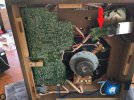
Replacing these photoresistors is not difficult. They are located on the PCB under the tonearm mechanism, from the bottom side. Here in the photo.


You only need to remove a few screws. This PCB can then be tilted aside.
 

Attachments

  • Bez tytułu dp 47.jpg
    Bez tytułu dp 47.jpg
    111.6 KB · Views: 15
Replacing these photoresistors is not difficult. They are located on the PCB under the tonearm mechanism, from the bottom side. Here in the photo.


You only need to remove a few screws. This PCB can then be tilted aside.
You're an absolute life saver, I'll have a look and see what I can do. Thank you for all your help!
 
Replacing these photoresistors is not difficult. They are located on the PCB under the tonearm mechanism, from the bottom side. Here in the photo.


You only need to remove a few screws. This PCB can then be tilted aside.
I don't believe this. I just took it apart, cleaned the photoresistors with some rubbing alcohol, and IT WORKS NOW! You're my saviour hahahahaha.

Only issue remaining is that when it tries to play 33rpm it doesn't lock with a solid green light, it flashes. 45rpm is fine, it locks in. And if I go to 45rpm, and then back down to 33rpm, it'll lock at 33rpm too.
 
I don't believe this. I just took it apart, cleaned the photoresistors with some rubbing alcohol, and IT WORKS NOW! You're my saviour hahahahaha.

Only issue remaining is that when it tries to play 33rpm it doesn't lock with a solid green light, it flashes. 45rpm is fine, it locks in. And if I go to 45rpm, and then back down to 33rpm, it'll lock at 33rpm too.

I’m glad it worked :)

Regarding the speed, there are usually two possible causes.

The first one is the motor. You can remove the motor, clean the rotor shaft and the stator sleeve bearing from old oil, and apply fresh mineral oil. This should help.

The second thing is speed adjustment. Switch the turntable to 33.3 rpm so that the quartz lock lamp is blinking. Then try to adjust potentiometer VR1 very slightly to the left or right — literally by about 1 millimeter. This should help. After that, check the 45 rpm speed as well.

Remember the original position of the potentiometer. It is best to take a photo or mark it with a pen before adjusting it.
 
Only issue remaining is that when it tries to play 33rpm it doesn't lock with a solid green light, it flashes. 45rpm is fine, it locks in. And if I go to 45rpm, and then back down to 33rpm, it'll lock at 33rpm too.
i have the same problem with mine denon dp-35f ( opened separate thread about it)....while starting it is blinking at 33, and when i press 45 and go back to 33 it locks speed? if i use carbon brush while blinking at 33, it lock speed, it looks like that resistance helps to lock speed...very strange...

everything else works fine...
 
Back
Top Bottom