sqlsavior
Lunatic Member
Recently I read a review in a high-end magazine, of some Harbeth speakers, where the reviewer compared them glowingly to his Quads:
"...a comparison not to be chosen lightly as it has the same neutrality, naturalness, musical authority, midrange beauty, and a really extraordinary top-to-bottom coherence evinced by very few dynamic speakers of any type or expense."
Wow.
My second thought was, "Oh, come on, now..."
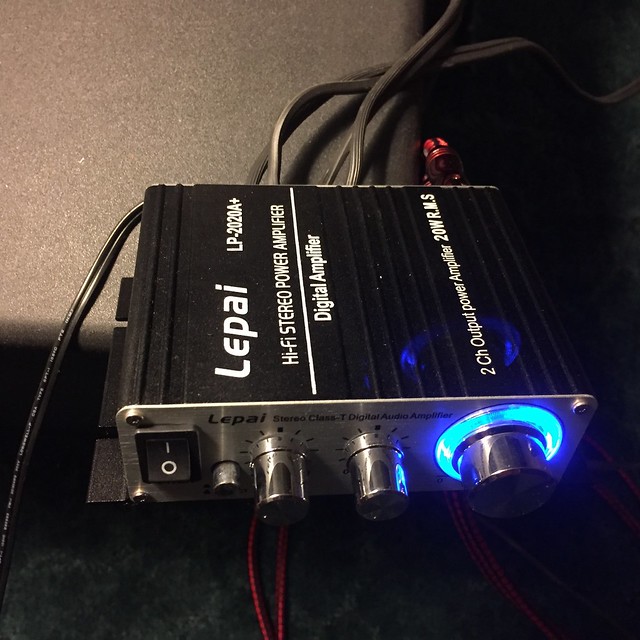
Well, I was recently re-educated, by a pair of speakers I had built in 1978, and given up for dead (actually for an excuse to get MMGs ) a few years ago. After checking them out (horrible banana connections, but otherwise OK) and hooking them up via second output of the TVC to a little Lepai LP-2020A+ (out of fear of an open connection damaging my tube amp), I was stunned at how similar they sounded.

Now, they do have what they used to call a "presence peak", that can vary from charming, to distracting, depending on the program material. But other than that, the imaging, separation, and overall tonal balance are VERY similar! [...he said as he damaged his rotator cuff patting himself on the back...]
I can't blame my Quads, nor my hearing, so I must blame my memory!

In my rush to start anew, I had forgotten how good my best "you are there" attempt sounded, and forgotten that I had heard Harbeths come close to Sound Labs in the early 80's, too. Live and re-learn.


By 1973, Small had published his sealed-box paper, but even five years later, few hobbyists knew about it. It was more like ".6 to 1.6 cu. ft.". My idea was to use a cement-column mold, made of super-dense cardboard, engineered to withstand the tremendous weight of a tall column of cement, for the enclosure. I've seen some very similar designs now that we have an internet, but thought of it independently, IIRC. I used a 6 dB/octave on top of the Bextrene 6.5" woofer, and 18 dB/octave on the bottom of the tweeters (originally rebadged Audax, replaced with Kef T27 by the friend who purchased them from me and partied too hearty with them). I remember learning that Harbeth used the same slopes, from opening them up and looking, even arguing about it with my boss, who realized I was right, in the middle of the argument.
Altogether a trip down memory lane - thanks for indulging me.
Anyway, I've ordered some binding posts, and some resistors. I have a parametric equalizer that I've never tried. And I realized I have FFT on my phone!! Who knew from Q?

"...a comparison not to be chosen lightly as it has the same neutrality, naturalness, musical authority, midrange beauty, and a really extraordinary top-to-bottom coherence evinced by very few dynamic speakers of any type or expense."
Wow.
My second thought was, "Oh, come on, now..."
Well, I was recently re-educated, by a pair of speakers I had built in 1978, and given up for dead (actually for an excuse to get MMGs
) a few years ago. After checking them out (horrible banana connections, but otherwise OK) and hooking them up via second output of the TVC to a little Lepai LP-2020A+ (out of fear of an open connection damaging my tube amp), I was stunned at how similar they sounded.Now, they do have what they used to call a "presence peak", that can vary from charming, to distracting, depending on the program material. But other than that, the imaging, separation, and overall tonal balance are VERY similar! [...he said as he damaged his rotator cuff patting himself on the back...]
I can't blame my Quads, nor my hearing, so I must blame my memory!
In my rush to start anew, I had forgotten how good my best "you are there" attempt sounded, and forgotten that I had heard Harbeths come close to Sound Labs in the early 80's, too. Live and re-learn.
By 1973, Small had published his sealed-box paper, but even five years later, few hobbyists knew about it. It was more like ".6 to 1.6 cu. ft.". My idea was to use a cement-column mold, made of super-dense cardboard, engineered to withstand the tremendous weight of a tall column of cement, for the enclosure. I've seen some very similar designs now that we have an internet, but thought of it independently, IIRC. I used a 6 dB/octave on top of the Bextrene 6.5" woofer, and 18 dB/octave on the bottom of the tweeters (originally rebadged Audax, replaced with Kef T27 by the friend who purchased them from me and partied too hearty with them). I remember learning that Harbeth used the same slopes, from opening them up and looking, even arguing about it with my boss, who realized I was right, in the middle of the argument.
Altogether a trip down memory lane - thanks for indulging me.
Anyway, I've ordered some binding posts, and some resistors. I have a parametric equalizer that I've never tried. And I realized I have FFT on my phone!! Who knew from Q?
Last edited: