• The move to the new server is done. There are some software and database maintenance updates in process. This has us passing the hat around to help out. We appreciate any donations. Seriously, even a dollar helps. The payment page may be found here - https://www.audiokarma.org/support.html

JBL 4333a/Sansui EC138

What's with the dip at ~200 Hz? The better you fill this in, the better your vocals will sound.

2241 in "Sub" cabinets (similar to JBL M-PRO) with very minimal stuffing. Look familiar?
80-pre_insulation_low_58b25cfba29f9988877df92e6decd104652f83f2.jpg


Same but "overstuffed" with fiberglass insulation. The difference in sound (~3 dB improvement through this area) is instantly notable for the better.
80-post_insulation_high_e4206444ad0a02aa29b578e5fef87e7d2a114892.jpg


More stuffing to come when the weather cools. I got lots and lots.

This is most likely attributable to the distance to the back wall of the cabinets which theoretically causes destructive interference at this distance. Maybe I'll even add a "false floor/maze" to change the rear dimension one day. JBL only rates the M-Pro (similar dimensions) up to 150 Hz.
 
Last edited:
Wouldn't this be floor bounce?
Not necessarily. I get similar with my cabinets and this is with the mic right up to the woofer (JBL 2241). When I put the mic up to the other woofer in the L200s (JBL 2235), I don't get this dip, so it is not floor bounce and not the room.

What it is is an internal reflection in the cabinet due to its depth (~29-1/2") which is roughly half the wave length. The wave hits the rear wall then reflects back, but is now out of phase. These are similar to the JBL M-Pro series and they use them as subs up to 150 Hz, so this is not an issue for them.

80-pre_insulation_low_58b25cfba29f9988877df92e6decd104652f83f2.jpg


So I tried overstuffing the cabinets to absorb this rear wave reflection interference and it did help the profile reducing the dip by ~3 dB. Note that overstuffing a cabinet would typically kill the higher end rather than boost it, but if it is mitigating an unwanted internal reflection, this can happen. I may even try more stuffing.

There is also the possibility that a panel may be absorbing this energy. In my experimentation, I put >100 pounds of water bottles on the cabinet and could see no appreciable change in the curve. The OP could try rerunning the curve but with the mic right at the woofer cone to see if this is an issue here.

80-post_insulation_high_e4206444ad0a02aa29b578e5fef87e7d2a114892.jpg
 
Last edited:
Hi @Oyster150

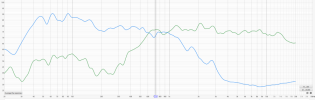
Thanks for the pic showing the individual responses ( woofer + horn/driver combo ). It's most enlightening!

Here's your pic again ( reformatted & enlarged for analysis > though the horizontal db lines are still hard to see > they are 5db per line ).
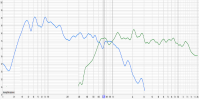
oYSTER_SPEAKER_trimmed+reformatted.png

A few things come to mind;

i) Yes, the 1-3K (+5db ) bulge is baked into your horn/driver combo. It shouldn't look like that.
- You'll need to investigate why that's happening.
- It's possible your le85's have compromised HF response ( perhaps, due to crumbling foam touching/damping the diaphragm and reducing HF response above 3K ).
- I would run another sweep of that driver/horn combo from 1/2 meter ( on axis ) without the lense and without the crossover in place. A raw sweep of that combo should look a lot smoother than what you're showing. Set your sweep to start at 300hz at a moderate ( listenable level > such as 80db > assuming you have a USB mic that also tells you db levels ). Post the results here.

ii) Also, I see that you do have too much overlap between the individual woofer and horn sections. I somewhat expected that the woofer would be reaching up higher than intended, based on info about your stated preferences. I'll suggest going back to the lowpass curve that actually matches the Nelson Pass lowpass. I'll post that schematic later ( after you've solved//discovered the reason for the rough response of the horn-driver combo ).

iii) Your horn-driver combo ( with it's Hi-Pass in place ) goes down lower ( to @ 550hz for a minus 3db point ) compared to what Nelson Pass intended with his reworked crossover ( at @ 700hz for a minus 3db point ) . After a couple of days looking for reasons, I tentatively settled on the most unlikely factor for the error.
It now seems to me that N.P. redesigned his L300 crossover for either a re-diaphragmed le85 ( sporting either a D16R2421 or maybe even a D16R2425 diaphragm ) or possibly a complete replacement driver ( and he's not aware of this substitution ) .
- FYI, JBL somewhat "tightened" up the suspension of their small format drivers when they moved to their patented diamond surround ( vs their older "tangential/swirl" surround ).
- The difference in surround types does /did change the lower end performance of these drivers.

Here's a comparison of the raw response of the two driver/diaphragm types ( on the shorter 2307/H91 horn ).
FYI, the 2312/H92 only adds a smidge more LF extension. ;
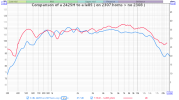
Comparison of a 2425H to the le85  on 2307 horns without the 2308 lense.png

When I plug in the blue trace ( which has the diamond surround type diaphragm ) into XSim ( using the LC values for the Nelson Pass Hi-Pass ), I get the projected 700hz crossover point. The red trace ( le85 with older tangential surround diaphragm ) gives a much lower ( somewhat > unworkable ) crossover point.
- Unfortunately, N.P.'s Hi-Pass can't be reformulated to use different LC values to raise up the Xover point ( because of how's he's laid out << & isolated >> the LC parts ).
- You might try substituting in, one of your older 2425J drivers ( if you still have them ) // and then rerun a horn sweep with the Hi-Pass in place to see if the crossover point climbs up from 550hz to @ 700hz ( as was intended ).

Here's Nelson Pass's reworked L300 showing the individual ( smoothed ) responses of the woofer and horn driver sections ;
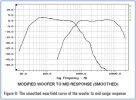
JBL_L300 NelsonPass LP+Horns-HP_2026-09-08_.png


EarlK
 
Last edited:
As a newcomer to this thread, I did not read thru the whole of the commentary. The biggest problem with this speaker is the use of the 2307 horn in combo with the 2235 woofer. The cutoff of the 2307 is 1.2 kHz. That is too high for the 2235. The 2312 horn is what should be used in this speaker system.
 
As a newcomer to this thread, I did not read thru the whole of the commentary. The biggest problem with this speaker is the use of the 2307 horn in combo with the 2235 woofer. The cutoff of the 2307 is 1.2 kHz. That is too high for the 2235. The 2312 horn is what should be used in this speaker system.

Since April of this year ( 2026 ), Oyster150 has been using a 2216nd woofer, le85 on 2312/HL92 and 2405/077 tweeter in custom L300 cabinets, along with a modified LowPass section of the Nelson Pass crossover ( due to the 2216nd substitution of his 2235's ).

Currently, the N.Pass crossover is in the process of being tweaked even more to address a1K-3K problem ( a +5db bump ) plus some ( possible ) roughness in the woofer-2-horn, crossover area.

So far, this has been a 3 year project.

;)
 
Back
Top Bottom