• The move to the new server is done. There are some software and database maintenance updates in process. This has us passing the hat around to help out. We appreciate any donations. Seriously, even a dollar helps. The payment page may be found here - https://www.audiokarma.org/support.html

JBL 4367 Am I crazy or stupid?

^^^ THIS. Can't emphasize that enough.

The actual crossovers themselves, can ALSO BE the EQ circuit, in some cases. Changes in the damping (the shape of the rolloff curve), and even slight gaps or overlaps in the crossover frequency (which JBL did a LOT) can change the electrical response curve to the drivers drastically, and make the crossover extremely "non-textbook" and hard to duplicate without some sophisticated DSP or the like.

I have personally done these tricks, with damping and overlap/underlap, to great results in speakers I've designed. Got a midrange with a rising response with frequency (the high end is higher output than the low end)? Use a high-Q highpass on the bottom (to add some energy in the midrange lower end), and a very low-Q lowpass on the top (to reduce the energy at the top end), overlap the midrange crossover frequency slightly with the woofer (so they "add" more), and under-lap the midrange crossover frequency with the tweeter (to "subtract" a bit). Turned out very well... and technically, no EQ involved. The circuit is no more complicated than a normal textbook crossover, but it does some things significantly differently!!

Regards,
Gordon.
 
Last edited:
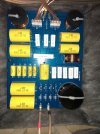
The crossover can make all the difference in the voicing.

I designed the crossover for the Mermans for the sweet spot in the room in which the speakers occupy and they are voiced accordingly. In a different room...

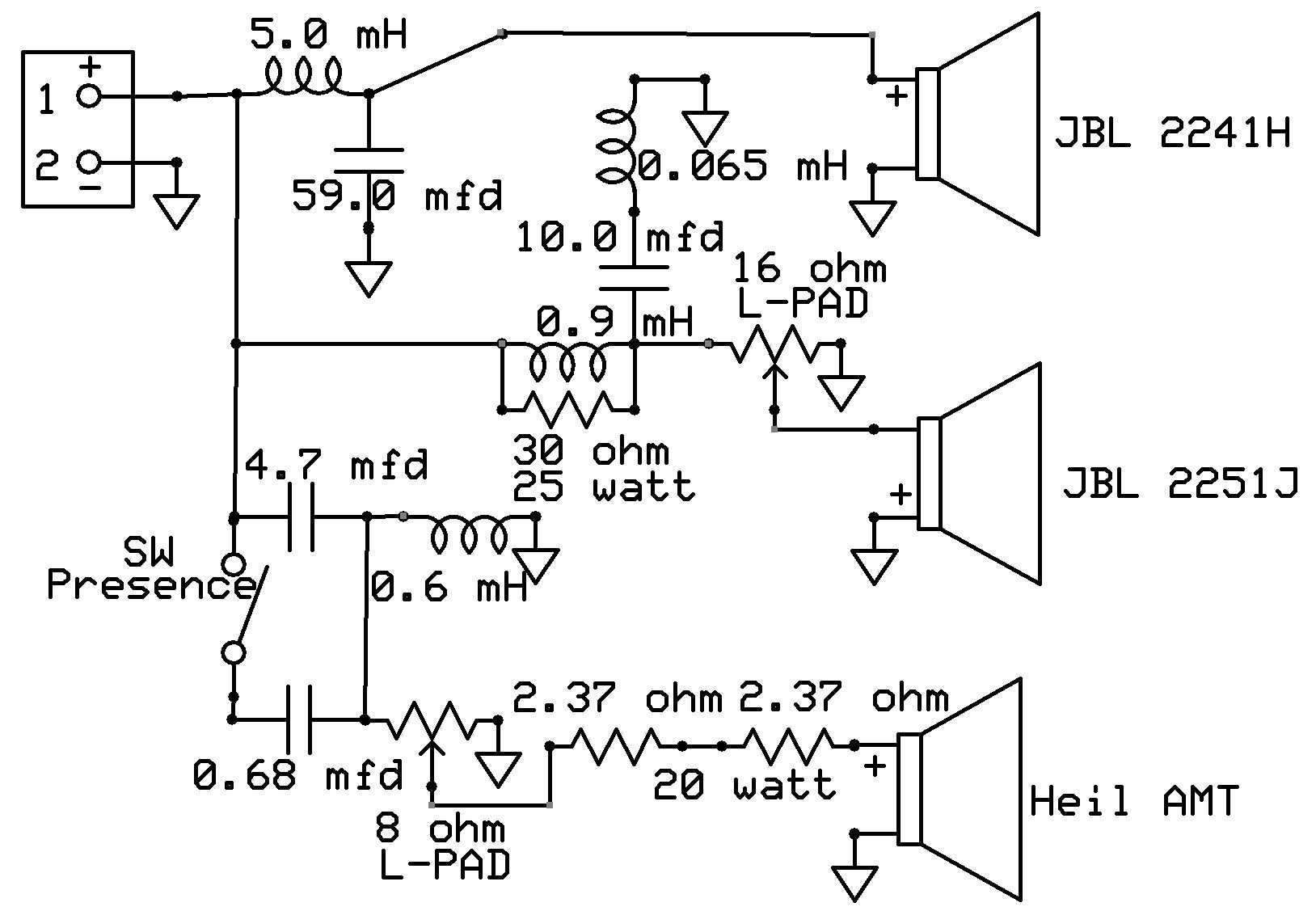
Note how the midrange circuit provides voicing for the 2251.


Somebody say dynamics?

80-screenhunter_458_sep_10_12_28_8d1b83abdbd81e33b23359439952b3d77dcf0853.jpg
 
Last edited:
index.php


I'm suprised that the caps are rated at such a low voltage and the resistors at such a low wattage. Does this change from standard practice in a charge-coupled network???
 
index.php


I'm suprised that the caps are rated at such a low voltage and the resistors at such a low wattage. Does this change from standard practice in a charge-coupled network???

IIRC, It's charge coupled- so many of those caps would be in series, as far as the signal is concerned. Double the voltage rating, that way.

Regards,
Gordon.
 
IIRC, It's charge coupled- so many of those caps would be in series, as far as the signal is concerned. Double the voltage rating, that way.

Regards,
Gordon.
Even at 200 volts..., isn't that fairly low for such a high-wattage rated speaker? I use Audyns rated at 400 volts and Solens and Clarity Caps rated at 630 volts, and those are considered as "low end" "high end" pieces.

I remember someone on this forum running the calculations and the ratings on the caps, which are in volts dc, need to be much higher than the input voltage.

I was thinking maybe something about charge coupling, beyond simple "series coupling" occurs. :dunno:
 
600W into the HF seems like a lot.

Even though the HF section will never see that- probably won't even see 10% of that- at least the first caps in the highpass, will see a voltage differential of essentially the entire AC voltage coming from the amp, across the caps, as they filter out the LF information. This means that at least the first cap in the chain, must be rated at the full output voltage (i.e, voltage at max power) of the amp, at any frequency. So, they potentially will still have issues at above 600 watts input, no matter what the frequency.

Regards,
Gordon.
 
Then perhaps that’s why they’re rated for “Maximum recommended amplifier power: 300 watts”. I can tell you that they’re painful below that point.
 
It's not like you need THAT much power, with a speaker that's as efficient as this. With 300w, the dynamic range is probably pretty incredible.

Regards,
Gordon.
 
It's going to start hurting above 30W
Exactly this. I’ve played mine well above the 45W mark, no peaks hit the 450W mark but around mid-point, and they were painful. 94dB sensitivity and drivers designed for high-SPL without compression, you need to be in a large room to be far enough away to be running even half of their rating in peak output. A lot of speakers tend to compress those peaks so you don’t hear them even though the amp is putting out the power.

White Paper:
 
The crossover can make all the difference in the voicing.

I designed the crossover for the Mermans for the sweet spot in the room in which the speakers occupy and they are voiced accordingly. In a different room...

Note how the midrange circuit provides voicing for the 2251.


Somebody say dynamics?

80-screenhunter_458_sep_10_12_28_8d1b83abdbd81e33b23359439952b3d77dcf0853.jpg
Very nice setup!

Crossover designed to meet the characteristics of each driver and blend the spectrum as seamless as possible --- makes all the difference in the world. :)
 
Lobing
Probably, and maybe much to be lost in the way of soundstage and imaging. And these speaker are really not great at imaging to begin with (Stereophile Magazine testing).
Lobing
Just joined the forum and saw this post.

Agreed about the lobing and some undesirable cancellation effects with stacking the JBL 4367 speakers. I remember back in the 70's it was popular to stack Advents.
Doubling up on cheap woofers and tweeters never made sense to me unless the only goal was just to be able to handle more power and play the system louder.
IMO the OP would be better off getting a pair of Everest's 66000/67000's on the used market. I used to have a pair and they are clearly better overall than the 4367's.

Owning a pair of 4367's I disagree about the imaging. They don't image like most small cone direct radiator speakers that Stereophile mostly tests and are therefore used to listening to. The 4367 with it's large 15" woofers and large format horn have much lower surface loudness. I find they more accurately portray the size of instruments that also have low surface loudness, like a piano or harp for example. It could be argued that unless one was at the recording session it can't be said with any certainty what correct imaging is.
 
Agreed about the lobing and some undesirable cancellation effects with stacking the JBL 4367 speakers. I remember back in the 70's it was popular to stack Advents.
When I stack speakers, I flip the top one so its tweeters are closer to the bottom ones. It helps maintain the imaging.

ca7498b2-6910-4866-9b04-d0e8d9c9f34a.jpg
 
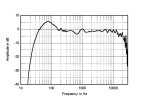
Wiring in series means the amps internal source impedance has no control over the woofer resonances. That only worked with woofers in parallel. Plus one speakers is not in sync with the second speaker in series as it recieves it signal behind the first speaker. Then to the resonances of one speaker will effect the other speaker in series. So wire them in parallel. JBL of that type are fairly efficient so your amplifier should not be overly stressed. Just keep an eye on the heat sinks and if the temps go much past 100 degrees then its either add whisper fans or up grade your Power amplifier. As you can see by this test curve whether you have 2 or 4 of these speakers careful room placement is going to be necessary to correct the bass bump. Other wise its close to a corner for better bass extension and digital equalization to smooth out that hump in the bass response. Everything else above 150 HZ or so is perfect. JBLfig4.jpg
 
Last edited:
Back
Top Bottom