• The move to the new server is done. There are some software and database maintenance updates in process. This has us passing the hat around to help out. We appreciate any donations. Seriously, even a dollar helps. The payment page may be found here - https://www.audiokarma.org/support.html

JBL Dynamics Project - L200 box, 2216ND/Smith Horn/2405 Slots

Emma's away playing pool (her tuesday recreation) -
and its in the high 40s out back, so -
the Kitchen counter will do fine for a standup workbench!
Tools all assembled. Old Mousepad under the driver
2445-begin-_8701.jpg

Never did diaphragm replacement in a large driver before!
I'm doing one driver at a time, so I can A/B between L&R horns.
Peeled the rubber surround off, took off the 3 screws, plus the screws for the Black & red terminals.
How do you get the cap off - its on pretty solid!
Tapped it lightly with a wooden mallet (crab tool!) then lightly tapped on a putty knife to pop off the cap.
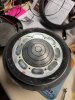
The old diaphragm is revealed - dated Aug 6, 1988 - 34 years old! Looks like titanium!
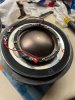
2445-Old-diaphragm_8705.jpg

Darned - you can see where I touched the foam in the cap and it compressed -
and its all soft and rotting ... its bad and its got to go!
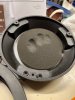
2445-DeadFoam_8704.jpg

I pulled all the bad foam out, then took the cap out back and washed the residue off with solvent.
I thought I had some sheet cork somewhere - but couldn't find it. No felt either. So, we'll try without anything in the cap.
Got the new diaphram in place and ready to reassemble.
Used a tone generator on my iPhone for 200Hz tone, with a lepai amp - no buzzing I can hear.
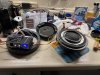
2445-new-phragm_8706.jpg

More pix in a bit ...
 
Last edited:
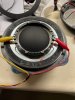
Since I've been down the road with L200s with walnut horns and 2445j drivers,
I'm kind of figuring they'll be a final set of speakers for me, and I can dabble
with the gear feeding them afterwards.
Since I already have a pair of Nelson Pass style passive crossovers for L300 Summits (untouched),
my thought is to set up the speakers with those passives first.
I already have the 4 lPads and 8 dual 5-way banana connectors to do so, and I
plan to build the passives into external cabinets so I can easily modify or bypass them.
The boxes can sit under the horns and support them.

I'm collecting info on the BSS digital processor as well as the dbx gear yesterday - a Harman company! :D
Apparently the DriveRack 260 might be a possibility ... if I decide to go with biamping ...

I have tried several methods of biamping with Class A, A/B. D amps, tube and solid-state, with passive crossovers in place and without, DSP and analogue, pro and consumer, even vintage active crossovers.

They are all quite fiddely.

Whether this is a good thing or not is a matter of personal preference, I'm going to guess from the scope of this project that you like fiddely.

If so you will want to eventually use DSP-type crossover pre-amplifier with a calibrated mic and drive your speakers directly (2-in 6-out DSP minimum, one out for each driver) so that you can do all of the shaping, phase correction, room correction, EQ all in one unit using your mic input at different points in the room and even have different programs for high room-load of people vs one listener, maybe even for different musical tastes. I love this option, and have different programs also for different speakers and for using a single passive crossover and only 2-channels of amplification.

The crossover that you have is an interesting one, but I'm sure that you know it's a pretty simple design with band-pass and little shaping, plus designed for a different horn. I did my time in filters professionally, there is a crap-load more than I'll ever know involved in audio crossover / filter-network designs, I decided to go the DSP route and let the electronics do all of the work and I just tell it what result I want. If you had stock passive crossovers and can simply use a driverack type solution that chooses the crossover frequency and gain of each element that is a fairly safe way to go. This way the shaping is already built-in as well as phase-correction.

In a full-on DSP setup you can change the type/slope/frequency of crossover, the overlap, the attenuation, phase-correction/delays, response curves, EQ some of the room artifacts / room-correction, really a lot of fun. Some also have limiters you can set for each input/output.

You can't fix bad design with a DSP bi-amp/tri-amp setup, but just about anything else can be balanced and tailored to create an excellent result.

Some might have a hard time with the D part of DSP, ... not me.
 
I've now done the second one, and cleaned the kitchen counter.
Its beer o'clock, time for a Guinness and some tunes!

They call it a 2" driver, but the diaphragms are HUGE!
2445j-diaphram-measured_8702.jpg
View under the diaphragm - showing the grove for the voice coil
and the phase plug the sound goes through.
(The dome faces into the back cap)
2445j-phasePlug_8709.jpg
test leads while I played a 200Hz tone to be sure it was centered
as I tightened down the 8 screws.
2445j-TestTone_8711.jpg
 
Last edited:
I'm a big fan of the BSS366T units as being the best of breed / best sounding along with the XTA units but a bit of a caveat is that the software is pretty ancient by now. It was cranky to make connections when I had Win 95 running on my Mac virtual machine and it gets a little harder to connect with each new version of Windows. Have yet to try with Win 10 and my last two BSS units are about to be sold off so probably never have a chance to try. In the end it was easier to buy cheap Windows laptops off ebay to talk to the DSP units than to talk to them with the Macs with virtual machines especially with the added layer of USB to serial port connection needed for the older devices. Another caveat with the BSS366s is that the displays are unobtainium and are among the first things to go out on units that have a lot of hours so the computer software is the only way to talk to them at that point..

I've never been a fan of the dbx crossovers since a demo unit failed rather dramatically a decade or more ago. The digital crossovers I've found to be most reliable over the years have been the Ashly Protea 4.24C or D models. Same units just that the D has no front panel controls. Easy to use software ( especially compared to even a well behaved copy of the BSS software ) and pretty widely available on ebay.

...


I'm collecting info on the BSS digital processor as well as the dbx gear yesterday - a Harman company! :D
Apparently the DriveRack 260 might be a possibility ... if I decide to go with biamping ...

View attachment 2690924
 
Last edited:
I love the XTA Audiocore software, but the units 2x6 and up are getting scarce. I have a DBX 360 for backup if/when the XTA goes down. I also have an older Ashly 3.24, but never deployed it in a full system.

I wouldn't mind a passive approach, but have as good a chance of building a space shuttle as a 3 way passive with the little tweaks I worked into the active I like now - I went through several iterations getting to this one.

I would like to give BSS Blu a whirl, they cost more than the XTA
 
Never did diaphragm replacement in a large driver before!
I'm doing one driver at a time, so I can A/B between L&R horns.
Peeled the rubber surround off, took off the 3 screws, plus the screws for the Black & red terminals.
How do you get the cap off - its on pretty solid!
Tapped it lightly with a wooden mallet (crab tool!) then lightly tapped on a putty knife to pop off the cap.
The old diaphragm is revealed - dated Aug 6, 1988 - 34 years old! Looks like titanium!
View attachment 2690990

More pix in a bit ...

Hi,
Interesting.
These are the old dia why you want to change them they look good to me visually?
But for the old foam replace it with felt.
When they talk about 2in it's for the throat, the dia are 4in and that's all the difference in my opinion some like me like these drivers.
Now JBL has gone to 1I/2in throat and smaller dia with double coils which respond higher and therefore allow the tweeter to be eliminated in the config, it is also the advantage of the best frequency response in the upper midrange of the 2216ND which allow this match. For my part my 2450 (it's the same as a 2445 except that the magnet is neodynium) are matched with Smith Horns and I'm very happy with the 2405 tweeters, think you're in a house then the 2360 is not for you I know I tried unless you like having that in your face.
And for this kind of system I can only recommend the use of a DSP, it seems more complicated but in fact it is really simpler and especially really more effective to correct many things that a passive cannot do
IMHO
 
The 34 year old diaphragms were noticably harsher, especially with sibilance.
Uncoated titanium, strong, but harsh in the home.
My friend said the new coated diaphragms would be warmer - and to me, I agree.
They are not harsh at all, I only hear sibilance with really bad recordings.

My initital build will be with the passive 3 way I already own.
I've got 2 nice amps I can use if I go active 2 way later ...
The listening will make the call.

Hi,
Interesting.
These are the old dia why you want to change them they look good to me visually?
But for the old foam replace it with felt.
When they talk about 2in it's for the throat, the dia are 4in and that's all the difference in my opinion some like me like these drivers.
Now JBL has gone to 1I/2in throat and smaller dia with double coils which respond higher and therefore allow the tweeter to be eliminated in the config, it is also the advantage of the best frequency response in the upper midrange of the 2216ND which allow this match. For my part my 2450 (it's the same as a 2445 except that the magnet is neodynium) are matched with Smith Horns and I'm very happy with the 2405 tweeters, think you're in a house then the 2360 is not for you I know I tried unless you like having that in your face.
And for this kind of system I can only recommend the use of a DSP, it seems more complicated but in fact it is really simpler and especially really more effective to correct many things that a passive cannot do
IMHO
 
The 34 year old diaphragms are not "broken" but they are harsh and hurt my ears.
They were designed for long life in a pro or club environment, not my home.
I can certainly hear the difference and will never use the old ones in my home.
 
Another satisfied 2445 owner LOL

The 34 year old diaphragms are not "broken" but they are harsh and hurt my ears.
They were designed for long life in a pro or club environment, not my home.
I can certainly hear the difference and will never use the old ones in my home
.
 
Okay, had a day before the rains, so I figured it might be a good day to cut the boards for making up the Passive crossover boxes.
(I know, if I go active I can sell them off - but since I already bought them, seemed I may as well set them up to try out)
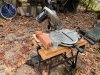
I hauled the shopmate up from our shed and set it up under the magnolia tree.
Then hauled the Delta Mitre saw from the shed as well, dropped the board I made holding it into place and clamped it all down.
(I have a table saw that also fits into the shopmate, but the mitre saw seemed best for this work.
- I've got no garage, got no workshop - the best I can do is simple woodwork on clear days.
AND - I am certainly NOT a woodworker in any sense of the imagination -
but - I still got all my fingers!

Shopmate-Saw_8798.jpg

Anyway, I figured a box 18 x 10 x 3" tall would be fine under the horns - and provide nice support for them as well.
I marked off a couple of the 6' 1x3 poplar boards I got the other day, cut 4 18" long piece for the front and back panels,
then cut 4 10" pieces for the side panels.
Took them upstairs to see how they'd look dimensionally, relative to the horns.
Box-18wide_8799.jpg

Nah - once I set them up on the horns I decided I'd prefer a bit narrower box -
so I took them back outside and whacked 2" off each of the long boards -
cut them down from 18" to 16" - I think visually a much better fit!
Box-16wide_8800.jpg

Gotta drill holes on the fronts for 2 lPads (Mid and Hi freqs), and holes for the inputs,
and the 3-way output pairs (5-way banana type jacks).
Once that's done I can stain them, glue them together with some brads to hold them tight,
then mount the hardware, and wire up the "Nelson Pass style L300 Summit crossovers."
I've got some thin masonite panels I'll cut for box tops and bottoms.
And some rubber isolation feet I can put top and bottom.

Again, I may wind up going active biAmp or triAmp, but, I already bought these crossovers,
and they'll sell better in nice finished cabinets than they will loose ...
Box-crossover-LPads_8803.jpg

But the outdoor woodwork part is done!
 
Last edited:
Used some paper to mock up the front and rear panels of the crossover box. Taped it to the boards and used a center punch (from my old days as a machinist)
to transfer and mark where to drill on the wood. Drilled and lightly sanded the boards, then stained the poplar with some MinWax Colonial Maple stain
since it looked to be a reasonable color match to the wood horn color. After it's had some drying time, I'll do a second coat of stain to even the finish up.
Once THAT dries I'll brush on a coat of MinWax polyurethane sealer.
After THAT dries, I can glue and pin the corners together, and then start assembling the crossovers in the box.

IMG_8806.jpeg IMG_8807.jpeg
 
Had some paneling from old shelves so I cut 10 x 16 pieces for the bottoms,
and glued rubber feet from isolation blocks in place.
These boxes will live under the wood horns, and also support them
(and replace the ugly silver foil/foam I'm using temporarily now).

I'll make similar top/lids as time allows. Letting this all dry overnight - ugh, the Fumes!
I'll run around the bottom edges with a router to trim the panelling.

Box-bottom_8809.jpg
2-boxes-built_8811.jpg
 
Did some more mocking up/dimensional checking on the crossover box.
Damn - I made the box too deep - should be 6-7 inch deep,
and not 10 inch deep, to better fit under the horn ...
The raised lip for the horn adapter limits how far back the box can go,
and that moves the driver back further than I'd like.
Ah well, don't want to take it apart and recut the side panels now ...
... and yet ...

Crossover-horn-Mockup_8813.jpg
 
Last edited:
Yep - after more thought, I did some measurements and decided to downsize the boxes after all.
Took a small hammer and knocked them down/apart, setup the mitre saw under the magnolia again,
Measured and marked the wood 3 inches shorter, then made the cuts.
I also grazed the other end of the sides with the saw to get a fresh glue surface for reassembly.


MitreSaw-setup_8825.jpg recut side panels on Horn_8828.jpg
 
Cut them down and glued them all back together with little brads to pin it all in place.
Waiting for a router bit with a bearing at the end (Amazon), so I can run it around the bottom edge, to cut off and trim the wood panels I glued/pinned to the bottom of these crossover boxes.
Tomorrow, once its all trimmed and dried, I can assemble all the input/output jacks & the LPads,
and solder it all together into the crossover boards.
(I built the boxes in mirrored config so the 3-way output lines would be away from the listener).
Mockup pictures.

Boxes built on our laundry room workbench
crossover-boxes-reduced_8829.jpg
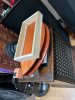
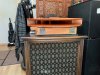
Overhead shot to show layout, set on the horn to show relative size.
cbox-mockup_8836.jpg
Box under the horn to show the design concept.
cbox-mockup_8838.jpg
 
Last edited:
Final mockup complete, parts fit checks out.
Now all that remains is the final assembly and solder work.
Off to church and afternoon church board meeting (Pastor's wife gets an invite & must attend).
Project will continue Monday ...
cboxes-final-Mockup_8855.jpg
 
Back
Top Bottom