• The move to the new server is done. There are some software and database maintenance updates in process. This has us passing the hat around to help out. We appreciate any donations. Seriously, even a dollar helps. The payment page may be found here - https://www.audiokarma.org/support.html

JBL L100 restoration and upgrade

I ended up just replacing the 3uf tweeter cap and left the chokes in place.
Is there a SIMPLE "better" alternative to this original crossover or will a swap to a capacitor change the original voicing?
I saw these pics in another thread, and I still find this x-o confusing. The early (vertical) L100 used a different tweeter (LE20-1) along with a 1.5uF cap, so I'd suggest that you just might be affecting the tonal qualities as well as jeopardizing the tweeter by using a larger value cap thus lowering its x-o frequency. Additionally, your pics show at least three resistors while the schematic shows only two. Attached is the schematic for the first version of L100.

(Edit: Attached schematic has been corrected thanks to comment in post #62.)
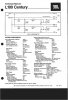
L100 v.1.jpg
 
Last edited:
I saw these pics in another thread, and I still find this x-o confusing. The early (vertical) L100 used a different tweeter (LE20-1) along with a 1.5uF cap, so I'd suggest that you just might be affecting the tonal qualities as well as jeopardizing the tweeter by using a larger value cap thus lowering its x-o frequency. Additionally, your pics show at least three resistors while the schematic shows only two. Attached is the schematic for the first version of L100.

You didn't attach the first version, you attached the 3rd version.
 
Your looking at ONE crossover. There is one cap and 2 chokes per cabinet.I left the chokes and replaced what i thought was a 3uf which actually should be a 1.5.

Can someone explain why the mid uses coils rather than caps?
 
There are two caps and two chokes per cabinet, not to mention the fixed and variable resistors. See below.

The mid range network has a 4 µF cap in series with the driver, and a 1 mH inductor in parallel. Together they make a 2nd order electrical high-pass filter. SaturationPt said the same above, but with different words.

The tweeter network is similar, but with a 1.5 µF cap and 0.3 mH choke.
upload_2019-3-19_11-14-12.png
 
There are two caps and two chokes per cabinet....
Yes, this is exactly my point, and thanks for providing a more readable version of the schematic that I showed in post #61.

I found this all really confusing but now this pic I found explains things much better - - - it shows the early version crossover LX12-10. Both inductors and the large cylindrical cap were immersed in the wax tub, while the second cap is tucked tight next to the terminal strip, similar to the two fixed resistors. Both caps (1.5uF and 4uF) should be replaced.

JBL L100 v.1 crossover.jpg
 
Just to be clear about something. The Murphy crossover mods do not totally change the sound of the L100. Rather, from my listening experience, it tames some of the rougher edges of it's sound. As I stated before, the woofer has no crossover at all, meaning it can and does extend up into the midrange frequencies. Well, there's a midrange driver that's there to perform that role. The same goes for the mid, there is nothing to limit how high it goes, and there's a tweeter there to do that. See what I mean?

Lee.
 
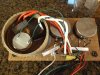
This crossover has a single cap as shown in my pics
Your pics in post #60 show two caps, not one. http://audiokarma.org/forums/index....ation-and-upgrade.349002/page-3#post-12562884

The first photo shows a cap above & between the two inductors. It's shiny metal. Maybe the yellow cover got removed.
index.php


The third photo in post #60 shows the other larger cap still inside the wax filled cardboard tube.
index.php


This next photo from ra.ra (post #70) shows both caps in their original locations. The large cap is inside the cardboard tube, and the small cap is the yellow thing on the right side of the bottom edge of the board.
index.php
 
Last edited:
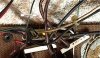
By posting the pic of original (early version) crossover in post #70, here is what I meant to point out: While I had originally thought there were three fixed resistors in that tangle of wires, I now think the third item (yellow?) might in fact be the second capacitor which would confirm the full list of original crossover components - - - (2) L-pads; (2) inductor coils; (2) fixed resistors; and (2) capacitors. Could you show a close-up pic of this component from either of the crossover boards?

L100 v.1 x-0 enl..jpg
 
By posting the pic of original (early version) crossover in post #70, here is what I meant to point out: While I had originally thought there were three fixed resistors in that tangle of wires, I now think the third item (yellow?) might in fact be the second capacitor which would confirm the full list of original crossover components - - - (2) L-pads; (2) inductor coils; (2) fixed resistors; and (2) capacitors. Could you show a close-up pic of this component from either of the crossover boards?

View attachment 1454347
Now I see why you said you were confused. So am I.
 
I never understood the popularity of these speakers. I worked for one of the largest JBL dealers in the South West during this speaker's heyday in the mid/late 70's. We literally sold thousands of JBL's in an average year in our 5 locations. The consensus of our staff and myself was this speaker had strong but very peaky bass, an average at best mid-range and highs that could take the chrome off a bumper. None of the staff actually owned L100's. To put it another way when we were listening to music just for pleasure in the store this speaker was never turned on. Never. And certainly nothing against JBL's in general as we stocked most of the non-pro line and our demo L300's were played often. A far better JBL of the period, to my ear anyway, and at roughly the same price point and size was the L166. Several of our staff owned these.
 
IMG_1966.JPG
Me trying to get my L100's to sound like my L300's. My Onkyo TX-NR1000 receiver pushing the L100's. Plus a Yamaha m-65 powered JBL 4642. Almost but still not L300's.
 
That's a tough requirement. When the L100s were new and the L166 came along I never really felt that the bass changed that much, but the HF did. Comparing my L100As to my L65As there is a complete shift in how the 077s handle HF compared to the L100's LE25, ... you're expecting a lot to get clear HF, MF, and the bass of a large-cabinet 15" woofer from a bookshelf speaker a couple of generations earlier with cone drivers!!
 
Back
Top Bottom