• The move to the new server is done. There are some software and database maintenance updates in process. This has us passing the hat around to help out. We appreciate any donations. Seriously, even a dollar helps. The payment page may be found here - https://www.audiokarma.org/support.html

JBL L100a

hifijohn

Active Member
One of the speaker I have always wanted since high school was the infamous jbl L100.well I
got my wish a few days ago when I found a pair for $40 at our local resale shop. the chezzy waffle
grill was gone but the speakers were in good shape, I would never spend that much money on a JBL speaker
but for nostalgia I had to plus I can resell it for ten times what I paid for .connecting them up was a chore, they were made at a time when people just went down to their local hardware store and bought
some cheap zip cord.the posts were difficult to use and only accepted the thinnest of wire.another odd
thing is while the speakers are usually placed vertically, the name plate and controls are mounted horizontally..???
I would grade the sound as "70's high school hifi".very punchy bass a rough midrange and cheap treble.they
sound fine played low (many speaker do)but turn them up and they get annoying very fast, every
vocal ,especially female, had a very annoying glare to the sound .I suppose this is the famous
west coast sound people keep talking about.the deep bass isnt bad , they have a noticable bump around 75 hz, this is either intentional or a badly tuned port.
they do love drums , any song with a good drum recording sounds good you can literally feel the
kick and snare in your chest! and you can turn them up to very loud levels and the bass never
gave out and stayed pretty tight.Now I realize this is a 40 year speaker so I shouldnt be too
hard, I have heard many speaker from that era and they didnt sound much better and many sounded worst!.I spent the
better part of today listening to music and I could not get through a single song, the problem
Im guessing is in the crossover , the woofer and the mid have no high cut filter and the
rest are just 6bd/octave.considering these speaker sold for over $500 back then JBL
should be ashamed of themselves for the poor crossover design, you never allow a woofer to
natural roll of.I learned that back in high school when I started building speakers,I played some of my
multi track recordings and was surprised they did a very nice job creating a soundstage,better than
some speaker costing ten times as much!the true acid test for speakers is some of my
"audiophile' grade binaural recordings I have made.they actually
didnt do a bad job, the soundstage wasnt great but it wasnt bad either.overall I would say great
for nostalgia only, I think I will use one of them for a speaker for my bass guitar, Im using
a rockfor/fosgate now which is amazing but no mid or treble, they should sound good but the
woofer is very floppy and I dont want to damage them because of the high resale value I may
cover up the port to dampen the woofer.
 
Register to hide this ad
Stuff the port and see how that sounds/feels for you. The midrange and tweeter are what they are, an acoustic reproduction of the then prevalent Altec 604 style Co-Axial and tri-Axial speakers that were used in recording and cinema during the 60's. JBL's design mandate were to re-create that sound in both a large version (the 4320) and a smaller bookshelf size (the 4310/4311/L100. They succeeded mightily in the professional realm, especially with the advent of multitrack recording and monitoring for some, and replaced the bulk of Altec's installations (older speakers, a botched replacement, and the need for some for smaller monitoring speakers or multiples of them) in recording studios. The Altecs had the same midrange issues and a peaky but top end rolled off treble, but was well known to engineers of the day and was the reference till something else came along.

The crossover design was and is a relatively simple design, using minimum # of components to enhance efficiency and sensitivity due to lack of watts till SS amplification caught up. Acoustically, it gave the JBL designers and users what they wanted to hear at the time. Crossover design then was still more art than science, as was T/S parameters and driver design and measurement, T/S only slowly reaching a worldwide knowledge point in the mid and late 70's. You are looking at a 70's design from a 1990's-2015 point of view. Lots of speakers of that era used very little filtering on the woofers (partly because of the cost issues), but JBL decided the 123a woofer worked acoustically in this manner. You can view the evolution of this type of design in the 4311,A-D, 4312A-D, and the 441x series, and the similar L96/L112/L166 consumer models, all becoming much flatter, crossover drivers much more sophisticated, and still maintaining high sensitivity and power output for the professional use of Studio and Control monitors. If you wanted to explore a "better or modern crossover" see the Troels Gravesen modification:
http://www.troelsgravesen.dk/JBL_L100.htm

If your woofers are truly floppy, best to examine the cloth surrounds and the spider, its possible they have fatigued if they had been hammered a lot in a previous life. The terminals accepted 18 gauge wire, maybe 16 gauge in a pinch. Very few speakers of the day accepted larger wire on their terminals, and the "high end" or audiophile interested in large gauge wire had only begun in the late 70's.

As for your comment on the "chezzy waffle grilles", you are entitled to your opinion of them. However, a ton of consumers and design people feel this was one of the most iconic and interesting grille designs to come through and put JBL squarely on the map in terms of consumer acceptance and appeal and industrial design. You could certainly get new and very close reproduction grilles, but you've already said you are not inclined to spend money on JBL speakers.

The L100 is what it is, a 1970's icon of profession to consumer crossover that was a big hit and JBL's best selling speaker. Its strengths and weaknesses are well known, even described by Zilch and many of us JBL fans as "fake but fun".

http://www.audioheritage.org/html/profiles/jbl/l100.htm

http://www.lansingheritage.org/html/jbl/specs/home-speakers/1973-l100.htm

101012_JBL%20L100%20Century%20speaker.jpg


Some current looks with new reproduction grilles:
jbl.jpg

l100-4-3l.jpg
 
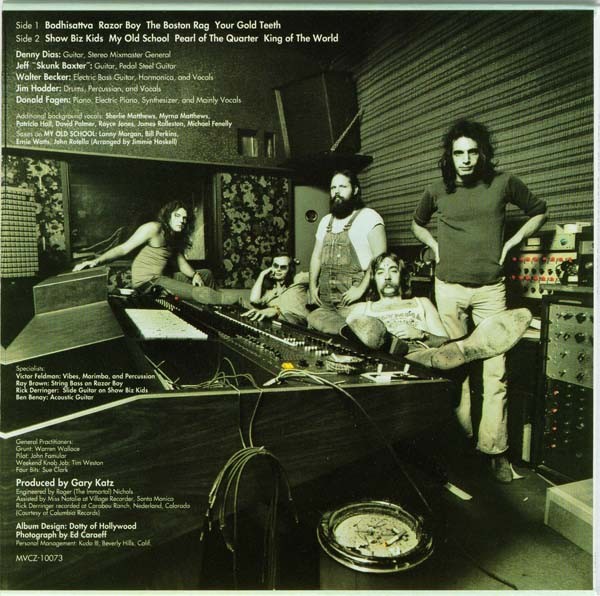
Oh, and here's a few guys who didn't have any problem with using them in the studio, although they certainly graduated beyond that later:
465275343_o.jpg


Also check out the Steely Dan DVD "Making of Aja" where in the background discussion of with guitarist Denny Dias, you can see in a "modern" studio, circa 2000, there were still L100's around along with their later blue baffled brother, the 4313:

0.jpg


DennyDiasAJA.jpg
 
Oh, and here's a few guys who didn't have any problem with using them in the studio, although they certainly graduated beyond that later:
Knowing Steely Dan's penchant for sound perfection on their albums, I was somewhat surprised to see this. On the other hand, this was only their second album, it's possible (As you alluded to) that they weren't as picky then.
 
Great speakers to buy cheap as they can (usually) be resold for a premium ...
I was not impressed by the sound of the clean pair I found, refurbed and resold.
Even tho I had good memories of a pair of JBL 4310 monitors in our college radio station ...

I much prefer the later, completely different L100T and L100T3
 
Stuff the port and see how that sounds/feels for you. The midrange and tweeter are what they are, an acoustic reproduction of the then prevalent Altec 604 style Co-Axial and tri-Axial speakers that were used in recording and cinema during the 60's. JBL's design mandate were to re-create that sound in both a large version (the 4320) and a smaller bookshelf size (the 4310/4311/L100. They succeeded mightily in the professional realm, especially with the advent of multitrack recording and monitoring for some, and replaced the bulk of Altec's installations (older speakers, a botched replacement, and the need for some for smaller monitoring speakers or multiples of them) in recording studios. The Altecs had the same midrange issues and a peaky but top end rolled off treble, but was well known to engineers of the day and was the reference till something else came along.

The crossover design was and is a relatively simple design, using minimum # of components to enhance efficiency and sensitivity due to lack of watts till SS amplification caught up. Acoustically, it gave the JBL designers and users what they wanted to hear at the time. Crossover design then was still more art than science, as was T/S parameters and driver design and measurement, T/S only slowly reaching a worldwide knowledge point in the mid and late 70's. You are looking at a 70's design from a 1990's-2015 point of view. Lots of speakers of that era used very little filtering on the woofers (partly because of the cost issues), but JBL decided the 123a woofer worked acoustically in this manner. You can view the evolution of this type of design in the 4311,A-D, 4312A-D, and the 441x series, and the similar L96/L112/L166 consumer models, all becoming much flatter, crossover drivers much more sophisticated, and still maintaining high sensitivity and power output for the professional use of Studio and Control monitors. If you wanted to explore a "better or modern crossover" see the Troels Gravesen modification:
http://www.troelsgravesen.dk/JBL_L100.htm

If your woofers are truly floppy, best to examine the cloth surrounds and the spider, its possible they have fatigued if they had been hammered a lot in a previous life. The terminals accepted 18 gauge wire, maybe 16 gauge in a pinch. Very few speakers of the day accepted larger wire on their terminals, and the "high end" or audiophile interested in large gauge wire had only begun in the late 70's.

As for your comment on the "chezzy waffle grilles", you are entitled to your opinion of them. However, a ton of consumers and design people feel this was one of the most iconic and interesting grille designs to come through and put JBL squarely on the map in terms of consumer acceptance and appeal and industrial design. You could certainly get new and very close reproduction grilles, but you've already said you are not inclined to spend money on JBL speakers.

The L100 is what it is, a 1970's icon of profession to consumer crossover that was a big hit and JBL's best selling speaker. Its strengths and weaknesses are well known, even described by Zilch and many of us JBL fans as "fake but fun".

http://www.audioheritage.org/html/profiles/jbl/l100.htm

http://www.lansingheritage.org/html/jbl/specs/home-speakers/1973-l100.htm

101012_JBL%20L100%20Century%20speaker.jpg


Some current looks with new reproduction grilles:
jbl.jpg

l100-4-3l.jpg
yes I came across that website, all I can see is that large midrange peak at 6.5K, I would have put an inductor in series with the mid to tone it down ,considering the price of the speakers and the huge quantity that JBL would have bought the inductor at , I cant image it costing them much of anything.as far someone still has to explain to me why the name plate on the baffle is mounted horizontally on a speaker that is almost always placed vertically.as far as the cheezy grill comment, I didnt mean it as a put down it was the early 70's and many things were cheezy.I will also never understand the asians fasination with JBL speakers, Ive come across some of the videos on youtube, you see tens of thousands of dollars worth of electronics driving a pair of L100's!!
 
someone still has to explain to me why the name plate on the baffle is mounted horizontally on a speaker that is almost always placed vertically.
Back then, probably more people placed their bookshelf speakers horizontally than vertical. These speakers were designed to sound about the same either way.

The L100 cabinet, about 1.6 cubic feet if I remember, is too small for that woofer, and results in that exaggerated bass. That woofer works much better in a sealed cabinet about 4 cubic feet. If you buy a 3" Plumbers Test Plug at a hardware store, you can close off the port. That improves it somewhat.
 
The nameplate (foilcal) is a typical JBL horizontal rectangle, and they wanted to get their graphics and lettering just so, and also readable out to a certain distance (probably listening distance). Many speakers lacked identification on the fronts, but JBL realized that having brand recognition, model recognition, as well as relatively easy access to the L-Pad controls could all be accomplished in their foilcal. Also, the foilcal defines where the L-pads are mounted, so there's that practical issue to mount the L-Pads there, but align the lettering along the side wall. It also allowed for a model number and nickname to be put there. Some models were just L100, others were the L100 Century.
This was later modified in some vertical speakers like the 4425 where the model number is short, so the info is just at the top of a narrow strip.

Also, recall that the original L100 had a vertical inline driver orientation so the foilcal and controls were along the long edge. This was kept when the offset cluster array was used (although they didn't make a mirror imaged pair version). I also agree that many "bookshelf" sized speakers of the day were actually put horizontally on bookshelves, so the labels were more readable that way.

attachment.php
maxresdefault.jpg
maxresdefault.jpg
DSC01356.jpg
 
Back
Top Bottom