• The move to the new server is done. There are some software and database maintenance updates in process. This has us passing the hat around to help out. We appreciate any donations. Seriously, even a dollar helps. The payment page may be found here - https://www.audiokarma.org/support.html

Jig or Protractor?

There used to be a lot of things like this 45 adapter available to set the overhang, there were also strobe discs with overhang scales ...


s-l300.jpg


s-l400.jpg


In the end, most people are just eyeballing the offset angle, but it helps to have an arc protractor with null point grids to really get both the overhang and cantilever offset set accurately to whichever alignment type you choose, even if just printed on regular paper ...

h6ygIKr.png
 
Last edited:
This is not always the case . I did calculations of individual protractors for several Japanese turntables . And if you follow the factory data on the overhang and effective length, then the zero point distances did not always coincide with the Stevenson standard .


As I said, I was referring to the tables that came with a jig (Pioneer, Technics). Also true for the Kenwood overhang indicator on the 45 adaptor.
 
There used to be a lot of things like this 45 adapter available to set the overhang, there were also strobe discs with overhang scales ...


s-l300.jpg


s-l400.jpg


In the end, most people are just eyeballing the offset angle, but it helps to have an arc protractor with null point grids to really get both the overhang and cantilever offset set accurately to whichever alignment type you choose, even if just printed on regular paper ...

h6ygIKr.png


I've wondered with the 45 adaptor gauges how you assure proper orientation of the gauge as related to the arm?
 
I've wondered with the 45 adaptor gauges how you assure proper orientation of the gauge as related to the arm?
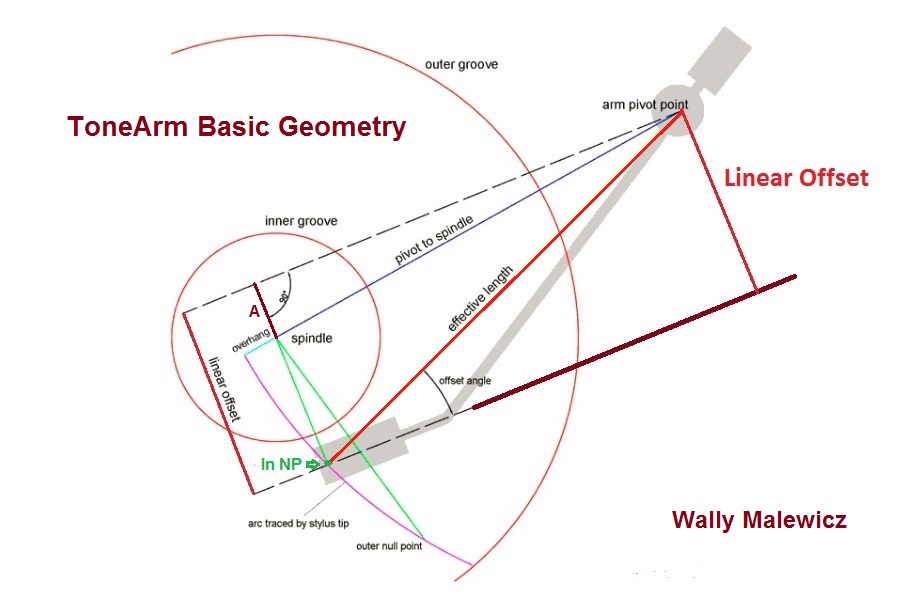
The overhang is the distance the stylus extends past the spindle, so just extend the line from pivot to spindle and that is the line to measure overhang.
 
The overhang is the distance the stylus extends past the spindle, so just extend the line from pivot to spindle and that is the line to measure overhang.

I understand what overhang is. But to be accurate, one would have to assure that the arm is at the appropriate angle to the spindle...an angle accounting for the headshell offset. How one would achieve that is what I was trying to ask.

If the arm is line up on the pivot to spindle line, the stylus will not have the correct overhang...at least, so it seems to me. I assume that if you can somehow assure that the stylus is on the pivot to spindle line, it would work.

Learning to use a protractor seems like the best approach to me. After getting it aligned with a protractor, you can of course measure from the stylus to some fixed location on the tonearm, and use that for a good approximation of that same alignment when swapping carts.
 
Last edited:
I understand what overhang is. But to be accurate, one would have to assure that the arm is at the appropriate angle to the spindle...an angle accounting for the headshell offset. How one would achieve that is what I was trying to ask.

If the arm is line up on the pivot to spindle line, the stylus will not have the correct overhang...at least, so it seems to me. I assume that if you can somehow assure that the stylus is on the pivot to spindle line, it would work.

Learning to use a protractor seems like the best approach to me. After getting it aligned with a protractor, you can of course measure from the stylus to some fixed location on the tonearm, and use that for a good approximation of that same alignment when swapping carts.
Well, it just follows the drawing like below, the arc will hit that same overhang point as the stylus intersects the pivot to spindle line ... It sounds like maybe you are looking for some measurement along the offset angle line to measure overhang within the headshell, similar to the Technics gauge, but that doesn't really define the overhang other than how it relates to the picture below.

0515TAB.jpg
 
Last edited:
Spark1 - I think the value for overhang is determined with the stylus, spindle, and arm pivot all in line. I understand your concern about the angle of the headshell, but I believe that overhang is simply a distance, and angle is irrelevant.
I'm not sure exactly helpful knowing that the center of the slots being 9mm back from the stylus tip is. Mounting screws to tip is not standardized at all, and measuring distances that are displaced in three dimensions is not easy, which is why I've wondered why many makers think that bayonet to tip distance is sufficient information (especially since few mention whether the rubber washer is supposed to be included in the measurement.
 
Well, it just follows the drawing like below, the arc will hit that same overhang point as the stylus intersects the pivot to spindle line ... It sounds like maybe you are looking for some measurement along the offset angle line to measure overhang within the headshell, similar to the Technics gauge, but that doesn't really define the overhang other than how it relates to the picture below.

0515TAB.jpg

No. That was not my question/point. Moot anyway, as I will not be using such a gauge.
 
Spark1 - I think the value for overhang is determined with the stylus, spindle, and arm pivot all in line. I understand your concern about the angle of the headshell, but I believe that overhang is simply a distance, and angle is irrelevant.
I'm not sure exactly helpful knowing that the center of the slots being 9mm back from the stylus tip is. Mounting screws to tip is not standardized at all, and measuring distances that are displaced in three dimensions is not easy, which is why I've wondered why many makers think that bayonet to tip distance is sufficient information (especially since few mention whether the rubber washer is supposed to be included in the measurement.

Yes, that's what I meant by assuring that the stylus is on the pivot to spindle line. I can't visualize how one would do that with much accuracy. The mark on the gauge would have to be on that same line, of course.

Agree about the center of the slots, altho it would work if you determined their relationship to stylus for a particular headshell (which is what I think was being referred to; ie the Luxman headshell on the OPs table) Effectively, it is the same as using the collar of the headshell...that is, using a measurement between a fixed point and the stylus. Using a fixed point on the tonearm seems better, in that it can be used with any headshell.
 
Note on the Protractor I linked to, it shows the "manufacturer's" specified Null Points.

What Null Geometry it is, it may follow no specific Geometry such as Baerwald, Stevenson, etc?

From the Null Points shown, one can sort of extrapolate what the close approximation is to other known Null Geometries.
 
If you really want to understand the math, the excellent paper by Graeme Dennes is a good place to start- https://www.vinylengine.com/turntable_forum/viewtopic.php?t=4854

When you boil it all down, the only needed measurement is the distance from the record spindle to the tonearm pivot, what I call the P2S distance. That one number, plus the inner and outer limits of the playing area (defined by DIN or IEC) will give you the overhang and all other numbers for any of the standard alignments.

What I've found is that turntable makers didn't always have a good understanding of arm geometry and some published overhang numbers don't make a lot of sense. I've even seen cartridge makers publish overhang numbers, which is pure nonsense. I (and my template generator) always calculate from the basic P2S distance and I never pay any attention to published overhang numbers. Now, you can do an infinite number of intermediate alignments that don't exactly match the standards, but IMO there's little point. BTW, overhang gages that come with specific turntables generally work well for whatever alignment the maker has chosen (or stumbled onto :D). Even if you don't want a template, you can use my template generator to calculate all the relevant numbers for a given tonearm, then just cancel the print.

Another useful utility is the John Elison spreadsheet found here- http://www.enjoythemusic.com/freestuff.htm It uses the same (correct) math as my template generator and makes a good check, especially for intermediate alignments.
 
Last edited:
I'm not sure exactly helpful knowing that the center of the slots being 9mm back from the stylus tip is
Not very, if one doesn't have access to the specs for a particular cartridge and are unable to measure it. However, many manufacturers do include this, the dimensions often can be found online. Shure, along with most other American brands, use 3/8" which corresponds to 9.5mm. You'll find more which fit this dimension or close to it than those which don't.
 
This is just armchair speculation, worth every penny you've paid for it. Decades ago, back when our classic Japanese turntables were new, I visited Japan on a business trip. We had recently adopted computers in most departments and were using them for engineering. I was shocked to see that the Japanese were very late to the party. Computers were rare in business! This is also pre-internet, at least for most practical purposes. Maybe Compuserve and a bunch of BBSs were around. So what you had was manual calculation of everything (OK, they had calculators) combined with slow and difficult access to information. It's not surprising to me that the Japanese turntable industry settled on Stephenson alignment or something similar to it, probably because that was the information most widely available. I'm guessing the advantages of doing it differently weren't a topic of significant research. It worked well enough (and still does) so why mess with success? You have to remember that things were very different in the '70s and before. Hey, the SR-71 was designed pretty much by hand- https://frontlinevideos.com/blogs/v...ign-through-a-computer-got-their-minds-blown/
 
When you boil it all down, the only needed measurement is the distance from the record spindle to the tonearm pivot, what I call the P2S distance. That one number, plus the inner and outer limits of the playing area (defined by DIN or IEC) will give you the overhang and all other numbers for any of the standard alignments
The only problem with this is that in many cases it is the effective length and overhang that are given as arm dimensions. If you already have either of these measurements you have everything you need to make an alignment gauge (jig). If you want to make a protractor, the P2S is easily calculated but the question of which spec to use, DIN or IEC, seems rather arbitrary as many records don't seem to conform to either spec. The first time I had the opportunity to use an overhang gauge was with the Sol arm, and I must say....I'm liking it. :)
 
Hey, the SR-71 was designed pretty much by hand
As was the Concorde SST - the safest passenger jet ever flown.

"For more than three decades, the Concorde flew the earth's airways with no crashes, no deaths and no injuries more serious than bumps and bruises from occasional evacuations after nonfatal incidents. That means that on the industry's standard safety measure, "hull losses" per million flights, it scored a perfect zero"
 
Last edited:
Ha! The SST is at the bottom of the safety list because it made so few flights that the accidents that did occur completely trashed the statistics. Bet it, like the SR-71, was a fun ride.
 
The only problem with this is that in many cases it is the effective length and overhang that are given as arm dimensions. If you already have either of these measurements you have everything you need to make an alignment gauge (jig). If you want to make a protractor, the P2S is easily calculated but the question of which spec to use, DIN or IEC, seems rather arbitrary as many records don't seem to conform to either spec. The first time I had the opportunity to use an overhang gauge was with the Sol arm, and I must say....I'm liking it. :)

IMO, the nice thing about P2S is you can accurately measure it, which is way better than deriving it from questionable numbers.
 
Ha! The SST is at the bottom of the safety list because it made so few flights that the accidents that did occur completely trashed the statistics. Bet it, like the SR-71, was a fun ride.
Through no fault of its own. Hard to say that these days.
 
IMO, the nice thing about P2S is you can accurately measure it, which is way better than deriving it from questionable numbers.
I suppose...about as easy to measure a cartridge for the stylus tip to mounting center. In many instances the radial center can only be estimated.

What standard do you use for the playing area?
 
I need the ability to quickly ( and easily ) replace the cartridge . I have several record players , several phono preamps , and periodically replace the cartridges ( along with the headshell). Therefore, tonearms without a removable headshell are inconvenient for me .

I have 7 tables and also several cartridges, none of this changes the fact I stated.

Not trying to convince you to change.
 
Back
Top Bottom