• The move to the new server is done. There are some software and database maintenance updates in process. This has us passing the hat around to help out. We appreciate any donations. Seriously, even a dollar helps. The payment page may be found here - https://www.audiokarma.org/support.html

JVC A-X2 no sound

LouR

New Member
Hello AK-members,

I just purchased a JVC A-X2 for 20 euro. Thought I give it a shot as I am looking for an amp with more power than my current one. Hooked it up to my speaker and the disappointment came: no sound. Well, just extremely soft.

What I found out:
- The relays click after some seconds turning it on.
- The soft 'sound' comes out of both speakers.
- I tried speaker system 1 and speaker system 2, but both only give a VERY soft sound if I put the volume real high.

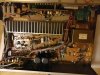
I opened it up, man it was dusty. Did some Dust Off, opened the plastic protection around the relays and gave it some DeOxit. Waited some hours, but made no difference: still just very very soft sound.

Is the relay dead and in need of replacement?
Or could the fuse be blown?

I'm a noob at too technical stuff (no experience in soldering f.e.). So kinda hope it'd be the fuse, that looks easy to replace. Or do you guys think this machine is gone?

Thanks in advance for any ideas!
 
Register to hide this ad
Do exercise all the switches. I had a problem with my A-X4 where one channel would go slient if the "SEA REC" switch was turned off. Turns out there was a bad solder joint in one of the connectors, and the signal path went only through there when SEA REC was disabled. Also, is Tape Monitor engaged?
 
@Hak Foo thanks for your reply.
I thoroughly switched on/off in many combinations. Including SEA REC. No difference.
I had read about the Tape Mon before posting, but there is no Tape Mon on this A-X2, unfortunately. So that can't be the issue either.

Still hoping there is a magical combination that I missed...

Also plugged in a headphone to test: this gave no sound, just cracking noise.
 
There are 2. TAPE1 and TAPE 2. Bottom, right pushbuttons.
You are right. I misinderstood the question. Yes there are 2 tape monitors, I have checked those, put them on and off in all possibilities. No effect .
I kind of gave up on this amp now, as I am not capable of recapping myself. Will sell it for parts.
Thanks for all you guys' messages.
 
Don't give up so easily. Why do you think it needs to be recapped? Certainly will not address your current issue. Since both channels are dead, it is something common to both. That eliminates about 3/4 of the parts.

Start by confirming all the power supply voltages are there and correct. Looks like we have +/-38.5 across C801 and C802. Then we have +/- 15 volts across Zener diodes D805 and D806.

If those check out, then set the balance control to center, and the volume control near the high end (select an unused input so there is no signal present) then physically touch the wiper terminal for the volume pots on both the left and right channels. Do you get a loud hum?
 
Don't give up so easily. Why do you think it needs to be recapped? Certainly will not address your current issue. Since both channels are dead, it is something common to both. That eliminates about 3/4 of the parts.

Start by confirming all the power supply voltages are there and correct. Looks like we have +/-38.5 across C801 and C802. Then we have +/- 15 volts across Zener diodes D805 and D806.

If those check out, then set the balance control to center, and the volume control near the high end (select an unused input so there is no signal present) then physically touch the wiper terminal for the volume pots on both the left and right channels. Do you get a loud hum?

The OP said he has no technical ability -

I'm a noob at too technical stuff (no experience in soldering f.e.). So kinda hope it'd be the fuse, that looks easy to replace. Or do you guys think this machine is gone?

He's going to need to either learn some skills or buy equipment that is going to work straight out of the box. Basic skills are not hard to learn - I started from pretty much zero about three years ago and I still consider myself a n00b, especially where amplifiers are concerned.

@LouR I think in all honestly you would be better to walk away from this unit as you don't have a lot of money invested in it. Certainly, if you do decide to continue looking at the unit and learning some basics, do not power it straight from the mains and do not connect any speakers to it until you verify it is working within its design parameters. The usual steps I take, when I start work on a piece like this, is to firstly thoroughly clean all switches, slides and rotary controls. I would then check for visual issues such as burned components, blown fuses etc, before powering up on a current limiting device (known as a VariAC or dim bulb tester). Once you have power to the unit, you should first check power supply voltages as noted by @Ylli above. Then you move on through the preamplifier stage and finally to the power stage. You would need to check the service manual to check for voltages at the various stages and also for the allowed DC voltage present at the speaker outputs.

Personally, I would use that unit as a learning unit. Why not grab yourself a soldering iron and practice removing / reinstalling components? It doesn't work anyway, so it can't get much worse. Practice making clean, tidy joints and learn how much or how little heat is required. Learn how to use a solder sucker (desoldering pump) and solder wick.

If you have an interest in vintage gear and learning new skills, that's the way I would go with it. Good luck
 
Encouragement is good thing. There are plenty of good kits out there that don't break the bank. Might try that before more complex amps. easy to read instructions and identification of parts etc. might sell the amp as is to buy one and some supplies /equipment.
 
Encouragement is good thing. There are plenty of good kits out there that don't break the bank. Might try that before more complex amps. easy to read instructions and identification of parts etc. might sell the amp as is to buy one and some supplies /equipment.

Good call, kit building is a great way to learn and most have explanations about how the different components work.
 
If it gets more complicated than dusting it off and doing deoxit, I think i will do more damage than good.
I like the idea of using this amp to practice soldering. On the other hand, i read it's a good amp and would love to fix it. Or let it be fixed, but not sure if that's worth the costs. I don't want to make money on amps, I just want a very nice sounding (and looking) amp, for not too much money, standing on my shelf and filling my room with good music :). And upgrade once in a while.
 
Put it on a shelf and admire it. Buy another cheap amp to practice on. One day, when you've learned the basics, go back to the JVC and get it singing again. Use it as your motivation to learn new skills :-)
 
Hello People,

This is my first post and i wanted to thank the members and LouR here.
i think i bought the amplifier from LouR member (or exactly the same one) without knowing. It had the same stickers on the same place en the opened plastic relay cover.
No sound. very soft only with high volume. I also new to fixing amplifier and not much experience only replacing capacitors and fixing and cleaning switches.
Hak Foo was about right with the SEA REC and SEA DEFEAT button! and the signal going through here. I cleanend the switches inside and it worked. perfect sound. no problems
Greetings!
Erik
 
Back
Top Bottom