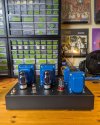
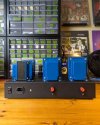
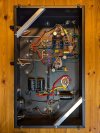
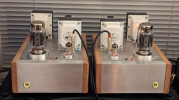
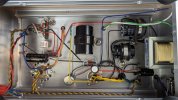
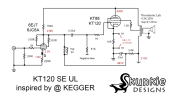
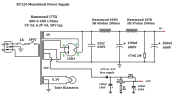
Hi everyone, I’ve been building and tinkering with this amp for almost a year now and my tweaking has settled enough that it’s time to share. This is my first scratch build so go easy on me! It’s mostly how Mark built his, but with a few tweaks & design choices.
- Used a 6BZ7 driver tube only because I had one.
- 4 ohm O/T secondaries since my speakers are Magnepan .7’s. Yes I drive Maggies with this amp in a smallish room and it’s magnificent. More on this below.
- Obsessed over the grounding scheme, probably went overboard, but this is a hobby right? The amp is silent. hum is < 1 mVrms.
- On my mains voltage of ~123 VAC the KT88 and 6BZ7 filaments were running at almost 7 Vrms, so I added parallel 0.18 ohm resistors on both sides of the center tap. (Total 4 resistors) for a total of 0.18 ohms series resistance. Now the filaments are bang on 6.3VAC.
- No UL
- No Schade feedback. Using my prized new (to me) HP3580A I confirmed that the Schade feedback decreases 2nd harmonic significantly and higher order harmonics to negligible levels. But to my ears there was no comparison, I guess I like the harmonics. At 1.5W output, 1000 hz, I get ~1% 2nd harmonic & unmeasurable higher order. At 6W, 2nd is 2.5%, 3rd is 0.3%. I left in the feedback wiring unhooked so I’ll probably tweak it to see if I like some higher resistance as a compromise.
- Played around with several KT88 cathode resistors and settled on 560 ohm. DC measurements below.
- Over a few months of use, the fuse blew a couple of times, so I installed a CL-80 thermistor. This fixed it.
- Coupling caps reduced to 0.047MFD. This brings the 3db high pass point up to 15 hz. I run subs with this amp crossed over at ~60 hz so I wanted to remove super low frequency work from this amp. I measured that these O/T’s can’t cleanly pass frequencies below 20-30 hz anyway. This coupling cap change made a huge improvement to sonic quality not only in the low end but way up into the mid-range.
- Tried various reductions on the plate load resistor of the 6BZ7 down to 28k (up to 1.7W plate dissipation). In frequency and distortion sweeps I couldn’t measure an appreciable difference, but in listening tests (subs off) I much preferred the 39k. More holographic all around, less strident midrange. Again, I guess I like the harmonics!
- The KT88s are a bit too close to the O/T transformers. In use the heat seems fine, but I’ll know better for next time!
DC voltages (running on 123VAC mains drawing 1.3A):
- B+ 484, B++ (before the 6BZ7 plate load resistor) 452
- KT88 (L / R): plate 479 / 479, screen 478 / 478, cathode 43.7/44.0. Plate dissipation (W) 33.9 / 34.1
- 6BZ7 (L / R): plate 184 / 175, cathode 2.8 / 2.8, 39k plate load resistor top vs. bottom 268 / 278. Plate dissipation (W) 1.2 / 1.2
I know some folks will be skeptical of running maggies with this amp. I’ve done months of listening comparisons between it and a big Marantz 2285B I restored. Both amps cleanly drive the maggies to loud levels (>85dB in my 18’x15’x9’room). Of course the subs help a lot. But this amp is special. On excellent recordings with a lot of ambient space captured, you’re transported to the room. It’s three-dimensional. You can feel the bow on the string, see the singer’s lips. Wow.
Thank you everyone who contributed designs, videos, and expertise to this thread. It's been super rewarding and fun for me to build!
Colin
- Used a 6BZ7 driver tube only because I had one.
- 4 ohm O/T secondaries since my speakers are Magnepan .7’s. Yes I drive Maggies with this amp in a smallish room and it’s magnificent. More on this below.
- Obsessed over the grounding scheme, probably went overboard, but this is a hobby right? The amp is silent. hum is < 1 mVrms.
- On my mains voltage of ~123 VAC the KT88 and 6BZ7 filaments were running at almost 7 Vrms, so I added parallel 0.18 ohm resistors on both sides of the center tap. (Total 4 resistors) for a total of 0.18 ohms series resistance. Now the filaments are bang on 6.3VAC.
- No UL
- No Schade feedback. Using my prized new (to me) HP3580A I confirmed that the Schade feedback decreases 2nd harmonic significantly and higher order harmonics to negligible levels. But to my ears there was no comparison, I guess I like the harmonics. At 1.5W output, 1000 hz, I get ~1% 2nd harmonic & unmeasurable higher order. At 6W, 2nd is 2.5%, 3rd is 0.3%. I left in the feedback wiring unhooked so I’ll probably tweak it to see if I like some higher resistance as a compromise.
- Played around with several KT88 cathode resistors and settled on 560 ohm. DC measurements below.
- Over a few months of use, the fuse blew a couple of times, so I installed a CL-80 thermistor. This fixed it.
- Coupling caps reduced to 0.047MFD. This brings the 3db high pass point up to 15 hz. I run subs with this amp crossed over at ~60 hz so I wanted to remove super low frequency work from this amp. I measured that these O/T’s can’t cleanly pass frequencies below 20-30 hz anyway. This coupling cap change made a huge improvement to sonic quality not only in the low end but way up into the mid-range.
- Tried various reductions on the plate load resistor of the 6BZ7 down to 28k (up to 1.7W plate dissipation). In frequency and distortion sweeps I couldn’t measure an appreciable difference, but in listening tests (subs off) I much preferred the 39k. More holographic all around, less strident midrange. Again, I guess I like the harmonics!
- The KT88s are a bit too close to the O/T transformers. In use the heat seems fine, but I’ll know better for next time!
DC voltages (running on 123VAC mains drawing 1.3A):
- B+ 484, B++ (before the 6BZ7 plate load resistor) 452
- KT88 (L / R): plate 479 / 479, screen 478 / 478, cathode 43.7/44.0. Plate dissipation (W) 33.9 / 34.1
- 6BZ7 (L / R): plate 184 / 175, cathode 2.8 / 2.8, 39k plate load resistor top vs. bottom 268 / 278. Plate dissipation (W) 1.2 / 1.2
I know some folks will be skeptical of running maggies with this amp. I’ve done months of listening comparisons between it and a big Marantz 2285B I restored. Both amps cleanly drive the maggies to loud levels (>85dB in my 18’x15’x9’room). Of course the subs help a lot. But this amp is special. On excellent recordings with a lot of ambient space captured, you’re transported to the room. It’s three-dimensional. You can feel the bow on the string, see the singer’s lips. Wow.
Thank you everyone who contributed designs, videos, and expertise to this thread. It's been super rewarding and fun for me to build!
Colin