• The move to the new server is done. There are some software and database maintenance updates in process. This has us passing the hat around to help out. We appreciate any donations. Seriously, even a dollar helps. The payment page may be found here - https://www.audiokarma.org/support.html

Kenwood KA-8100 - Relays won't engage

Arne-Tom

New Member
Hi fellow AK members, I've got a problem with a Kenwood KA-8100.
I got it from a friend in order to repair it. He said when it broke he was listening at quite some volume already and then hit the gain switch adding another 10db which resulted in silence.
What I did so far: Checked all soldering and reflowed everything suspicious wit new solder added, reattached 2 of the four output transistors as they had become loose (also bent the parts that became loose properly so it wont happen again), checked them for shorts and they tested to be good, replaced all the electrolytics while I was at it, replaced the psu transistors on the front panel board, desoldered and all switched,pots etc, took them apart, cleaned them, replaced the three transistors surrounding the relais (used ksc1845,ksc2690AY) and also replaced some of the diodes...thats it for now as far as I remember...When turned on with a dim bulb protection it seems fine but the relais wont click hence no sound...Oh I also checked dc offset and its 2mv and 4mv.
Now there are several threads telling some more possibilities but I'm just not smart enough yet to decide what to do first and I'm moving a few hundret km south in two weeks, so time is kinda running out.
Any suggestions are much apreciated!! Thanks a lot!
Arne (from germany, which might explain some crappy english, sorry)
 
Register to hide this ad
Did you check for DC offset before or after the relay? It must be checked before the relay in this situation. The junction point of Re79 and Re80 should do, that will check both channels at the same time.

Craig
 
Pins 7 and 8 are not exactly the output of the amplifier but as long as the voltage is low it should prove that DC offset is not the problem. What voltages do you have on Qe29, Qe30 and Qe31?
 
Pins 7 and 8 are not exactly the output of the amplifier but as long as the voltage is low it should prove that DC offset is not the problem. What voltages do you have on Qe29, Qe30 and Qe31?
I do measure from collector to emitter right?
 
Diodes De 13-16? I had a bad flyback diode on a 7100 give me fits before I found it. The LED on the 7100 was burned on another amp, and it also affected the relay. Don't know how the LED affects the relay in the 8100 though. You'll be checking the transistor voltages there.
 
Is power LED on? Schematic shows fuse Fe3 (4A fuse) supplies ac to a circuit which supplies power to the LED and used to monitor AC for quick shut off when unit turned off. (in other words, check the fuses. If the others are ok, unit will still come on but no relay or LED.
Second, check base of Qe29 if this voltage is greater than .6 or less than -.6 (compared to ground), the relay won't turn on, because of problems with one of the channels. If okay, measure voltages and trouble shoot the rest of the relay circuit. My 2 cents...
 
Hi, since I ad a little incident it will take till tomorrow untill I will be able to measure the transistor voltages. I had the amp running on the dim bulb thingy in order to take the measurment and as I was slowly aproaching the first transistor with the dmm tip ( somehow whenever I test things on a runing amp I behave like a cat with a new owner at its first attempt to get food....veeeery carefully and a bit afraight something might explode any second) a polarized capacitor in the control section exploded as I found out I was smart enough to put it in the wrong way....took some time to figure out which one etc etc to make a long story not even longer: found cap, replaced cap (this time the right orientation), reassembled unit, 3.55 am now...so off to bed and another attempt tomorrow. good night
 
Is power LED on? Schematic shows fuse Fe3 (4A fuse) supplies ac to a circuit which supplies power to the LED and used to monitor AC for quick shut off when unit turned off. (in other words, check the fuses. If the others are ok, unit will still come on but no relay or LED.
Second, check base of Qe29 if this voltage is greater than .6 or less than -.6 (compared to ground), the relay won't turn on, because of problems with one of the channels. If okay, measure voltages and trouble shoot the rest of the relay circuit. My 2 cents...
As I have to sleep now (close to 4am here) just a few notes : Led is on, fuses are all good, preamp also works according to oscilloscope. had one cap in the control section the wrong way and it exploded, does the control section (front panel) interact with the relais? coukld ave been it then. More fun tomorrow :)
 
Diodes De 13-16? I had a bad flyback diode on a 7100 give me fits before I found it. The LED on the 7100 was burned on another amp, and it also affected the relay. Don't know how the LED affects the relay in the 8100 though. You'll be checking the transistor voltages there.
De 13-16 are already replaced with 1n5256b and 1n4007. oh btw the relais has been cleaned too. will check those voltages very soon after a bucket of coffee/cigarette/shower and one or two tracks of way too loud psytrance "noise".
 
did we verify the outputs are fine?

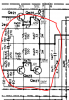
Qe25/Qe27 for the left channel and Qe26/Qe28 for the right channel.

I'd check the voltages at the Re67/Re69 junction for the left and Re68/Re70 for the right and post your results. if these voltages are not 0v +-10mV, I'd suspect the outputs.
ka-8100-output.PNG
You might be able to check pins 7 and 8. I couldn't tell if you posted these values but moved on to other parts to check.

When I read "hit the gain switch...which resulted in silence" I wonder if the outputs got blown.
 
did we verify the outputs are fine?

Qe25/Qe27 for the left channel and Qe26/Qe28 for the right channel.

I'd check the voltages at the Re67/Re69 junction for the left and Re68/Re70 for the right and post your results. if these voltages are not 0v +-10mV, I'd suspect the outputs.
View attachment 1632062
You might be able to check pins 7 and 8. I couldn't tell if you posted these values but moved on to other parts to check.

When I read "hit the gain switch...which resulted in silence" I wonder if the outputs got blown.
FWIW if you have less than .6 V and more than -.6 volts at base of Qe29, then this is not your problem. However, if (as I and others suspect) , you won't and here is where to start trouble shooting.
Also - a simple tip. Put some electrical tape around your meter probes, so only the last few mm are bare. Prevents oops smoke from happening - as I and many others learned the hard way. Also, clip leads can be very useful if you do a lot of troubleshooting.
 
FWIW if you have less than .6 V and more than -.6 volts at base of Qe29, then this is not your problem. However, if (as I and others suspect) , you won't and here is where to start trouble shooting.
Also - a simple tip. Put some electrical tape around your meter probes, so only the last few mm are bare.

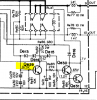
I see where we are looking. shouldn't the base of Qe29 be 75mV not 600mV?

ka-8100-protection.PNG

heat shrink on the probe tips work too. however, i only use mini clips now.
 
I see where we are looking. shouldn't the base of Qe29 be 75mV not 600mV?

Exact voltage is not critical, as long as it is less than .6 and greater then -.6. Normal operation Qe29 should not be active, which allows relay to turn on. If that point goes above .6, the base of Qe30 gets pulled down and the relay doesn't turn on. If it goes below -.6, the base of Qe30 gets pulled down directly and the relay shuts off.
 
Thanks Steve. I noticed that. probably should have updated my response. nice that the schematic has a few voltages to compare with Herr Arne's amp.
 
sorry for my late response, I just got home and will finally to somemeasuring now....had to help a friend getting a couch up to the 5th floor without elevator so the 8100 had to wait :( ....about the diodes I strictly followed echowars' suggestions on them but will recheck if I didnt screw up...after having this cap explode I am suspicious...first time this happened though after quite some amps recapped...and I never do this one at a time and check...I always replace at least 10-20 if not all at once but I always do this kinda grouped so I dont mix up the caps and only remove caps that are the same and replace them emediately before I move to the next group of same caps. thanks for your suggestions, brings back te fun working on this one as I was a bit lost on what to do next...also I would like to finally get this amp back in service as I dont have time to refurbish my own gear which I really really look forward to as I finally found an affordable sansui 5000x which sits infront of me waiting to get some tlc.
 
Last edited:
Back
Top Bottom