

You are using an out of date browser. It may not display this or other websites correctly.
You should upgrade or use an alternative browser.
You should upgrade or use an alternative browser.
Kenwood KR-790 issue
- Thread starter Anonky
- Start date
-
- Tags
- kenwood kr790 repair repair help

Anonky
Kenwood KR-9600 / Pioneer SX-950 / Sony STR-GX10ES
DC offset measurements:
Channel A
R:28.8mV
L:25.0mV
Channel B (not sure if it’s necessary to do both channels? Probably measuring the same stuff?)
R: 29.4mV
L: 26.1mV
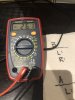
See photo to double check my meter is set to the correct settings. Also, found a source for what bias on this unit is supposed to be: 50 mA
See document page 6 KR-790. https://www.vintageshifi.com/repertoire-pdf/pdf/telecharge.php?pdf=Kenwood-Audio-Adjustment.pdf
Next step?
Channel A
R:28.8mV
L:25.0mV
Channel B (not sure if it’s necessary to do both channels? Probably measuring the same stuff?)
R: 29.4mV
L: 26.1mV
See photo to double check my meter is set to the correct settings. Also, found a source for what bias on this unit is supposed to be: 50 mA
See document page 6 KR-790. https://www.vintageshifi.com/repertoire-pdf/pdf/telecharge.php?pdf=Kenwood-Audio-Adjustment.pdf
Next step?
Attachments

Offset looks fine.
As regards bias:
If it is not running hot, you might want to just let it be. If both sides feel similar, and neither side is hot (warm is ok, hot is not), you are probably ok.
Otherwise, you will need to measure voltage across emitter resistors (measure across one on left channel, and then across one on the right channel). Divide the measured voltage by the resistance of the emitter resistor. This will give you the existing bias current. You can use algebra to determine the voltage needed to obtain the desired bias amperage (50mA).
Current x resistance = voltage. Voltage/resistance = current.
For example, if the emitter resistor`` is .47ohms, you would adjust the voltage (via the adjustment pot) to 23.5mV. If the emitter resistor is .33ohms, you would adjust to 16.5mV. Etc, etc.
This is a somewhat risky process. Perhaps wait until your electrical engineer friend is on hand. If you find that the bias needs to be adjusted (off by more than 10%), you will need to identify the proper variable resistors (pots) for making the adjustment. I would strongly recommend that they be tested, with the unit off, before proceeding. If they show any open spots or large jumps (via the ohmmeter function of your multimeter), they should be cleaned with something like Deoxit. Then test again. Before you start turning them, determine their current setting (using ohmeter) so that you can put them back to where they were before testing them. A bad adjustment pot can do some serious downstream damage.
As regards bias:
If it is not running hot, you might want to just let it be. If both sides feel similar, and neither side is hot (warm is ok, hot is not), you are probably ok.
Otherwise, you will need to measure voltage across emitter resistors (measure across one on left channel, and then across one on the right channel). Divide the measured voltage by the resistance of the emitter resistor. This will give you the existing bias current. You can use algebra to determine the voltage needed to obtain the desired bias amperage (50mA).
Current x resistance = voltage. Voltage/resistance = current.
For example, if the emitter resistor`` is .47ohms, you would adjust the voltage (via the adjustment pot) to 23.5mV. If the emitter resistor is .33ohms, you would adjust to 16.5mV. Etc, etc.
This is a somewhat risky process. Perhaps wait until your electrical engineer friend is on hand. If you find that the bias needs to be adjusted (off by more than 10%), you will need to identify the proper variable resistors (pots) for making the adjustment. I would strongly recommend that they be tested, with the unit off, before proceeding. If they show any open spots or large jumps (via the ohmmeter function of your multimeter), they should be cleaned with something like Deoxit. Then test again. Before you start turning them, determine their current setting (using ohmeter) so that you can put them back to where they were before testing them. A bad adjustment pot can do some serious downstream damage.
Last edited:
Anonky
Kenwood KR-9600 / Pioneer SX-950 / Sony STR-GX10ES
Yeah so I’m playing it now and the channel imbalance is really not that bad. It’s barely noticeable and mostly bother me because I can see it with on the L/R channel graphic depicting output. I’ve just turned the balance slightly to the softer side and it has balanced it perfectly. Sounds just lovely! It’s running what I consider warm but the vented area isn’t ~hot~ to the touch like it was when I was first powering it on laying on a bed—then it was HOT. Goodness. Never doing that again.Offset looks fine.
As regards bias:
If it is not running hot, you might want to just let it be. If both sides feel similar, and neither side is hot (warm is ok, hot is not), you are probably ok.
Otherwise, you will need to measure voltage across emitter resistors (measure across one on left channel, and then across one on the right channel). Divide the measured voltage by the resistance of the emitter resistor. This will give you the existing bias current. You can use algebra to determine the voltage needed to obtain the desired bias amperage (50mA).
For example, if the emitter resistor`` is .47ohms, you would adjust the voltage (via the adjustment pot) to 23.5mV. If the emitter resistor is .33ohms, you would adjust to 16.5mV. Etc, etc. Current x resistance = voltage. Voltage/resistance = current.
This is a somewhat risky process. Perhaps wait until your electrical engineer friend is on hand. If you find that the bias needs to be adjusted (off by more than 10%), you will have to identify the proper variable resistors (pots) for making the adjustment. I would strongly recommend that they be tested, with the unit off, before proceeding. If they show any open spots or large jumps (via the ohmmeter function of your multimeter), they should be cleaned with something like Deoxit. Then test again. Before you start turning them, determine their current setting (using ohmeter) so that you can put them back to where they were before testing them. A bad adjustment pot can do some serious downstream damage.
I think I’m going to leave this be and worry about manipulating things later if an issue arises. Thanks for helping walk me through some of this. It will come in handy with a few other problem units my buddy and I are gonna crack open New Year’s Day. Cheers!
The imbalance issue is almost assuredly not related to bias. More likely dirt/oxidation in a switch or control pot. Cleaning them is a highly recommended first step. Get some Deoxit and Faderlube.
FYI it appears that VR1 and VR2 are for offset adjustment, while VR3 and VR4 are for bias adjustment. Keep in mind my comments above about testing and cleaning adjustment pots before using them.
FYI it appears that VR1 and VR2 are for offset adjustment, while VR3 and VR4 are for bias adjustment. Keep in mind my comments above about testing and cleaning adjustment pots before using them.
Last edited:
Anonky
Kenwood KR-9600 / Pioneer SX-950 / Sony STR-GX10ES
You were right. Imbalance was from the aux switch. It’s perfect now! Thanks again manThe imbalance issue is almost assuredly not related to bias. More likely dirt/oxidation in a switch or control pot. Cleaning them is a highly recommended first step. Get some Deoxit and Faderlube.
FYI it appears that VR1 and VR2 are for offset adjustment, while VR3 and VR4 are for bias adjustment. Keep in mind my comments above about testing and cleaning adjustment pots before using them.