

You are using an out of date browser. It may not display this or other websites correctly.
You should upgrade or use an alternative browser.
You should upgrade or use an alternative browser.
KLH speakers reference thread (original models/Henry Kloss era) 1957-1977
- Thread starter RxDx
- Start date
It's clear from these photos of the Model Five and Twelve woofers that I was mistaken when I said the two models shared the same woofer. They not only use different magnets, but their top plates are different thicknesses. Since the Model Twelve enclosure is larger, Henry would have designed a woofer appropriate to that enclosure volume. It would be helpful to get the voice coil resistance for each woofer.
Regarding the tweeters and high end response, I remember the Model 5/12 tweeter as having a thinner top plate than the Model 6/17 tweeter. Again voice coil resistance of both tweeters would be helpful. The Models 5 and 12 had audibly more extended high end than the Model 6/17.
I was the Assistant Sales Manager at KLH from 1964 to 1969. During that time I led many factory tours and became intimately familiar with the manufacturing processes. During that time KLH was the only speaker company in the world that made all the critical parts of its speakers. We made the woofer, midrange, and tweeter cones; formed the skivers (surrounds) and spiders; and wound all our own voice coils. However, I was not yet involved in speaker design except, as I noted before, when I designed the Model 23. Therefore I didn't know the technical details of the various drivers that we manufactured. That would change at Advent, but that's another story.
Andy K
Regarding the tweeters and high end response, I remember the Model 5/12 tweeter as having a thinner top plate than the Model 6/17 tweeter. Again voice coil resistance of both tweeters would be helpful. The Models 5 and 12 had audibly more extended high end than the Model 6/17.
I was the Assistant Sales Manager at KLH from 1964 to 1969. During that time I led many factory tours and became intimately familiar with the manufacturing processes. During that time KLH was the only speaker company in the world that made all the critical parts of its speakers. We made the woofer, midrange, and tweeter cones; formed the skivers (surrounds) and spiders; and wound all our own voice coils. However, I was not yet involved in speaker design except, as I noted before, when I designed the Model 23. Therefore I didn't know the technical details of the various drivers that we manufactured. That would change at Advent, but that's another story.
Andy K

Tim D
Super Member
I remember the Model 5/12 tweeter as having a thinner top plate than the Model 6/17 tweeter.
The community has reported the difference in tweeters and which models share which of the two types. Often we get members asking what are the models that share tweeters because they have to search for replacements for blown tweets. There are more that share the 6/17 tweets such as model 20 (which was a 4 ohm version of the 17) and maybe one or two more. I don't recall which one the 23 uses.
@700K
Andy,
- My 3 double magnet KLH Twelve woofers have DCR readings of 5.4, 5.4 and 5.5. (all 3 have a gram weight and a 12 on the cones)
- My KLH Five speakers with round magnet woofers, both ink stamped Sept 5 1968, have DCR readings of 3.6 and 3.7. (from my notes)
- I have 2 spare KLH Five square magnet woofers, they have a gram weight and a 5 written on the cones, DCR readings are 3.6 and 3.7
- My KHL Twenty Three speakers with round magnet woofers, both dated Sept 1969, both have DCR readings of 3.8 (from my notes)
These DCR numbers are with the lead resistance subtracted out . Taken with a Fluke 77 that I had calibrated 4/22/2019, Fluke certified lab.
KLH tweeters, I have several spares:
- Thin top plate, DCR readings: 3.9, 4.0, 4.3, 4.0, 4.0, 3.6
- I have only one with equal plate thickness, DCR of 3.4
I had no clue until now, the 3 KLH Twelve woofers clearly have a different DCR than my KLH Five and Twenty Three woofers.
Sounds like you suspected that?
"M-12" is stamped into the metal tweeter flange front (not ink) on most of my thin top plate tweeters.
Do you recall the significance of that?
Also, "M-12 Test" is inked stamped on some KLH drivers and on some crossover components.
Do you recall anything about that?
I could dig up pictures if needed......
Thank you Andy,
Jef
It would be helpful to get the voice coil resistance for each woofer
Andy,
- My 3 double magnet KLH Twelve woofers have DCR readings of 5.4, 5.4 and 5.5. (all 3 have a gram weight and a 12 on the cones)
- My KLH Five speakers with round magnet woofers, both ink stamped Sept 5 1968, have DCR readings of 3.6 and 3.7. (from my notes)
- I have 2 spare KLH Five square magnet woofers, they have a gram weight and a 5 written on the cones, DCR readings are 3.6 and 3.7
- My KHL Twenty Three speakers with round magnet woofers, both dated Sept 1969, both have DCR readings of 3.8 (from my notes)
These DCR numbers are with the lead resistance subtracted out . Taken with a Fluke 77 that I had calibrated 4/22/2019, Fluke certified lab.
KLH tweeters, I have several spares:
- Thin top plate, DCR readings: 3.9, 4.0, 4.3, 4.0, 4.0, 3.6
- I have only one with equal plate thickness, DCR of 3.4
I had no clue until now, the 3 KLH Twelve woofers clearly have a different DCR than my KLH Five and Twenty Three woofers.
Sounds like you suspected that?
"M-12" is stamped into the metal tweeter flange front (not ink) on most of my thin top plate tweeters.
Do you recall the significance of that?
Also, "M-12 Test" is inked stamped on some KLH drivers and on some crossover components.
Do you recall anything about that?
I could dig up pictures if needed......
Thank you Andy,
Jef
Tim, feel pretty confident saying the KLH Twelve, Five and Twenty Three speakers used the same thin top plate tweeters.I don't recall which one the 23 uses
Jef
Tom Tyson said the same thing a while ago over at The Classic Speaker Pages.Henry would have designed a woofer appropriate to that enclosure volume
He theorized that the larger volume of the Twelve would dictate a different design woofer than the Five.
Jef
woodturner
Member
Having received a replacement woofer for my model 23s from a member here (thank you again!), I set about some gentle cosmetic work on the cabinets today. These were from a heavy smokers home, so all the parts that should be silver coloured, were in fact champagne!! I didn't realise this until I started cleaning 
Anyway, I thought I'd stick up a few pics of the serial numbers and hat looks like a checker mark. What is interesting is that these were bought from a dealer here in the 70's or maybe 80's but they are nowhere near consecutive serial numbers....
Anyway, I thought I'd stick up a few pics of the serial numbers and hat looks like a checker mark. What is interesting is that these were bought from a dealer here in the 70's or maybe 80's but they are nowhere near consecutive serial numbers....
Attachments


woodturner
Member
The cosmetic cleanup is not quite finished but the electrical part is done. The treble switches needed a really good clean, so that got sorted out, and I replaced the wire nuts with solder joints. The caps had already been replaced with new film ones and the resistors measured fine so I left them in place. There was a little filled to be done on the driver rebate, and they are back now playing while the last touches to the finish are applied.
One further query - the surrounds on the woofer seem to be in good shape, I can't see leaks or tears, or can't feel any air when running a bass frequency. If you push in on the woofer it feels a bit "stiff" - its kinda hard to explain..... if you push a normal rubber surround driver it generally feels "springy" but these don't feel like that, they have a bit more resistance. I looked around to see if I could find a youtube video or something to compare but didn't turn anything up. Does this sound correct?
One further query - the surrounds on the woofer seem to be in good shape, I can't see leaks or tears, or can't feel any air when running a bass frequency. If you push in on the woofer it feels a bit "stiff" - its kinda hard to explain..... if you push a normal rubber surround driver it generally feels "springy" but these don't feel like that, they have a bit more resistance. I looked around to see if I could find a youtube video or something to compare but didn't turn anything up. Does this sound correct?
woodturner
Member
Nope, there's plenty of bass, that is not a problem at all!
Also - they haven't been run in years, so leaving them running for a while might not hurt either. I can only say they both look original and not messed with in any way
Also - they haven't been run in years, so leaving them running for a while might not hurt either. I can only say they both look original and not messed with in any way

RxDx
Speaker collector
If the surrounds are not at least a little sticky, they are probably
costing you some low end response. The proper sealant fills
voids in the fabric, stays sticky and doesn't really "dry". Best
way to check all this is press down around the dust cap and
watch the return. It should be slow to resume at-rest position,
at least a second or more. If it pops right back, you've got one
or more air leaks- driver frame to cabinet (either driver) and/or
woofer surround/s dried out.
Eventually the factory mandated all woofers get a new
application of sealer if a system came in for service, regardless
the reason.
costing you some low end response. The proper sealant fills
voids in the fabric, stays sticky and doesn't really "dry". Best
way to check all this is press down around the dust cap and
watch the return. It should be slow to resume at-rest position,
at least a second or more. If it pops right back, you've got one
or more air leaks- driver frame to cabinet (either driver) and/or
woofer surround/s dried out.
Eventually the factory mandated all woofers get a new
application of sealer if a system came in for service, regardless
the reason.

RTally
Speaker addict
If the surrounds are not at least a little sticky, they are probably
costing you some low end response. The proper sealant fills
voids in the fabric, stays sticky and doesn't really "dry". Best
way to check all this is press down around the dust cap and
watch the return. It should be slow to resume at-rest position,
at least a second or more. If it pops right back, you've got one
or more air leaks- driver frame to cabinet (either driver) and/or
woofer surround/s dried out.
Eventually the factory mandated all woofers get a new
application of sealer if a system came in for service, regardless
the reason.
When you press the woofer cone in, be sure to hold it pressed in for about 10 seconds before you release it. If you press and release immediately, the internal pressure will push the cone back out as soon as you release. Holding the cone in for a bit allows the pressure in the cabinet to equalize with the external pressure so that, when released, the cone returns to position based on the tightness of the cabinet's air seal.
Also, if the surrounds have been properly sealed, you should be able to see the weave of the cloth used for the surround. Some of the wrong, alternative goop people used are so thick that you cannot see the weaves in the cloth.

One further query - the surrounds on the woofer seem to be in good shape, I can't see leaks or tears, or can't feel any air when running a bass frequency. If you push in on the woofer it feels a bit "stiff" - its kinda hard to explain..... if you push a normal rubber surround driver it generally feels "springy" but these don't feel like that, they have a bit more resistance. I looked around to see if I could find a youtube video or something to compare but didn't turn anything up. Does this sound correct?
You may have to redope the surrounds. VintageAR on ebay sells the proper doping compound. I feel it is imperative to use the proper compound for the surrounds. There are other methods, one of which I tried, that work but not as well.
Also, if you haven't already, check out https://community.classicspeakerpages.net/. There is a wealth of knowledge of New England speakers there.
When you press the woofer cone in, be sure to hold it pressed in for about 10 seconds before you release it. If you press and release immediately, the internal pressure will push the cone back out as soon as you release. Holding the cone in for a bit allows the pressure in the cabinet to equalize with the external pressure so that, when released, the cone returns to position based on the tightness of the cabinet's air seal.
Also, if the surrounds have been properly sealed, you should be able to see the weave of the cloth used for the surround. Some of the wrong, alternative goop people used are so thick that you cannot see the weaves in the cloth.
Agreed. Pictures of the woofers would help.

woodturner
Member
OK,
So I have attached a few pics here and a link to youtube that shows how it "feels" in action. There are 2 separate woofers shown - I had to replace one woofer here as the voice coil was blown out, so one is square magnet (blacker surround) and one is round magnet (lighter surround with orange dustcap). They don't look as if they have ever been messed with.
Thank you for the heads up on the member selling the material here - ideally I'd try get a source in Europe if I need it.

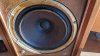
So I have attached a few pics here and a link to youtube that shows how it "feels" in action. There are 2 separate woofers shown - I had to replace one woofer here as the voice coil was blown out, so one is square magnet (blacker surround) and one is round magnet (lighter surround with orange dustcap). They don't look as if they have ever been messed with.
Thank you for the heads up on the member selling the material here - ideally I'd try get a source in Europe if I need it.
si.kwoi.uh
Member
What’s the biggest difference in the vinyl model six models? I found one with the ASV serial number and had no idea what it meant. Are the other models preferable ?Bit of a bump, because I bought a second pair of Sixes because they had the nicer walnut veneer, and the price was right. To my surprise, the seller already recapped and resealed them!
Serial numbers are AS0637952 and unknown (tag’s missing).
This puts them later than my vinyl-clad pair, which are ASV615500 and were marked 0774 on the original caps before I recapped them.View attachment 1768122
Now, one thing I find interesting is that my vinyl pair seems to have a slightly heavier woofer. It takes a bit more resistance to move the woofers, and they don’t feel as “papery”. Bass seems a bit lighter (only a little bit), but I’m listening to FM right now and haven’t given them the goods yet. They’re well sealed-the seller mentioned that he used two coats of the VintageAR sealant.
I’ll have to pull the woofs in both and do a comparison. My hunch is that my vinyl pair actually has the beefier Five woofer, effectively making them Twenty Threes. They were definitely repaired at one point by a previous owner, so anything’s possible. They still sound wonderful, though!
View attachment 1768136
RxDx
Speaker collector
A few people have said that the epoxied versions go a bit deeper in bass.What’s the biggest difference in the vinyl model six models? I found one with the ASV serial number and had no idea what it meant. Are the other models preferable ?
The only difference in the later (non-epoxied) versions I can think of is if you
prefer wood veneer to vinyl wrap. Otherwise, best I can tell is that performance
is quite similar. I don't know if the Six was built with the Five woofer, but I
don't believe it was.
Tim D
Super Member
What’s the biggest difference in the vinyl model six models? I found one with the ASV serial number and had no idea what it meant. Are the other models preferable ?
I prefer the ones with real wood veneer, but sonically there isn't any difference. I have no idea what ASV means and I don't think there is much significance in it.