• The move to the new server is done. There are some software and database maintenance updates in process. This has us passing the hat around to help out. We appreciate any donations. Seriously, even a dollar helps. The payment page may be found here - https://www.audiokarma.org/support.html

KLH speakers reference thread (original models/Henry Kloss era) 1957-1977

@700K
I took dcr readings on two KLH 12 double magnet woofers. They have dcr readings of 5.2 and 5.5 ohms.
Readings were taken with a Fluke 115 and the lead resistance was subtracted.
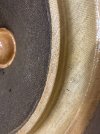
Each of these woofers have writing in black marker, "12" is on each cone and also cone weights of "26.1" on one and "27.6" on the other.

My KLH 5 woofers have a dcr numbers of less than 4 ohms.
My KLH 5 woofer cones are marked with a "5" and also a weight number.

I took dcr readings on 6 tweeters that have the thick magnet side plate and thin cone side plates: 3.6, 4.3, 4.0, 3.5, 4.1, 3.5 ohms.
I only have one tweeter with equal thickness plates and it has a dcr of 3.5 ohms.

There has been extensive debate on whether the Twelve speaker and Five speaker used the same woofer.
I feel certain they did not for several reasons:
-One reason is that you state the larger KHL Twelve box size would require a larger magnet mass.
-The speaker model number is typically marked in black marker on the woofer cones.
-They have different dcr readings; the Twelve has low 5 ohms where the Five speakers are high 3.x ohms.
-KLH advertising material states that the Five and Twelve share the same mid and high drivers. It does not say they share the same woofer.

So I assume the differing dcr readings of the 12 woofers vs the 5 woofers would indicate different woofer impedances and thus different crossover points. True?

Thank for any insight, Jef
 
The Model 5 and 12 woofers were definitely different. The Model 12 had a larger magnet, and from your measurements it had a different voice coil, most likely heavier to extend the deep bass.
 
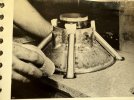
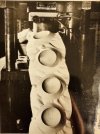
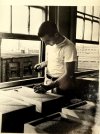
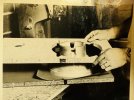
I came across some photos of KLH 6 manufacturing that you all might find interesting. This was the production method from the start of production in 1958 until the mid 1960's. As you can see, the woofer frame was cast into the front baffle using metal conduit to support the magnet assembly. The parts were epoxied together to form a rigid structure. Then the cone/voice coil assembly was dropped in.
 

Attachments

  • IMG_0017.jpeg
    IMG_0017.jpeg
    117.4 KB · Views: 34
  • IMG_0019.jpeg
    IMG_0019.jpeg
    123.5 KB · Views: 31
  • IMG_0018.jpeg
    IMG_0018.jpeg
    133.8 KB · Views: 31
The Model 5 and 12 woofers were definitely different. The Model 12 had a larger magnet, and from your measurements it had a different voice coil, most likely heavier to extend the deep bass.
@700K
Thank you Andy for this conformation that the Model 12 and 5 definitely have different woofers.
It is nice to hear facts about KLH speakers from someone who was actually there, so we all appreciate you commenting on this forum.

Thanks for the pictures you posted above (in post 303). We all love seeing these pics!
Also, in post 222 you state that "KLH was the only speaker company in the world that made all the critical parts of its speakers" in house.
Pretty amazing.........

BTW...I think I like my 23's better than my 5's. You did some great voicing design work on the 23's (post 281).

Thanks, Jef
 
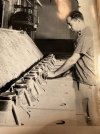
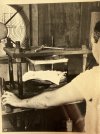
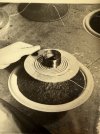
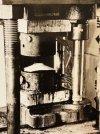
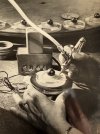
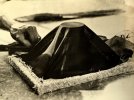
The raw ingredients for the cones are placed into the laboratory paper beater to blend them to the proper fiber length. This mixture, in this case for the woofer cone, is drawn through perforated brass screen in the shape of the final cone. After drying in an oven, the cone is separated from the fixture.
 

Attachments

  • IMG_0025.jpeg
    IMG_0025.jpeg
    146.6 KB · Views: 28
  • IMG_0024.jpeg
    IMG_0024.jpeg
    151.9 KB · Views: 26
  • IMG_0100.jpeg
    IMG_0100.jpeg
    138.4 KB · Views: 25
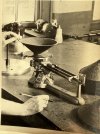
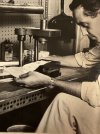
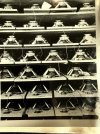
Each cone is weighed to determine that it falls within clearly defined limits. Meanwhile the voice coils are being wound, and the finished coil and cone are attached. Elsewhere in the plant the cloth surround is being heat pressed into its final shape and the then trimmed leaving only the finished surround. Likewise a different material is heat pressed into the shape of the dust cap and another material into the shape of the spider.
 

Attachments

  • IMG_0027.jpeg
    IMG_0027.jpeg
    132.5 KB · Views: 28
  • IMG_0029.jpeg
    IMG_0029.jpeg
    127.8 KB · Views: 28
  • IMG_0031.jpeg
    IMG_0031.jpeg
    130.7 KB · Views: 28
  • IMG_0032.jpeg
    IMG_0032.jpeg
    129.4 KB · Views: 28
  • IMG_0033.jpeg
    IMG_0033.jpeg
    119.8 KB · Views: 28
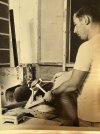
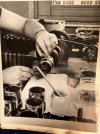
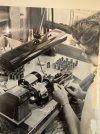
The finished cone/voice coil/spider assembly is inserted into the woofer frame using removable shims to insure proper centering of the voice coil. The surround is coated with a rubber sealant to make it airtight. The tweeter cones are also made in house from a special paper formulation and then trimmed to the precise diameter. The tweeter voice coils are wound, then baked in an oven to cure the adhesive that binds the layers of wire. The tweeter spiders are heat pressed into shape.
 

Attachments

  • IMG_0037.jpeg
    IMG_0037.jpeg
    118.3 KB · Views: 29
  • IMG_0038.jpeg
    IMG_0038.jpeg
    115.3 KB · Views: 29
  • IMG_0036.jpeg
    IMG_0036.jpeg
    156.8 KB · Views: 31
  • IMG_0101.jpeg
    IMG_0101.jpeg
    117.3 KB · Views: 32
A butyl rubber suspension is applied between the tweeter cone and rim. When cured it acts in the same manner as the impregnated cloth suspension on the woofer. The tweeter voice coil is precisely attached at the apex of the cone, and then with the spider attached the entire assembly is inserted into the magnet assembly.
 

Attachments

  • IMG_0039.jpeg
    IMG_0039.jpeg
    125.4 KB · Views: 36
  • IMG_0040.jpeg
    IMG_0040.jpeg
    146.4 KB · Views: 36
  • IMG_0042.jpeg
    IMG_0042.jpeg
    126.4 KB · Views: 34
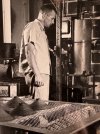
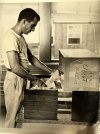
The finished assemblies await testing in the anechoic chamber. After inspection the baffle board is covered with grille cloth, and the finished assembly is glued and nailed into the cabinet.
 

Attachments

  • IMG_0043.jpeg
    IMG_0043.jpeg
    164.1 KB · Views: 38
  • IMG_0044.jpeg
    IMG_0044.jpeg
    112.6 KB · Views: 35
  • IMG_0045.jpeg
    IMG_0045.jpeg
    107.1 KB · Views: 33
  • IMG_0046.jpeg
    IMG_0046.jpeg
    112 KB · Views: 36
  • IMG_0047.jpeg
    IMG_0047.jpeg
    124.8 KB · Views: 33
KLH used Alnico magnets in the Model Six, in fact all their speakers, until Cobalt (the "co" in Alnico) shot up in price because of geo political issues in the early 1960's. KLH and practically everyone else switched to ceramic magnets, which are not drop in replacements because of their shape. So KLH had to change the way they made the Model Six and all their other speakers, making the method I described in these posts obsolete. The soft parts, the cones, voice coils, spiders and surrounds, etc remained the same but KLH transitioned to conventional basket/frame structures that could be serviced in the field instead of returned to the factory for repairs.
 
Pretty new to vintage audio and KLH here. I recently picked up a pair of Model 32’s that I thought I’d use as bench speakers, but I was honestly shocked at how good they sound. I intend to refurbish them and use them in my bedroom or office now. I’m happy to provide pictures or measurements should anyone be interested.

If anyone is looking to try something vintage KLH, the 32’s seem to be one of the more available and affordable options.
 
Sure...send me a message through the “conversation” feature of the forum.

Roy
Hi Roy,
I’m fixing up a pair of KLH model 5s and need your magic sealant for the speaker surrounds. How do I order/pay?
Please get back to me when you’re free.
 
Hi Roy,
I’m fixing up a pair of KLH model 5s and need your magic sealant for the speaker surrounds. How do I order/pay?
Please get back to me when you’re free.


Message sent…
 
The pictures and process descriptions of KLH Six production from the early days is a great addition to this excellent thread. (IMG_0047 shows that the KLH factory wasn't too far from a Heinz facility).
Thanks Andy.
 
Last edited:
Wow!
Fantastic thread,everything KLH.
Thank you to @RxDx for all the great info in this thread!
I've never seen this thread until today,making a post so I will notified when new posts show up here.
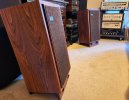
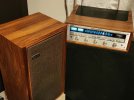
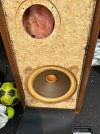
A couple pictures of my beautiful Model 23's.

20230910_103323~3.jpg

20240224_194315~2.jpg
 
I'm Raúl, from Madrid (Spain). First of all, thank you all for sharing your knowledge and experience. And in particular, to the contribution of photos on the manufacturing process of the Model 6 at that time. Amazing.
In my case, I got a pair of KLH 6s by chance. It is very rare to find these speakers in this part of the world. It came from one of those shops that empty homes when they are free.
I have to say that when I tried them (after cutting the grid fabric and replacing the condenser of the tweeters) that silly smile appeared in me that makes you happy like a child. I love its sound. The stereo image is perfect, nailed to the center.
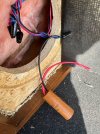
By the way, I have not managed to seal the fabric suspension (they have quite a few air leaks) as customs restrict international shipping to Spain due to the solvents contained in the product.
I'll have to wait for it to arrive in Europe. Greetings.
 

Attachments

  • IMG_3939.JPG
    IMG_3939.JPG
    206.5 KB · Views: 21
  • IMG_3948.JPG
    IMG_3948.JPG
    157.2 KB · Views: 20
  • IMG_4246.JPG
    IMG_4246.JPG
    159 KB · Views: 21
Good afternoon, everyone. I'm from Russia, and I don't have the opportunity to buy KLH or AR speakers, but I'm interested in self-assembling similar low-frequency speakers. On our forums like this, people often measure the T.-S. parameters of their speakers. What are the parameters T.-S. of KLH low-frequency speakers? Has anyone measured them here??
 
Back
Top Bottom