FireGuruMN
Active Member
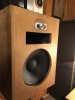
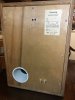
I got a set of original Heresy's a couple of years ago. When I got them I hooked them up and they were unimpressive. I was hoping for 1980's boomy base to shake the room and that was not there. It never will be there until you buy Heresy IV's (or so I have heard). I Googled and Googled and eventually found this crossover schematic (for people that don't read to the end DON'T USE THIS ONE):
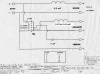
I implemented this schematic with a new iron core inductor for the woofer even though the value matched the existing inductor. I have sense given up on swapping out inductors unless the values have to change. I could not find a 20 watt 11 ohm resistor so I used two 22 ohm 10watt in parallel. I got nice new Solen film caps. Hooked it all up and it sounded the same. Maybe worse. And if I brought the volume up even a little it would clip my amplifier. I got frustrated, gave up, and bought some other stuff to relieve my anxiety.
Since I have been on a speaker recap kick this winter I brought these back to the bench. This time I was going to try this schematic:
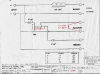
As far as my simple mind can determine this matches the original schematic except they are tapping down the squawker (mid-range) and tweeter to a lower level on the transformer. Then adding a 16 ohm resistor across the squawker to balance out the impedance the amplifier sees. It also modifies the inductor to the woofer to a higher value. but not much higher. If you are really into symbols you will notice the difference between air core and iron core inductors in the different drawings. Air core cost more because they require more turns to make the required inductance. And it has to be bigger wire to keep the resistance down. Iron core generate the required inductance without the extra wire but there are trade offs. Maybe that is too simple. Feel free to google your way down the rabbit hole on that one. but I digress. . .
Here is the original schematic if anyone cares:
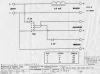
I guess most people are happy to replace the 2uf caps with nice new film ones and get on with their lives. That is probably just fine. But not very interesting. So here is what I ended up putting in my speakers:
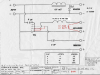
How's that for a Frankenstein Monster! I added a 30uf across the woofer to shunt high frequencies. I left the inductor in the squaker to keep some high frequencies out of there. I tapped down the transformer and added the 16 ohm resistor. I think the woofer capacitor should be on the other side of the inductor the way i installed it but I have to go back and check. It's probably not doing much anyway. Here is what it looked like in the speaker:
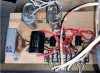
I guess that's a 33uf cap instead of a 30uf like the schematic. Don't tell anyone, maybe they won't notice.
I left the original can caps on the board for posterity. Everything could have been laid out better but I was mostly winging it on this one.
I hooked the driver up with the back still opened to check my work. OH NO, No squawker or tweeter? But they work when I hook them up directly to the amp (carefully not to fry them with out a crossover). After a bit of head banging and wire jiggling I found this:
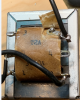
Bad day in quality control on the transformer line I guess. I reflowed the solder (or maybe flowed for the first time) and all was well again.
I did read somewhere that adding fill to the speaker will help the poppyness of the bass. That seemed reasonable. Got some at Walmart. But first I put some house hold bug screen over the woofer to keep the fill from messing with the driver:
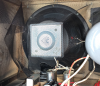
This is what one 16oz bag looks like after it expands. I have a few extra bags. . .
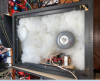
Maybe I'll make the teddy bear:
That's a really awful picture:
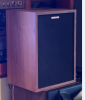
They sound better than they did when I first got them. But still no boomy bass. Never had it, never will. Unless you go down the road of replacing the woofers like some people I have googled. But then it's not the same speaker. I have other speakers (lots) if I want boomy bass. The now sound smooth without any painful ear ripping highs. And that is good enough for me. End of story until I get some replies telling me I am an idiot for my Frankenstein modifications and other replies offering kind suggestions.
I implemented this schematic with a new iron core inductor for the woofer even though the value matched the existing inductor. I have sense given up on swapping out inductors unless the values have to change. I could not find a 20 watt 11 ohm resistor so I used two 22 ohm 10watt in parallel. I got nice new Solen film caps. Hooked it all up and it sounded the same. Maybe worse. And if I brought the volume up even a little it would clip my amplifier. I got frustrated, gave up, and bought some other stuff to relieve my anxiety.
Since I have been on a speaker recap kick this winter I brought these back to the bench. This time I was going to try this schematic:
As far as my simple mind can determine this matches the original schematic except they are tapping down the squawker (mid-range) and tweeter to a lower level on the transformer. Then adding a 16 ohm resistor across the squawker to balance out the impedance the amplifier sees. It also modifies the inductor to the woofer to a higher value. but not much higher. If you are really into symbols you will notice the difference between air core and iron core inductors in the different drawings. Air core cost more because they require more turns to make the required inductance. And it has to be bigger wire to keep the resistance down. Iron core generate the required inductance without the extra wire but there are trade offs. Maybe that is too simple. Feel free to google your way down the rabbit hole on that one. but I digress. . .
Here is the original schematic if anyone cares:
I guess most people are happy to replace the 2uf caps with nice new film ones and get on with their lives. That is probably just fine. But not very interesting. So here is what I ended up putting in my speakers:
How's that for a Frankenstein Monster! I added a 30uf across the woofer to shunt high frequencies. I left the inductor in the squaker to keep some high frequencies out of there. I tapped down the transformer and added the 16 ohm resistor. I think the woofer capacitor should be on the other side of the inductor the way i installed it but I have to go back and check. It's probably not doing much anyway. Here is what it looked like in the speaker:
I guess that's a 33uf cap instead of a 30uf like the schematic. Don't tell anyone, maybe they won't notice.
I left the original can caps on the board for posterity. Everything could have been laid out better but I was mostly winging it on this one.
I hooked the driver up with the back still opened to check my work. OH NO, No squawker or tweeter? But they work when I hook them up directly to the amp (carefully not to fry them with out a crossover). After a bit of head banging and wire jiggling I found this:
Bad day in quality control on the transformer line I guess. I reflowed the solder (or maybe flowed for the first time) and all was well again.
I did read somewhere that adding fill to the speaker will help the poppyness of the bass. That seemed reasonable. Got some at Walmart. But first I put some house hold bug screen over the woofer to keep the fill from messing with the driver:
This is what one 16oz bag looks like after it expands. I have a few extra bags. . .
Maybe I'll make the teddy bear:
That's a really awful picture:
They sound better than they did when I first got them. But still no boomy bass. Never had it, never will. Unless you go down the road of replacing the woofers like some people I have googled. But then it's not the same speaker. I have other speakers (lots) if I want boomy bass. The now sound smooth without any painful ear ripping highs. And that is good enough for me. End of story until I get some replies telling me I am an idiot for my Frankenstein modifications and other replies offering kind suggestions.