

You are using an out of date browser. It may not display this or other websites correctly.
You should upgrade or use an alternative browser.
You should upgrade or use an alternative browser.
Kraut's New Listening Space

Wondering what you use to cut the veneer edges - and what is your sanding method? It appears that you sand your edges to a bevel, with no signs of edge cuts following the grain into the danger zone along the edge.

KrautNotRice
Well-Known Member
Thanks K! Great looking work on those.
Kraut!
Beautiful veneer work here!
I need me a new project!
Cheers, Glenn
Thank you for the kind words.
Where do you source your veneer and what kind? How much does something like this effort cost in veneer?
I get all my veneer directly from JSO Wood Products. They're great and also have an ebay store.
I only mess with paper backed veneer and contact cement. Raw veneer takes a great deal of extra work and equipment. That burl piece was an exception, and also a ton of extra effort.
These speakers are wrapped in cherry, a $60 (plus shipping) 4 x 8' sheet (very cheap for wood veneer) with plenty left over. Also, a bucket of contact cement is $30 but lasts several projects. Rollers, brushes, utility knife blades, 220 grit sandpaper, tung oil, rags and microfiber towels are consumables.
The biggest expense is simply time, these speakers were extra labor intensive because of the front edging.
Wondering what you use to cut the veneer edges - and what is your sanding method? It appears that you sand your edges to a bevel, with no signs of edge cuts following the grain into the danger zone along the edge.
I only use a fixed blade utility knife, the retractable ones have too much play. I flip / change the blade often to keep it fresh and prevent tearing of the wood. I cut close to the edge with the blade along the grain, then sand the rest of the way with a sanding block and 220 grit. When trimming an edge that is against the grain, I trim right against the edge with the blade. Against the grain is less nerve wrecking. Then follow with 220 grit.
I lightly round over the edges with the sanding block so it feels smooth and not sharp. The different kinds of wood veneer all vary in how much the edges show, just depends on how well the paper backer color matches the wood, the type of finish also makes a difference.


Thank you for the kind words.
I get all my veneer directly from JSO Wood Products. They're great and also have an ebay store.
I only mess with paper backed veneer and contact cement. Raw veneer takes a great deal of extra work and equipment. That burl piece was an exception, and also a ton of extra effort.
These speakers are wrapped in cherry, a $60 (plus shipping) 4 x 8' sheet (very cheap for wood veneer) with plenty left over. Also, a bucket of contact cement is $30 but lasts several projects. Rollers, brushes, utility knife blades, 220 grit sandpaper, tung oil, rags and microfiber towels are consumables.
The biggest expense is simply time, these speakers were extra labor intensive because of the front edging.
I only use a fixed blade utility knife, the retractable ones have too much play. I flip / change the blade often to keep it fresh and prevent tearing of the wood. I cut close to the edge with the blade along the grain, then sand the rest of the way with a sanding block and 220 grit. When trimming an edge that is against the grain, I trim right against the edge with the blade. Against the grain is less nerve wrecking. Then follow with 220 grit.
I lightly round over the edges with the sanding block so it feels smooth and not sharp. The different kinds of wood veneer all vary in how much the edges show, just depends on how well the paper backer color matches the wood, the type of finish also makes a difference.
Very nice work! I popped over to fleabay to check out his veneer. Oh man - there's a 4x8 of teak for 180.00. Drool! Anyway, great veneer work you've done there.
KrautNotRice
Well-Known Member
Finally got around to snapping some more pics of the ADS L520. I'm moving into a smaller place soon, so I actually need to get rid of most of my speakers. I'm not sure how many pairs I actually own right now, but it's over 10.
I'll be posting these on BT shortly.
The L520s sound absolutely amazing, probably the most accurate and clear vintage speakers I've ever heard. They don't have an excessive midrange dip, nor are the highs rolled off. Just accurate, full and clear with great bass.
I enjoy listening to these quite a bit.

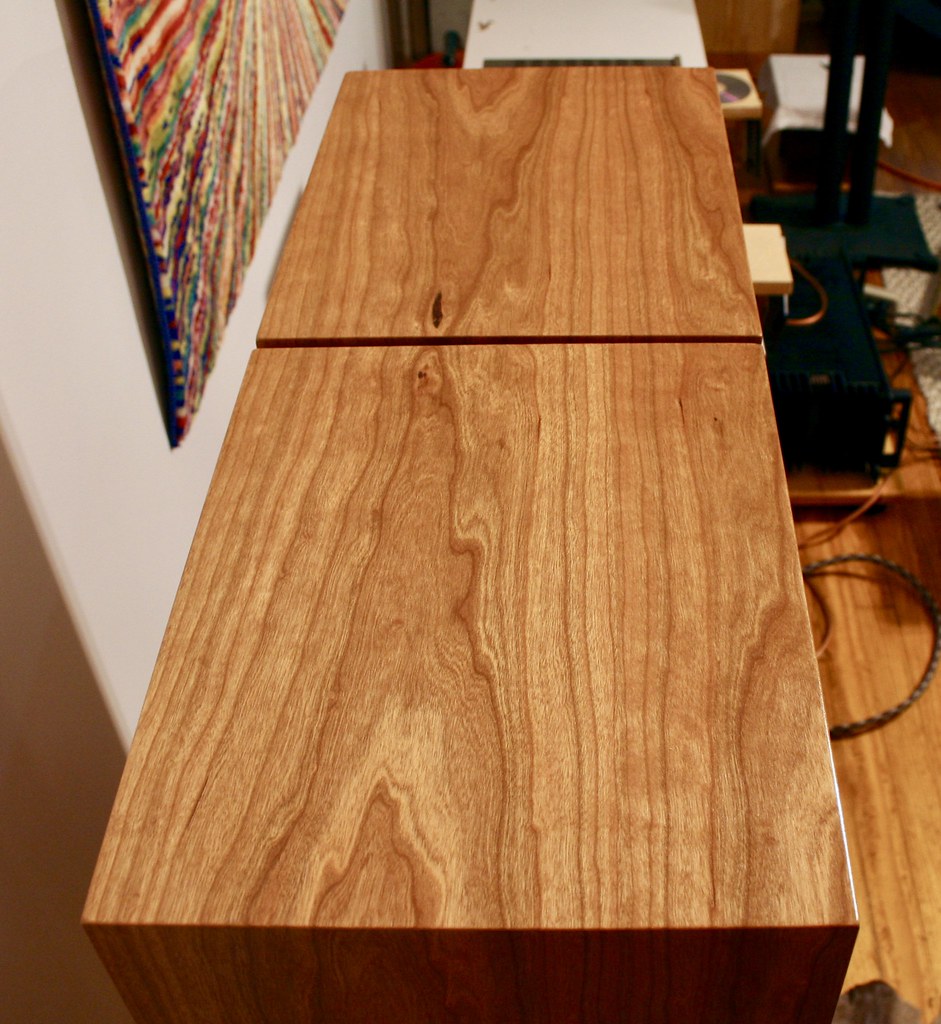


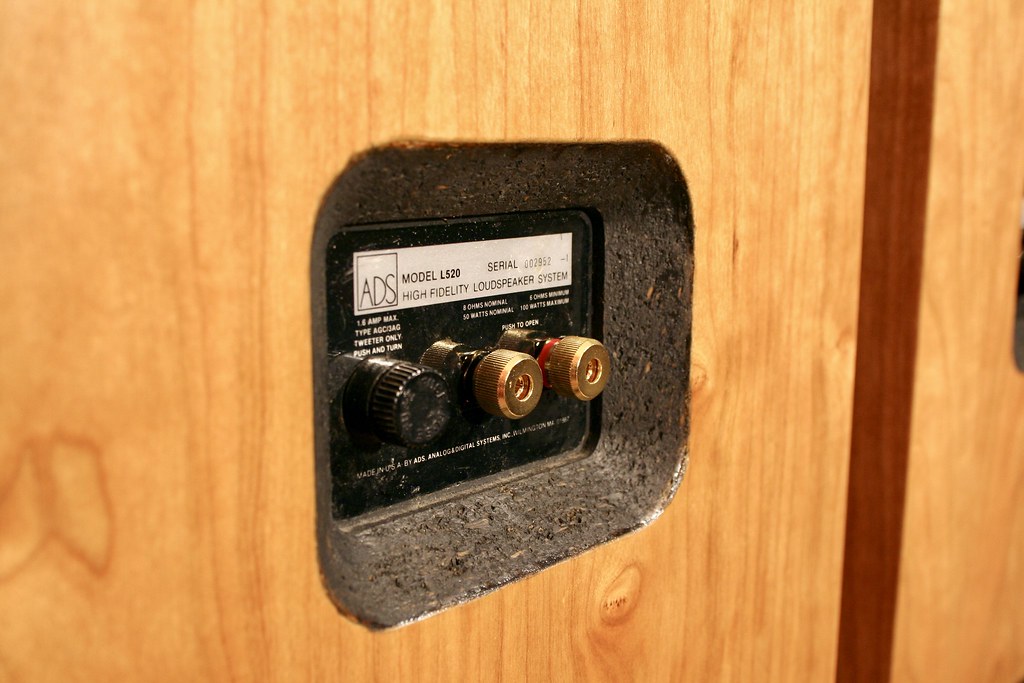


I'll be posting these on BT shortly.
The L520s sound absolutely amazing, probably the most accurate and clear vintage speakers I've ever heard. They don't have an excessive midrange dip, nor are the highs rolled off. Just accurate, full and clear with great bass.
I enjoy listening to these quite a bit.
KrautNotRice
Well-Known Member
^^^^^^ Forgot to mention: I did veneer the front baffles in cherry as well. However, I didn't like how it looked, it just didn't look like proper ADS anymore without black baffles, so I blacked out the fronts by mixing ebony stain with tung oil finish, yielding a semi-gloss black, compared to the more matte sheen the rest of the cabs have.
^^^^^^ Forgot to mention: I did veneer the front baffles in cherry as well. However, I didn't like how it looked, it just didn't look like proper ADS anymore without black baffles, so I blacked out the fronts by mixing ebony stain with tung oil finish, yielding a semi-gloss black, compared to the more matte sheen the rest of the cabs have.
Nice job on the refinish.
Very Beautiful!Finally got around to snapping some more pics of the ADS L520. I'm moving into a smaller place soon, so I actually need to get rid of most of my speakers. I'm not sure how many pairs I actually own right now, but it's over 10.
I'll be posting these on BT shortly.
The L520s sound absolutely amazing, probably the most accurate and clear vintage speakers I've ever heard. They don't have an excessive midrange dip, nor are the highs rolled off. Just accurate, full and clear with great bass.
I enjoy listening to these quite a bit.
The cabinets look better than when new!The L520s sound absolutely amazing, probably the most accurate and clear vintage speakers I've ever heard. They don't have an excessive midrange dip, nor are the highs rolled off. Just accurate, full and clear with great bass.
I used to work part time in college selling those during the 70s. That's an update of the popular L500. I owned a pair of Braun (predecessor to ADS) LV1020s.

Glad you like the L520 as I am also a fan of the L420/L520 speakers. They do nothing wrong and are easy to listen to. In a medium to small room they perform very well. Put them close to the wall for better bass response.
Last edited:
OK, I just ordered some cherry veneer from JSO. I've got a set of speakers I want to try this on.
GLWTS by the way!
Still waiting on my veneer to arrive....

KrautNotRice
Well-Known Member
OK, I just ordered some cherry veneer from JSO. I've got a set of speakers I want to try this on.
GLWTS by the way!
Hope that your project comes out well, would love to see pics of it once done. It can be very tedious, just take your time.
Nice K!
Good call on the baffles.
What ya gonna do about the grilles?
Thanks to everyone for the comments.
The grilles will be upholstered in a fabric of the new owner's choice.
I'm having a bit of a Tannoy-off / Tannoy-a-thon / Tannoying the neighbors as of late. I'm a fan.

The ones in the middle are about to receive a complete make over incl. new custom cabinets from scratch, rebuilt crossovers, upgraded wiring and inputs, etc. Then I'm most likely building a pair of twin 15" PA subs to flank them and the JBL towers.
KrautNotRice
Well-Known Member
Been listening to these for a good few days now with a wide variety of music, probably 30+ hrs, and very much like them. Since I finally decided on dimensions and style of new cabs, it was time to crack these open for a first look.
Tannoy i8 professional / pa speakers using type 2062 8" dual concentric, paper cone driver.
1.7 khz crossover point with 4th order high pass, 2nd order lowpass
Dynamic hf protection (light bulb)
In only .56 cf front ported
8 Ohm, 92db
-3db point is 85hz
130w average / 260w program / 520 peak power handling
Designed for high power handling, not full range, sound reinforcement
Just going to deposit this Tannoy pr0n here.


Just a stamped frame, paper cone woofer and aluminum dome tweeter here.
Who knew? Apparently it doesn't take super exotic materials and vapor deposited precious metals, nor cast baskets to make a ridiculously good sounding speaker with very high power handling, high sensitivity and near linear frequency response.


Crossovers look like there aren't any cheap electrolytics that need replacing right away.
Date code on woofer magnet reads 1998.
They sound really good above 100 hz or so, obviously they're not meant to have much bass. I don't know the stock cabs' tuning frequency, but the woofers' fs is most likely really high, they're very stiff. So I figured they'd be great with a pair of 15" pa subs.
The idea is to put these Tannoys in slightly larger, vintage style cabs and high pass them electronically somewhere around 100 to 200 hz, depending on how the subs end up sounding / blending.
Yes, mounting them in larger cabs with lower tuning will drop their power handling when they're played as stand-alone speakers (not high passed), but to be honest the P2200's needles haven't gone over 10 watts at my personal reference levels, and as is they can take 130 to 260.
In other words: these get crazy loud.
Tannoy i8 professional / pa speakers using type 2062 8" dual concentric, paper cone driver.
1.7 khz crossover point with 4th order high pass, 2nd order lowpass
Dynamic hf protection (light bulb)
In only .56 cf front ported
8 Ohm, 92db
-3db point is 85hz
130w average / 260w program / 520 peak power handling
Designed for high power handling, not full range, sound reinforcement
Just going to deposit this Tannoy pr0n here.
Just a stamped frame, paper cone woofer and aluminum dome tweeter here.
Who knew? Apparently it doesn't take super exotic materials and vapor deposited precious metals, nor cast baskets to make a ridiculously good sounding speaker with very high power handling, high sensitivity and near linear frequency response.
Crossovers look like there aren't any cheap electrolytics that need replacing right away.
Date code on woofer magnet reads 1998.
They sound really good above 100 hz or so, obviously they're not meant to have much bass. I don't know the stock cabs' tuning frequency, but the woofers' fs is most likely really high, they're very stiff. So I figured they'd be great with a pair of 15" pa subs.
The idea is to put these Tannoys in slightly larger, vintage style cabs and high pass them electronically somewhere around 100 to 200 hz, depending on how the subs end up sounding / blending.
Yes, mounting them in larger cabs with lower tuning will drop their power handling when they're played as stand-alone speakers (not high passed), but to be honest the P2200's needles haven't gone over 10 watts at my personal reference levels, and as is they can take 130 to 260.
In other words: these get crazy loud.
Last edited:

Interesting project K. Makes sense as those in their current form really aren't very useful or attractive for how good they are.
Question for you, how do you press the veneer when gluing onto the existing speaker cabinet? Most of the youtube tutorials I have been watching for veneer are of course doing panels only.
Question for you, how do you press the veneer when gluing onto the existing speaker cabinet? Most of the youtube tutorials I have been watching for veneer are of course doing panels only.
Last edited:
KrautNotRice
Well-Known Member
Question for you, how do you press the veneer when gluing onto the existing speaker cabinet? Most of the youtube tutorials I have been watching for veneer are of course doing panels only.
I press the veneer by hand, I make a fist and run the bottom of my palm over the surface systematically, sometimes I use a hard rubber roller, or if it's really small ledges I sometimes use a smooth, curved metal piece. They sell hand tools for pressing down veneer, but I haven't needed it yet. Those rubber rollers for sound deadener application can come in handy.
I press the veneer by hand, I make a fist and run the bottom of my palm over the surface systematically, sometimes I use a hard rubber roller, or if it's really small ledges I sometimes use a smooth, curved metal piece. They sell hand tools for pressing down veneer, but I haven't needed it yet. Those rubber rollers for sound deadener application can come in handy.
So no clamping somehow?
KrautNotRice
Well-Known Member
So no clamping somehow?
Contact cement. My best friend and worst nightmare at the same time lol