

You are using an out of date browser. It may not display this or other websites correctly.
You should upgrade or use an alternative browser.
You should upgrade or use an alternative browser.
Leestereo's Restoration/Upgrade Of A Sansui AU-717
- Thread starter Leestereo
- Start date

Soundphile
Active Member
Great learning thread. You advise that Ceremic capacitors be replaced with same value C0G type. But in Post #20, the 100pF Ceremic capacitors C03 & C04 (low input pass) were replaced with WIMA FKP2 polyproplyene caps of same value. Just trying to understand why polyproplyene here instead of C0G?
Keep the pics and comments coming. Its awesome.
Cheers, Robert.
Keep the pics and comments coming. Its awesome.
Cheers, Robert.

Leestereo
Super Member
The characteristics of polypropylene film and C0G capacitors are very close to ideal (see below). In this particular case, the polypropylene film capacitor was used primarily for 2 reasons: it was available in a higher precision variant (2.5% tolerance) and there was sufficient space on the phono board to accommodate is larger physical size.
Comparison of distortion plots for a garden-variety (X7R) ceramic capacitor, a C0G/NPO capacitor and a polypropylene film/foil capacitor.

The X7R ceramic capacitor shows obvious distortion of the 1kHz signal; interestingly, the odd-order harmonics (which are more objectionable) are more prominent.
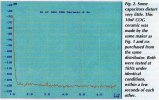

All figures from the Capacitor Sound article by Cyril Bateman published in Electonics World (July 2002).
Comparison of distortion plots for a garden-variety (X7R) ceramic capacitor, a C0G/NPO capacitor and a polypropylene film/foil capacitor.
The X7R ceramic capacitor shows obvious distortion of the 1kHz signal; interestingly, the odd-order harmonics (which are more objectionable) are more prominent.
All figures from the Capacitor Sound article by Cyril Bateman published in Electonics World (July 2002).
Last edited:


super98lsc
Well-Known Member
Excellent thread/data/pictures and explanations! Learning a lot here thanks again.
Soundphile
Active Member
Hi Leestereo,
Thanks a million. Really appreciate the explanation and charts. A great amount of knowledge and learning is coming along with your AU717 restoration.
Cheers,
Robert.
Thanks a million. Really appreciate the explanation and charts. A great amount of knowledge and learning is coming along with your AU717 restoration.
Cheers,
Robert.
super98lsc
Well-Known Member
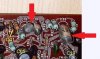
Leestereo, what type of caps are these? I noticed the CA-3000 has a bunch of them and it appeared the previous "tech" prior to my ownership let the soldering iron touch a few of them as there are melted marks in the outer plastic cases. I would like to just replace them for piece of mind.
Attachments
Leestereo
Super Member
Those are polystyrene film capacitors. They are very high quality types, available up to ~10nF in capacity and are often used in the RIAA equalization (as seen the picture), although Sansui also used them in low-pass filters (e.g., C01 on the driver boards). Note that they are solvent and heat sensitive (solder with a heat sink attached to the leads).

super98lsc
Well-Known Member
GIGANTIC Polypropestylinefoil main caps!!!:lmao:
super98lsc
Well-Known Member
This unit should sound incredible when its done as all the upgrades are selected using logic and data.
Leestereo
Super Member
GIGANTIC Polypropestylinefoil main caps!!!:lmao:
You'd probably have to have them delivered one-by-one on a low loader.
Wouldn't you know it, those caps were "Out of Stock"; it was just as well since the delivery costs alone are more than my car is worth!
Leestereo
Super Member
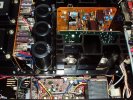
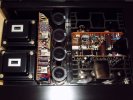
The 4 original power supply main capacitors (C701-C704), rated at 15,000µF/63V, were in great condition. They maintained a stable DC voltage of ±58V and the AC ripple was <12mV (this last measurement is as good as I have measured in similarly rated new capacitors). Following a discussion with the AU-717's owner, it was decided to forgo the expensive replacement of the main capacitors at this point. For future reference, a good "drop-in" replacement currently being manufactured is the Nichicon KG (Gold Tune) 15,000µF/63V capacitor, which uses solder lugs and is of the same 40mm diameter as the originals.

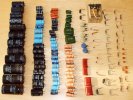
Below is picture of the all of the components that were replaced in this restoration/upgrade. Note that a number of the capacitors had "shrunken" sleeves (mostly from the F-2663 regulated power supply board), indicative of internal over-heating and failure. Even many of the F-2663 capacitors that looked fine were found to be defective, often measuring <10% of the stated capacitance.
Below is picture of the all of the components that were replaced in this restoration/upgrade. Note that a number of the capacitors had "shrunken" sleeves (mostly from the F-2663 regulated power supply board), indicative of internal over-heating and failure. Even many of the F-2663 capacitors that looked fine were found to be defective, often measuring <10% of the stated capacitance.
Last edited:
Soundphile
Active Member
It must sound amazing. Listening impressions?

Karl vd Berg
Super Member
These illustrated works of him are... :tresbon:
Leestereo
Super Member
Sound Impressions of the Restoration/Upgrade
In the 12 days since the final work on the AU-717 was completed, it has received ~30 hours of play time. Playing CD and LP recordings that I'm very familiar with (e.g., Steely Dan/Aja; Miles Davis/Kind of Blue; Dire Straits/Love Over Gold; Beatles/Abbey Road; ECO/Bach Brandenburg Ctos; Duke Ellington Orchestra/Digital Duke; Bohm, 1972 Beethoven Symphony cycle), the AU-717 never failed to impress! I would characterize the overall sound as very neutral and balanced, the Sansui never seemed to impose its sonic signature on the music but rather equally revealed the good and not-so good aspects of each recording. Subjectively, one could describe the AU-717's sound as having a lively/dynamic presentation with a wide soundstage and good image depth/height (the latter characteristics often attributed to amplifiers with "dual mono" construction). The upper range reproduction can be very detailed but was never found to be overly harsh; even recordings that are known to have an aggressive high range (e.g. Standage/ECO Four Seasons; Rolling Stones/Some Girls) were not overly "bright". The reproduction of the bass range was subjectively quite extended (the Beatles/Abbey Road remaster sounded particularly good). What is often referred to as "bass transients" was also impressive, but this may be more the result of the accurate reproduction of the middle frequencies. Indeed, reproduction of vocals does seem very clear and with a "live-in-the-room" quality; all of the little vocal "breaths" and 'hiccups" are easily discerned (e.g., Eric Clapton/Unplugged).
Before starting a restoration/upgrade, I typically listen to a unit to establish a "baseline sound" for comparison with the "restored/upgraded" sound. Unfortunately, due to the loud "hum" noise on both channels that was present in the AU-717 when I received it, I could not make this comparison. Note, however, that during the audition period, I never felt compelled to disconnect the Sansui and return to some of my usual gear: a Conrad Johnson PV-8 tube preamplifier; a restored/upgraded NAD 106 preamplifer (http://www.audiokarma.org/forums/showthread.php?t=550017); Hafler DH-110 preamplifier; a harman kardon hk770 power amplifier (http://www.audiokarma.org/forums/showthread.php?t=543774); recapped Marantz 170DC power amplifier; recapped Technics SE-9060 power amplifier.
A Couple of Other Thoughts: The "weak" spot in the AU-717, as in many integrated amplifiers, is the preamplifier stage (and its power supply). With the signal path upgrades (bi-polar, C0G and film capacitors) and power supply upgrades (greatly increased capacitance reserve), the preamplifier stage has been significantly improved; it is now a better match to the excellent power amplifier stage. IMO, the "sound" of this Sansui is the result of the circuit topology and the implementation of this topology; the quality of the components used in the build can only maximize/enhance the inherent sound potential of the design. Hence, as this restoration project demonstrates, the performance of a good vintage design can be returned to original or better by replacing failing/tired components with upgraded parts that weren't available (or were deemed too costly by the bean counters) when the unit was originally manufactured. I consider this restored/upgraded Sansui AU-717 among my personal list of "Top 10" integrated amplifiers, in terms of build quality and sound.

In the 12 days since the final work on the AU-717 was completed, it has received ~30 hours of play time. Playing CD and LP recordings that I'm very familiar with (e.g., Steely Dan/Aja; Miles Davis/Kind of Blue; Dire Straits/Love Over Gold; Beatles/Abbey Road; ECO/Bach Brandenburg Ctos; Duke Ellington Orchestra/Digital Duke; Bohm, 1972 Beethoven Symphony cycle), the AU-717 never failed to impress! I would characterize the overall sound as very neutral and balanced, the Sansui never seemed to impose its sonic signature on the music but rather equally revealed the good and not-so good aspects of each recording. Subjectively, one could describe the AU-717's sound as having a lively/dynamic presentation with a wide soundstage and good image depth/height (the latter characteristics often attributed to amplifiers with "dual mono" construction). The upper range reproduction can be very detailed but was never found to be overly harsh; even recordings that are known to have an aggressive high range (e.g. Standage/ECO Four Seasons; Rolling Stones/Some Girls) were not overly "bright". The reproduction of the bass range was subjectively quite extended (the Beatles/Abbey Road remaster sounded particularly good). What is often referred to as "bass transients" was also impressive, but this may be more the result of the accurate reproduction of the middle frequencies. Indeed, reproduction of vocals does seem very clear and with a "live-in-the-room" quality; all of the little vocal "breaths" and 'hiccups" are easily discerned (e.g., Eric Clapton/Unplugged).
Before starting a restoration/upgrade, I typically listen to a unit to establish a "baseline sound" for comparison with the "restored/upgraded" sound. Unfortunately, due to the loud "hum" noise on both channels that was present in the AU-717 when I received it, I could not make this comparison. Note, however, that during the audition period, I never felt compelled to disconnect the Sansui and return to some of my usual gear: a Conrad Johnson PV-8 tube preamplifier; a restored/upgraded NAD 106 preamplifer (http://www.audiokarma.org/forums/showthread.php?t=550017); Hafler DH-110 preamplifier; a harman kardon hk770 power amplifier (http://www.audiokarma.org/forums/showthread.php?t=543774); recapped Marantz 170DC power amplifier; recapped Technics SE-9060 power amplifier.
A Couple of Other Thoughts: The "weak" spot in the AU-717, as in many integrated amplifiers, is the preamplifier stage (and its power supply). With the signal path upgrades (bi-polar, C0G and film capacitors) and power supply upgrades (greatly increased capacitance reserve), the preamplifier stage has been significantly improved; it is now a better match to the excellent power amplifier stage. IMO, the "sound" of this Sansui is the result of the circuit topology and the implementation of this topology; the quality of the components used in the build can only maximize/enhance the inherent sound potential of the design. Hence, as this restoration project demonstrates, the performance of a good vintage design can be returned to original or better by replacing failing/tired components with upgraded parts that weren't available (or were deemed too costly by the bean counters) when the unit was originally manufactured. I consider this restored/upgraded Sansui AU-717 among my personal list of "Top 10" integrated amplifiers, in terms of build quality and sound.
Last edited: