• The move to the new server is done. There are some software and database maintenance updates in process. This has us passing the hat around to help out. We appreciate any donations. Seriously, even a dollar helps. The payment page may be found here - https://www.audiokarma.org/support.html

Life span 6BQ5 tubes

It is the 6p14p-v that are rated at 1k hours. The regular 6p14p and -k are rated at 3k hours with the K being vibration resistant. The 6p14p-ev are rated at 5k hours and are the ones you want to use if running at say 375v or higher.

The way I see it is at current prices of NOS European and US tubes, its a way better value to purchase 3 or 4 quads of those old 6p14p with that $80.
 
Last edited:
It is the 6p14p-v that are rated at 1k hours. The regular 6p14p and -k are rated at 3k hours with the K being vibration resistant. The 6p14p-ev are rated at 5k hours and are the ones you want to use if running at say 375v or higher.

The way I see it is at current prices of NOS European and US tubes, its a way better value to purchase 3 or 4 quads of those old 6p14p with that $80.
That was my thinking. Now that I've listened to the 6P14P-K's, I'm going to buy a couple more quads of them. I can get two quads for less than a quad of JJ EL84's or Sovtek EL84M's.
 
I run my 6P14P-EV in push pull on my Raphaelite for +25000 hours

Probably good for another 25000 hours.

The secret is in the thermistors and amplifier specs, tubes turned on slowly and runs on cool side (300V).
 
Last edited:
I run my 6P14P-EV in push pull on my Raphaelite for +25000 hours

Probably good for another 25000 hours.

The secret is in the thermistors and amplifier specs, tubes turned on slowly and runs on cool side (300V).
Thermistors do help make the turn on less stressful since they limit the inrush current. But once the amp is powered on they have essentially zero effect other than the very small voltage drop which has a minimal effect. At that point they function as a very low value resistor.

The heaters will not be stressed as much at turn on but, other than reducing the possibility of having a heater burn out, I don't see how it would influence tube life if the heater voltage is the same. I've found a few used tubes with dead heaters over the past 20 years but I've never had one burn out in use.

An indirectly heated rectifier will produce a much slower ramp up of the B+ than a thermistor but if the amp has a SS rectifier they can help a bit.

Thermistors would not affect the B+ voltage by any appreciable amount after the amp is powered up. And it's not simply the voltage that matters, it's the dissipation, which is a combination of voltage and current. So saying that the amp runs cool at 300v is meaningless unless the current is factored in.

For example, in another recent thread I posted operating points of several 6BQ5 amps. One was a Packard Bell that ran the tubes at 330v and another was a Pilot that ran them at 335v. But the P-B runs them at 30.5mA for a dissipation of 10.06 watts while the Pilot runs them at 41.7mA for a dissipation of 13.96 watts. The data sheet maximum is 14 watts.

I've never attempted to keep track of how many hours I have on a particular amp or the tubes that are installed in it.

Did you test the tubes for both emission and transconductance and compare their readings when new and then with 25,000 hours? Or are you just basing your comment on how they sound?

Tubes can certainly still sound nice even if they don't test so great. When I first got a tube tester I pulled some 6BQ5s from a Sherwood S-5000 that I had been using regularly. All the tubes were what was in the amp when I bought it.

The tester was an Eico 666 which is basically an emissions tester, no transconductance readings. The tubes sounded great but tested in the yellow, "Weak / ???", zone. I popped in some new ones of the same brand and didn't really hear any obvious difference so I popped the old ones back in.

BTW, the Sherwood runs the outputs at 412.5v and 20.8mA for a dissipation of only 8.58 watts.
 
Last edited:
Thermistors do help make the turn on less stressful since they limit the inrush current. But once the amp is powered on they have essentially zero effect other than the very small voltage drop which has a minimal effect. At that point they function as a very low value resistor.

The heaters will not be stressed as much at turn on but, other than reducing the possibility of having a heater burn out, I don't see how it would influence tube life if the heater voltage is the same. I've found a few used tubes with dead heaters over the past 20 years but I've never had one burn out in use.

An indirectly heated rectifier will produce a much slower ramp up of the B+ than a thermistor but if the amp has a SS rectifier they can help a bit.

Thermistors would not affect the B+ voltage by any appreciable amount after the amp is powered up. And it's not simply the voltage that matters, it's the dissipation, which is a combination of voltage and current. So saying that the amp runs cool at 300v is meaningless unless the current is factored in.

For example, in another recent thread I posted operating points of several 6BQ5 amps. One was a Packard Bell that ran the tubes at 330v and another was a Pilot that ran them at 335v. But the P-B runs them at 30.5mA for a dissipation of 10.06 watts while the Pilot runs them at 41.7mA for a dissipation of 13.96 watts. The data sheet maximum is 14 watts.

I've never attempted to keep track of how many hours I have on a particular amp or the tubes that are installed in it.

Did you test the tubes for both emission and transconductance and compare their readings when new and then with 25,000 hours? Or are you just basing your comment on how they sound?

Tubes can certainly still sound nice even if they don't test so great. When I first got a tube tester I pulled some 6BQ5s from a Sherwood S-5000 that I had been using regularly. All the tubes were what was in the amp when I bought it.

The tester was an Eico 666 which is basically an emissions tester, no transconductance readings. The tubes sounded great but tested in the yellow, "Weak / ???", zone. I popped in some new ones of the same brand and didn't really hear any obvious difference so I popped the old ones back in.

BTW, the Sherwood runs the outputs at 412.5v and 20.8mA for a dissipation of only 8.58 watts.


Depend where you placed the thermistor(s), I did put one on the 280V PT Secondary while there is another one on primary, both 120 ohms 1.8A (I measured ≈150 ohms ≈22°C (72°F)

I think Voltages and Dissipation of the amp been calculated for 120V input and 6BQ5/EL84 tubes while 6P14P-EV are rugged versions.

And with double thermistors, it can starts playing music in about 45 seconds with a directly heated rectifier (As buffer after rectified by diodes and cap)

I used to use directly heated RCA 5Y3GT for long time, now for a week or two I use a SS Weber Copper Cap WY3GT to compare, I still benefit of the thermistor.

I didn't check transconductance but Emission, when new the Sencore TC 162 marked about 107/120 , and maybe 2 or 3 years ago while it passed the 20000 hours, they measured about 104/120

25000 hours is approximative, I did run it for long time 15 hours per day and I use it for 10 years (Sometimes I use some other amps)

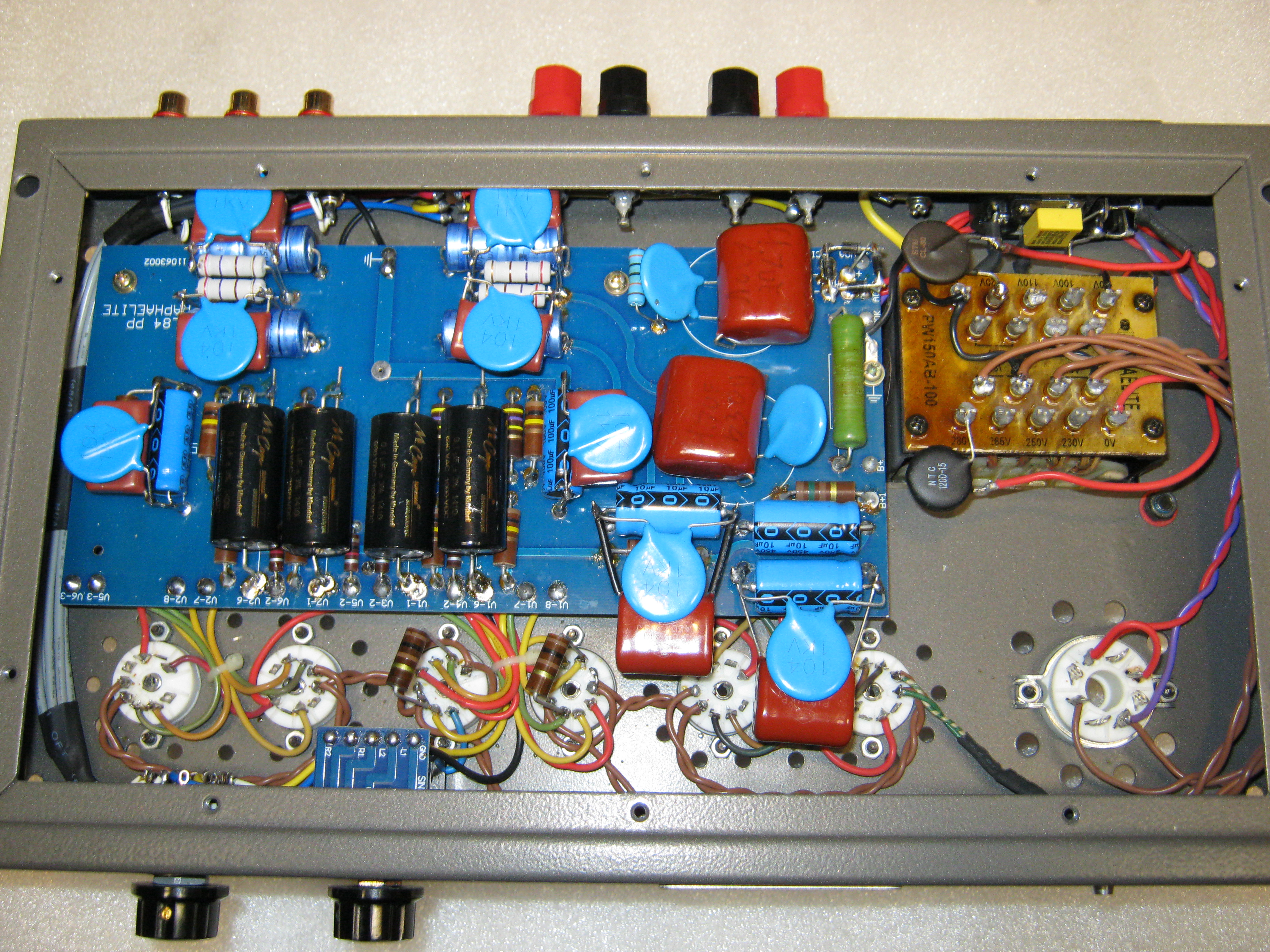
IBovgoRjbQs_DP84.JPG


GKclZyRUGxt_Raphaelite-DP84-Schematics.jpg
 
Depend where you placed the thermistor(s), I did put one on the 280V PT Secondary while there is another one on primary, both 120 ohms 1.8A (I measured ≈150 ohms ≈22°C (72°F)

I think Voltages and Dissipation of the amp been calculated for 120V input and 6BQ5/EL84 tubes while 6P14P-EV are rugged versions.

And with double thermistors, it can starts playing music in about 45 seconds with a directly heated rectifier (As buffer after rectified by diodes and cap)

I used to use directly heated RCA 5Y3GT for long time, now for a week or two I use a SS Weber Copper Cap WY3GT to compare, I still benefit of the thermistor.

I didn't check transconductance but Emission, when new the Sencore TC 162 marked about 107/120 , and maybe 2 or 3 years ago while it passed the 20000 hours, they measured about 104/120

25000 hours is approximative, I did run it for long time 15 hours per day and I use it for 10 years (Sometimes I use some other amps)

IBovgoRjbQs_DP84.JPG


GKclZyRUGxt_Raphaelite-DP84-Schematics.jpg
The 120 ohm rating is when the thermistors are cold. After the amp is switched on their resistance drops drastically.

I looked at the specs for several similar ones (rated at 120 ohms 2A) and the resistance drops to between 0.693 ohms and 2.34 ohms depending on the brand. So, again they will have almost no effect on the operating points of the tubes after the initial startup.

The schematic you posted shows that drop across R16 (100 ohms) is 17v, so the entire circuit is drawing 170mA. If your two thermistors measure 1.5 ohms each when hot the additional resistance will only drop the voltage 17.51v. So that's only 0.51 volts more voltage drop than without them. This will have no effect on the longevity of the tubes. Variations in the voltage from the wall that normally occur throughout the day will have a larger effect than that on the operating points.

The actual voltage drop will likely be less since the circuit doesn't draw as much current as the parts are rated for. You can measure after the amp has warmed up and voltages have stabilized. Then use Ohm's Law to calculate their resistance when hot.

And, according to the schematic, the output tubes are not being run at 300v. Plate voltage is measured across the tube from the plate to the cathode. It shows 296v on the plate and 10.5v on the cathode, so voltage is 285.5v. With 10.5v on the cathode and a 270 ohm bias resistor on each tube the current draw is 10.5/270 = 0.0388 or 38.9mA. Dissipation is then 285.5 x .0389 = 11.1 watts.

Dissipation is key and if the amp ran the tubes closer to, or higher than, 14 watts of dissipation then they wouldn't last as long.
 
Last edited:
The 120 ohm rating is when the thermistors are cold. After the amp is switched on their resistance drops drastically.

I looked at the specs for several similar ones (rated at 120 ohms 2A) and the resistance drops to between 0.693 ohms and 2.34 ohms depending on the brand. So, again they will have almost no effect on the operating points of the tubes after the initial startup.

The schematic you posted shows that drop across R16 (100 ohms) is 17v, so the entire circuit is drawing 170mA. If your two thermistors measure 1.5 ohms each when hot the additional resistance will only drop the voltage 17.51v. So that's only 0.51 volts more voltage drop than without them. This will have no effect on the longevity of the tubes. Variations in the voltage from the wall that normally occur throughout the day will have a larger effect than that on the operating points.

The actual voltage drop will likely be less since the circuit doesn't draw as much current as the parts are rated for. You can measure after the amp has warmed up and voltages have stabilized.

And, according to the schematic, the output tubes are not being run at 300v. Plate voltage is measured across the tube from the plate to the cathode. It shows 296v on the plate and 10.5v on the cathode, so voltage is 285.5v. With 10.5v on the cathode and a 270 ohm bias resistor on each tube the current draw is 10.5/270 = 0.0388 or 38.9mA. Dissipation is then 285.5 x .0389 = 11.1 watts.

Dissipation is key and if the amp ran the tubes closer to, or higher than, 14 watts of dissipation then they wouldn't last as long.

In my mind Slow start-up is a major key for longevity of tubes, regardless if thermistors change the continuous operating points or not, what I don't really want them to.
 
Last edited:
In my mind Slow start-up is a major key for longevity of tubes, regardless if thermistors change the continuous operating points or not, what I don't really want them to.
I like the idea of slow startup too so I try to use indirectly heated rectifier tubes whenever possible. That said, lots of vintage amps use directly heated rectifiers without any thermistors and they don't seem to have issues with tube life, so I think dissipation is the dominant factor as long as ventilation is adequate.

If you want a much softer start than you're getting with the thermistors there are a couple of variations of the 5Y3 that are indirectly heated - the 6087 and 6106 - which are drop in subs. There may also be a Chinese rectifier that's similar.
 
I like the idea of slow startup too so I try to use indirectly heated rectifier tubes whenever possible. That said, lots of vintage amps use directly heated rectifiers without any thermistors and they don't seem to have issues with tube life, so I think dissipation is the dominant factor as long as ventilation is adequate.

If you want a much softer start than you're getting with the thermistors there are a couple of variations of the 5Y3 that are indirectly heated - the 6087 and 6106 - which are drop in subs. There may also be a Chinese rectifier that's similar.

Yes, I have some Bendix 6106 and GE 5 Star 6087, very soft start with the 6106, but always preferred the RCA 5Y3GT for the sound it help achieve, over some other 5Y3GT too.
 
In my mind Slow start-up is a major key for longevity of tubes, regardless if thermistors change the continuous operating points or not, what I don't really want them to.


I use some thermistors on the primary of the mains transformer - that will prevent the 12AT7 behaving like a flashbulb at startup and ensures slowly heating up of the filaments. I also use a single 6CL3 damper diode in the return wire to the C.T. of the HT to the mains transformer. The damper diode also helped to reduce the slightly too high B+ voltage (it dropped around 14V DC) There is a thermal delay relay powered from the 6.3V winding that bypasses the thermistors after about 1 minute.

The only issue with this is if there is a power outage and power comes back before the thermal delay relay has been reset. But since I am using a UPS this will not be happening otherwise I would use a Tempatron solid state delay relay that immediately resets.

I am particular to Telam / Polam EL84. These were made in the Polam factory in Poland which was a Philips factory. At one stage these were very cheap, don't know the current pricing. But the "sound" of the output tube is in my honest opinion a lot of bollocks in HiFi equipment since the feedback corrects the deficiencies of the output tube. Far more important is the output transformer as it will restrict frequency response, creates phase shifts and has an impact on stability with difficult loads. Unless you are running tubes in fixed bias and in class AB2 you can most of the time get away with non matched tubes as long as the cathode current can be individually adjusted.

I also am fond of a floating paraphase inverter that can be adjusted. It allows to adjust for minimum overal distortion in the phase inverter and output stage. When I tested this I managed to adjust to half the distortion than if the phase inverter was adjusted to "perfect" operation (with identcial levels as output) and "matched" output tubes. Slightly adjusting the phase inverter reduced the distortion at the output.
 
I use some thermistors on the primary of the mains transformer - that will prevent the 12AT7 behaving like a flashbulb at startup and ensures slowly heating up of the filaments. I also use a single 6CL3 damper diode in the return wire to the C.T. of the HT to the mains transformer. The damper diode also helped to reduce the slightly too high B+ voltage (it dropped around 14V DC) There is a thermal delay relay powered from the 6.3V winding that bypasses the thermistors after about 1 minute.

The only issue with this is if there is a power outage and power comes back before the thermal delay relay has been reset. But since I am using a UPS this will not be happening otherwise I would use a Tempatron solid state delay relay that immediately resets.

I am particular to Telam / Polam EL84. These were made in the Polam factory in Poland which was a Philips factory. At one stage these were very cheap, don't know the current pricing. But the "sound" of the output tube is in my honest opinion a lot of bollocks in HiFi equipment since the feedback corrects the deficiencies of the output tube. Far more important is the output transformer as it will restrict frequency response, creates phase shifts and has an impact on stability with difficult loads. Unless you are running tubes in fixed bias and in class AB2 you can most of the time get away with non matched tubes as long as the cathode current can be individually adjusted.

I also am fond of a floating paraphase inverter that can be adjusted. It allows to adjust for minimum overal distortion in the phase inverter and output stage. When I tested this I managed to adjust to half the distortion than if the phase inverter was adjusted to "perfect" operation (with identcial levels as output) and "matched" output tubes. Slightly adjusting the phase inverter reduced the distortion at the output.

For short outages and sudden current return I use a TRC Shock Shield, whenever the current stops for half a second, the TRC Shock Shield stops current, have to push on the reset button for the current to come back. Simple and safe.
 
I’m a fan of the 6p14p-EV tubes. They sound great and are 5000 hour tubes when run hard and more when not. The EL84M are the same as the EV from what I’ve heard. They can be pushed harder than the other versions. You can get matched quads from Ukraine right now without too much delay.
 
Back
Top Bottom