• The move to the new server is done. There are some software and database maintenance updates in process. This has us passing the hat around to help out. We appreciate any donations. Seriously, even a dollar helps. The payment page may be found here - https://www.audiokarma.org/support.html

Linear tracking - a myth debunked?

Well, all in can say is that my old SL-5 apparently didn't know that it wasn't supposed to work right in practice. And I'd suspect it wouldn't have cared, even if I had told it - ignorant little bugger... ;)

Grinnings from Munich!

Manfred / lini

My SL-10 has the same issue.
 
So where is the myth and where was it de-bunked? Surely your test of a DL album wasnt your case for this conclusion.

The myth is that linear tracking never worked right in practice, a comment that I've seen a number of times in my short stay here.

The truth of the matter is a severely out-of-alignment record that plays fine on a linear tracking table, with the cartridge tracking the grooves perfectly. There's no reason to fear a decent linear tracking table over any other type of automatic.
 
I find best potential of sound quality in specific hanging suspended TT's when alligned and adjusted best.

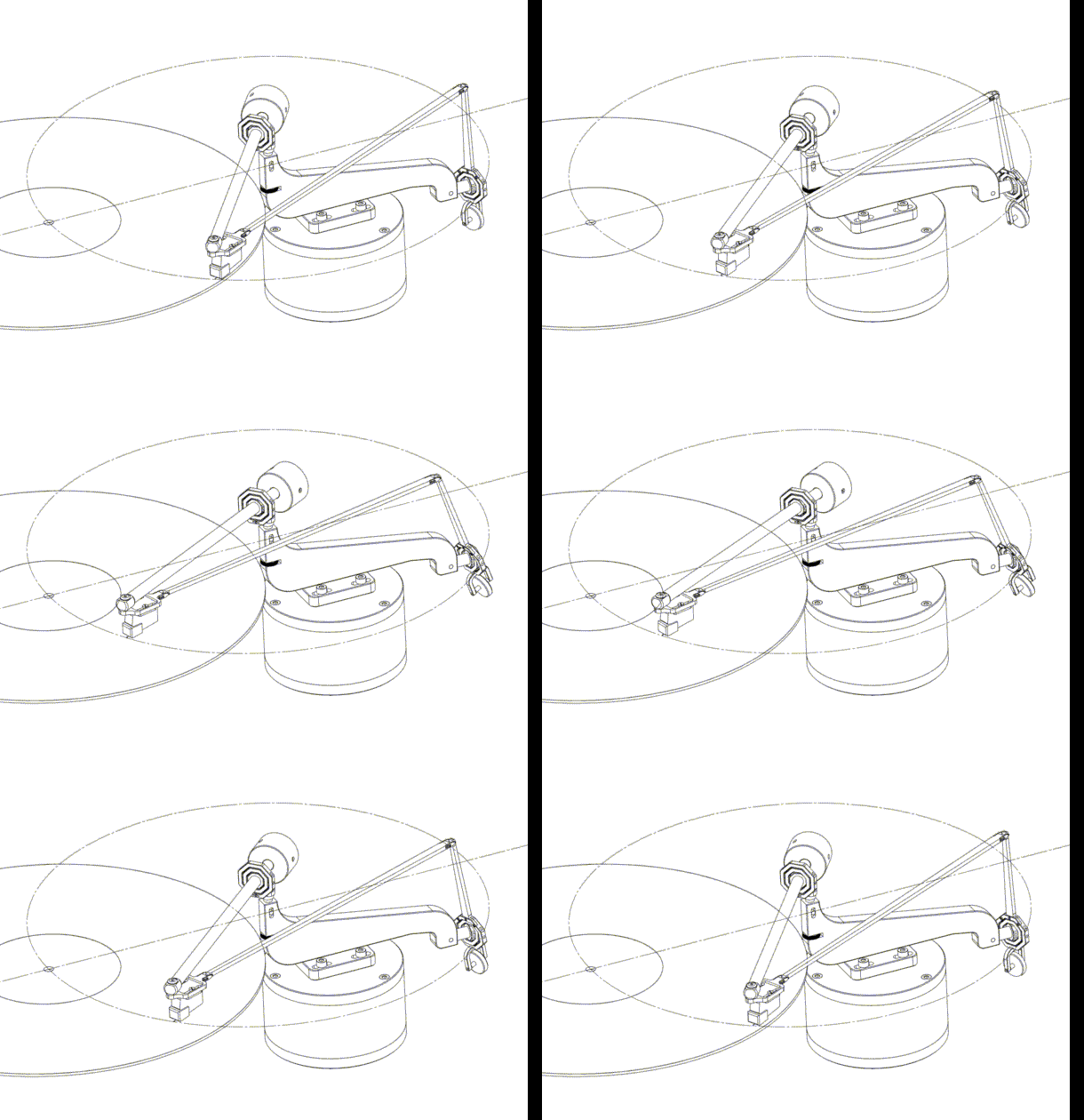
This leaves a problem with most linear trackers.

Here is the soultion to that problem:


1.jpg


5.gif


"dolph"

Interesting post, I appreciate the active drawing! Wouldn't this just be a more sophisticated version of a Garrard Zero 100? :scratch2:
 
Wasn't there a B&O that did something similar with a pivoting headshell?

This sort of arrangement doesn't seem to have much superiority over linear tracking in the realm of cost and complexity. It does look very cool, though.
 
Hi end linear trackers typically use air bearings, not servo motors. There is really no reason why they shouldn't be able to track off-center pressings.

Here is an example:

vyger1.jpg


But there are others, the Walker, the Clearaudio, the Forsell.
 
A very good friend has the Walker table and it is so good that a burned CD off his player is not only way better than any CD its better than my roughly $3000 vinyl rig can produce. Ask member Stanton if you dont believe me, he heard one of the CDr disks that was made off the Walker fed into a Masterlink.
Yes its super expensive and obviously way too much for most to spend on Vinyl (its around $50k all told but it blows away anything a average guy could throw at it.
 
If you friend wants to spend $50k on one TT, he is welcome to, I'm happy for him that he has the cash sitting around. I'd spend $500 on one TT and pay down my mortgage with the other $49.5k (he says surrounded by 20 or so evidently cheap-ass linears).
 
I know I know.
Not many even rich folks would pay that for a table, I was just sharing a cool story and Stanton just was over Sunday so that disc we played was fresh in my mind. While its obvious many wouldnt spend that kind of money I hope folks could atleast appreciate hearing something really great.....good sounding music is good sounding music!
 
It's a lovely piece of equipment, I'd make myself one like that someday, if I could find a DD motor that would drive it...
 
Hi end linear trackers typically use air bearings, not servo motors. There is really no reason why they shouldn't be able to track off-center pressings.

Here is an example:

vyger1.jpg


But there are others, the Walker, the Clearaudio, the Forsell.

HI,
You have a beautiful and impressive turntable. What is it? Tell us about the arm, please.

I have two Eminent Technology air bearing linear arms, one on a Sota Nova and the other on an Oracle V. And, for all to hear, they work great.

Everybody seems to forget that there are several ways to achieve linear tracking. IHO, air bearings are the best.

Sparky
 
In the early, developmental stages, and at the cheaper, bottom end of the market, some linear trackers deserve their 'flawed' reputation. But towards the higher end, they are wonderfully good performers, that can AND DO out-track any pivot arms. Theoretically, everyone knows this SHOULD be true; the argument that it was never achieved in practice is true only for the lesser models.:

So it is only some of the cheaper, early LT's -the lesser models - that deserved the flawed rep?

MOST of the arguments against linear trackers originated within a certain time frame, from reviewers in British audio magazines, whose advertisers included a number of small manufacturers in England and Scotland (Linn, Ariston, etc...).

The big Japanese audio firms and their associated conglomerates like Yamaha, Mitsubishi, etc... were putting serious resources into developing improvements in audio gear, such as direct drive and linear tracking. The small, "craftsman" companies in the U.K. couldn't possibly compete with these firms, given the kind of development and tooling expense that was involved. The U.K. firms were facing marketplace extinction, if they were to compete on product quality alone. And it didn't sit well with British (any more than it did with Americans, really) that they were going to lose a beloved domestic industry to the Japanese.:

Direct drive and linear tracking were improvements, and not just a cheaper or different way to build a table? Or a way to claim an improvement in one facet of performance while ignoring others? Are all direct-drives better than the belted ones? All LT tonearms better than pivoted?

So the magazines --whose continued existence also depended upon the continued existence of their advertisers!-- came to the rescue. They trotted out all manner of stupid reasons why direct drives and linear trackers were no good, why Linns were the best turntables ever made, etc... including some ridiculously unfair "rigged" comparison tests, and the undiscerning, ignorant, trusting and patriotic public swallowed it all, hook, line and 'stinker'! A lot of this drivel was picked up and regurgitated in the U.S., as well. :

I recall seeing lots of ads of Japanese equipment in the magazines, too. I may have a slightly higher estimation of the intelligence of the turntable-buying public than you share.

The Japanese, never the best English communicators at the best of times, did a lousy job of getting the message through that the machines they were turning out really WERE an improvement over almost all of the traditional "craftsman" models. In the absence of a good job of refutation by the Japanese, the British propaganda became "common knowledge", and continues to hang around even today.:

Nice to read your unbiased view.

For various reasons, the Japanese basically gave up marketing the really good machines in export markets, and only sold the good ones domestically (i.e., in Japan).

Only in relatively recent years have people begun to realize/know/understand this, and to look for those great direct drive and linear tracking turnables, outside of Japan.

Basically, cheaper low-end LTs are not very good; GOOD ones are somewhere between wonderful and phenomenal. It is no accident that LT arms are found on many of the very best "exotic" turntables made today. When done right, they do track better! :

Let's not deliberately try to confuse the very best with the very mediocre. While you make a few valid points in your presentation, you also revealed a definite bias for linear tracking turntables, delivered in a True-Believer, Moses-from-the-Mountain, Turntable Gospel style which seems to be geared towards proselytizing, rather than addressing some of the problems relevant to the genre.

Yes, a LT should have less lateral tracking error. However, it should also be pointed out that many of the more common examples of the type suffer from very short tonearms which can introduce a high degree of VTA variation and an unsteady tracking force during real-world play, high friction, sloppy bearings, noisy drives, resonance issues from mounting topologies, and many also don't actually offer much of an improved lateral tracking ability over pivoted-arm models due to the nature of the self-correcting servos. Those that are truly excellent overcome these issues in various ways, all of which tend to be very expensive.

Yes, the very best ones are exemplary. As are the very best pivoted. The plain fact is that many LT's introduce more problems than they solve. However, at anywhere near the affordable end of the spectrum, I'll opt for a pivot. YMMV. I'm glad you like them; I'm glad you're happy with your turntable. I am not interested in being argumentative; I just felt that your post begged for a dissenting view with less in the way of sweeping generalities and political nationalism.
 
HI,
You have a beautiful and impressive turntable. What is it? Tell us about the arm, please.

I have two Eminent Technology air bearing linear arms, one on a Sota Nova and the other on an Oracle V. And, for all to hear, they work great.

Everybody seems to forget that there are several ways to achieve linear tracking. IHO, air bearings are the best.

Sparky

Ha, I wish!

At least that is my Merc clamped to the platter, an FR1 pressing of Ancient Airs and Dances. I took the picture at the Stereophile show in 2002. The turntable is a VYGER Indian

The sound was quite impressive, but I couldn't find out much about the table because the demonstrator was a Japanese guy with little English. He did like classical LPs, though, and knew what mine was.

I have more recently had a chance to hear the VYGER Baltic, which uses a conventional SME arm, and the VYGER Atlantic, which is a smaller version of the Indian.

I do like the sound of these tables, but the expensive ones are a little too exotic to be practical. The air pump failed on the Atlantic, and my buddy the reviewer is waiting for the distributor to deliver parts. It was the same thing with the Air Forsell, many of them failed after a few months of use.
 
HI,
You have a beautiful and impressive turntable. What is it? Tell us about the arm, please.

I have two Eminent Technology air bearing linear arms, one on a Sota Nova and the other on an Oracle V. And, for all to hear, they work great.

Everybody seems to forget that there are several ways to achieve linear tracking. IHO, air bearings are the best.

Sparky

i have always wanted and almost bought one of Bruce's tone arms but they say they are really tweaky and both hard to set-up and keep correct. Perhaps I was mislead but that kept me from trying one on my SOTA table.
 
We should be open to the possibility that air tangents may be prone to instability along the track plane in response to varying groove modulation. The application of a pump and air distribution within a fine tolerance (enough force to float an arm, but weak enough not inhibit cross-record transit) might be vulnerable to variable stylus drag from groove modulation. Nothing proven, however, on even the existence of such "micro-wows". Just a thought, if you care to go there.
All best,
Mario
 
Just my .02 cents... I only have experience with this particular arm, so I can't judge other designs. A couple of remarks: this combination (Goldmund Studietto TT/Goldmund T5 arm) is by far the best soundig TT I've ever owned. A friend of mine owns a Studietto with an SME V arm (pivoted) and to my ears that's not as good as my own combination. He has, however, a completely different system, so perhaps his Goldmund/SME is better.

So my TT sounds great. Does that prove that lineair trackers are superior? Errrmmm.. welo, this specific T5 arm has some issues. It's a pain in the behind to adjust, even though you don't have to worry about the tracking angle. It's also complicated: it has a sensor that detects possible tracking errors, and the adjusts the position of the arm. Nice engineering, but hard to adjust and there's room for mistakes and failure. And the worst thing: the wiring from the arm can pick up the hum from the motor that adjusts the position of the arm. So it can sound very good, but it takes some work and maintenance.

However, I feel that you have to put some effort into any TT/arm combination to get the best out of it. I also feel that the perfect arm doesn't exist, whether is pivoted or a lineair tracker. So I stopped worrying about that and just enjoy the music.

For those who are curious: the cartridge is a Kiseki Agaat Ruby, which looks beautiful but needed a retip. So I decided to sell it and buy a little less exotic but gorgeous sounding Lyra Dorian.

20090676bu4.jpg


48884237sk4.jpg
 
Very informative thread. Thanks to everyone who's chimed in.

My experience with the LT is about the same as Sam Cogley's, though I know far less about fixing and adjusting them. (Nothing is less than a lot even with "new math, right?) I acquired one last summer as a throw-in with some speakers. The guy said it didn't work, but I've had no problems with it and have done nothing to it.

It's a Luxman P-406 with a Grado ZF3. It does a great job tracking some wobbly grooves. Niether horizontal or vertical movement seems to give it any grief. It seems to sound a bit less "lively" than the Dual 1228 it sits next to, though that could be a lot of things from cartridge to different pre-amps. I really like it a lot and am tempted by a Technics LT that's been on the CL a couple days.

Mine says it's Tangential Tracking. It's also a belt drive and the arm seems to be independent of the platter in that while the arm is returning home, the platter has already stopped turning.
 

Attachments

  • luxmanp406 001.jpg
    luxmanp406 001.jpg
    53.9 KB · Views: 147
  • luxmanp406 007.jpg
    luxmanp406 007.jpg
    67.6 KB · Views: 114
ET-2 Air Bearing NOT Tweaky At All

i have always wanted and almost bought one of Bruce's tone arms but they say they are really tweaky and both hard to set-up and keep correct. Perhaps I was mislead but that kept me from trying one on my SOTA table.

HI,
I have heard that folks have had trouble with the ET-2 or ET-2.5 arm. This is very hard for me to understand. I have been using the one on my Sota Nova for 20 years. I have had ZERO, NADA, NONE, (0) problems. Not one.

Mounting is no more difficult than a pivoted arm. It is true that I bought the mounting jig from ET which helps. I suggest the jig.

Set up is FAR easier than any pivoted arm because of the precision of the arm and the linear geometry. VTA is an example (there are other examples I could cite). I can rather easily find a single arm height where the sound field just POP's into focus. The ET-2 has a really excellent VTA adjuster mechanism. I have never had this happen with even really good pivoted arms (Graham 2.2, SME V). They tend to define a range of heights and no single point. The sound never really POP's into focus. The implication is a pivoted arm never actually finds the exact, precise point where the stylus exactly fits the groove modulations. This is because all pivoted arms have compromized geometries and skating force. Linear arms of any stripe do not develop skating force. The geometry, and the resultant perfect stylus to groove fit, is very important if you use, as I do, fine line contact styli. You CAN hear the difference.

Once set up the ET-2 maintains its adjustments over time. Mine has certainly not been "tweaky". It just works....year, after year, after year. But, you will never take the arm for granted. The frictionless nature of the air bearing continues to amaze me. It's spooky.

However, there is some maintenance on the adjustments that must be made once in a while, maybe every 6 months or so. The turntable suspension springs will continue to settle for a long time (even after 20 years) and this causes the plinth to move from level. You would never notice this on a pivoted arm. But the frictionless air bearing will react and the arm will develop a small side force. The arm or plinth must be adjusted for level. I usually adjust the arm because it is so easy to do. The shift from level is tiny, not noticible with a bubble level, but the air bearing sees it. In fact, you use the arm itself to indicate a level condition. No level on earth is as sensitive as the air bearing. Forget about bubble levels.

In the final analysis, I have no reason to not be very enthusiastic about the ET-2 arm. I love them and they sound better than any pivoted arm because of the better geometry.

I say, do not hesitate. Used ones are not that expensive. Only those folks who own and use one can really appreciate this beautiful design.

Sparky

 
Back
Top Bottom