• The move to the new server is done. There are some software and database maintenance updates in process. This has us passing the hat around to help out. We appreciate any donations. Seriously, even a dollar helps. The payment page may be found here - https://www.audiokarma.org/support.html

Linear tracking - a myth debunked?

Dave is correct in that if it's a truly straight tonearm, if you draw a line from the tonearm pivot point to the stylus, the cartridge body would be centered on, and square with respect to that line, not at an angle. In this case there is no skating when the stylus is at a point where the tracking angle is zero. Get away from that null point, however, and I believe the cartridge would skate. Could skate either inward or outward, depending on the direction of the tracking angle error. This is because the drag from the stylus no longer acts in a direction that goes through the pivot point, the tangent of the groove is at an angle (tracking error).

I'd have to draw this with a free-body diagram to confirm this, I'm visualizing the force resultants in my head right now and that's dangerous.

And on Mario's point: if the groove were smooth, friction (and therefore skating force) would be independant of speed. We wouldn't have any music to listen to then, however...

Bottom line, anti-skating is NOT a trivial exercise. Linear tracking seemed like an ideal solution because it eliminates tracking angle and eliminates skating forces. It's just the implementation of linear tracking (or a 4 bar linkage concept) that has difficulties.

IMHO Technics did a pretty fair job of producing a line of linear trackers that still fit most everybody's budget.

This all means that if the stylus can be positioned exactly in a straight line from the pivoting point and through the line of the arm, then there will be no skating force.
It can't be that the angling of the stylus in exactly this point creates the skating force .................. or what?

Just trying to read your mind. I don't have it on paper either.
:-)

"dolph"
 
This all means that if the stylus can be positioned exactly in a straight line from the pivoting point and through the line of the arm, then there will be no skating force.
It can't be that the angling of the stylus in exactly this point creates the skating force .................. or what?

Just trying to read your mind. I don't have it on paper either.
:-)

"dolph"


Here's how to simulate the effect. Open a door (with hinges). Tie a rope to the door handles. Now pull the rope. If you're pulling the rope in line with the hinges--the rope points from you back to the hinges-- the door doesn't swing left or right. Pull off to the side, though, and the door will swing in that direction.

When there's no tracking error, with a truly straight tonearm, you've basically got the "door", with the drag from the stylus (rope) pulling straight in line with the pivot point (hinges). However, once you get away from the null point, the tracking error makes the drag from the stylus pull in a direction away from the pivot point.
 
Here's how to simulate the effect. Open a door (with hinges). Tie a rope to the door handles. Now pull the rope. If you're pulling the rope in line with the hinges--the rope points from you back to the hinges-- the door doesn't swing left or right. Pull off to the side, though, and the door will swing in that direction.

When there's no tracking error, with a truly straight tonearm, you've basically got the "door", with the drag from the stylus (rope) pulling straight in line with the pivot point (hinges). However, once you get away from the null point, the tracking error makes the drag from the stylus pull in a direction away from the pivot point.

Good explanation!:thmbsp:
 
Bill: Your description seems entirely correct to me - for the straight dj style arms, you'd only have zero skating force in that single null-point. In every other position there would be a sideways vector either inward or outward - which is bad, 'cause that would make it more complicated to implement an anti-skate function for that. Whereas with a longer hifi style arm with offset one doesn't only have the advantage of having a flatter skating force curve with two null-points to begin with, but the sideways deflection by the offset angle also becomes the dominant part of the whole deflection and the remaining mistracking angles are just the icing on that cake, that add or substract a little from the dominant deflection. As a consequence, it's much simpler to implement an anti-skate function there, as that will only have to work unidirectional.

I.e., the reason to not implement an anti-skate function for a straight dj style arm isn't that there would be no skating, it's because it would be rather complicated to implement. Even more so, if one keeps in mind what use the arms are actually designed for - i.e., if one wanted to do it right, that anti-skating function would also have to be able to reverse its direction for reverse spinning/back-cueing. And considering the amount of skating to compensate due to such severe mistracking in combination with rather high tracking forces, an anti-skate function powerful enough to handle that would probably also interfere with the lift in way that would make it pretty difficult for the dj to predict where the needle will hit the groove. So, in order not to render the lift function unusable, the whole affair would become even more complex - i.e. the anti-skate function would have to be implemented in way so that it can be decoupled, as soon as the needle is lifted from the record...

Greetings from Munich!

Manfred / lini
 
Inward skating comes primarily from the pivoted arm's offset head stylus contact point being effectively beyond the pivot ref'ed tangetal line (called "overhang"), rotation vs friction simply pulls the arm/cart inward. It is necessary to have this offset vs overhang to minimise tracking error with a pivoted arm's physical relationship to the platter. If it was mis-set behind that line the skating force would be outward. Groove modulation variations in a properly tracking stylus do vary the friction induced drag and therefore the skating force, therefore the ideal anti-skate counter-force is a "moving target", the countermeasures take an averaged value determined (or guess-timated) by the designer. Anti-skate force countering skating force can also bias the resting alignment of the stylus cantelever inward, altering the stylus tracing relationship with the groove walls.
Good linear tangental tracking is really better but achieving it with solid stable mass loading of the cart is difficult in practice. The result pref depends on an individual's priorities in reproduction. Solid bass & resonance control vs lowest distortion and trackability/tracing accuracy.

Only slightly OT observation;
Digital media trade all this for an entirely different set of problems and compromises FWIW. Losing the physical and mechanical problems, inevidable progressive result-destructive wear of critical component interfaces, and hygeine ritual hassles associated with analogue playback is what makes any alternative attractive. Escalating complexity, cost, and the maintainance and hygeine issues are what kept me from progressing to the superior vacuum platter 'tables and higher mass air bearing arms, never mind the poor cost-result ratios of said systems and inescapably short stylus service life of any decent cart's stylus tip.
Most of us would just like to forget the fussy BS and listen to the music at the end of the process. If only the media content providers could get their act together standards-and-quality-wise to make it worth the effort of achieving some semblance of excellence at our end.
S.B.
 
Just a little off topic, but in the next week or so I will be attempting to get a pic of each of my 20 or so linears on my Webshots pages. I'll post a link when I get them up. There's quite a variety out there.
 
Good evening all, a fascinating thread. Many thanks! I know absolutely nothing about these kinds of turntables, so I've learned a lot! I think that these kinds of tracking approaches are probably superior to pivoted tonearm arrangements, though possibly offset by additional complexity and allied issues.

Having said that though, I think that conventional pivoted tonearms are fascinating, especially in trying to get them to track at their best! I've certainly had a lot of fun and education in coming to terms with subject of overhang! All very interesting. Once again, many thanks to all. Regards, Felix aka catman.
 
Wow, what a thread! I have 2 Mitsu LT-20s and a Yamaha YP-D8, mainly for variety and fun. Something I didn't see brought up (except about the Zero100) is matching a cartridges compliance to an LT, as they never seem to be listed. I found that my Boston HOMC (a Van den Hul) ddin't do well in the LT, but sounds spectacular in the YP-D8 (thanks Hakaplan). I have a V15III with a Jico SAS on LT-20, still breaking in, that tracks superbly. I'd like to see Kosetris collection as I haven't see too many designs different than the PX-2 / LT-20 servo type.
 
I was an early adopter of the just-introduced H-K RABCO ST-7 linear tracker TT in 1977, since long gone. A few years ago another showed here freebies courtesy of a friend's yard sale find and languished in a storage bldg until last week. Fortunately and astonishingly, all the rubber drive components were still usable and so some lube and a lot of cleanup and adjustments had it tracking flawlessly. I mounted a new A-T93ECD and it set the arm perfectly level with no spacers, what luck. One should adjust the tracking precession comp for the "RABCO" arm pivot block to be perfectly squarely aligned in it's carrier when playing, ignore making it parallel with the restrictor arm as that is not tangent to the tracking rails. One of the problems with this arm is that the sliding weight is a rattle fit and needs to be wedged to the tube with a sliver of soda straw after it is set to the desired tracking pressure.
Of course the cartridge mounting jig was absent and I was able to determine by experimentation that the desired stylus tip-to-arm head distance should be ca 3/4"-13/16" and the tip-to-arm plug-end distance for tangent tracking is 6 &1/8", 5 &7/8" to the base of the collar of the arm tube. If someone with the jig and a tangency guide could confirm/correct these figures it would be a service to other users without the cart jig.

Addl, there is a note in the on-line svc manual saying that the tracking tire can be replaced with an 'O' ring of 3/4" OD with a 19/32 ID as long as the outer moulding bit is carefully removed to leave an even circumference to ride smoothly on the tracking shaft. The thickness of the tracking tire will affect the uncomp'ed level arm height, mine does not have an 'O' ring replacement so it's possible the A-T universal cart may not allow the arm to be level with a less thick replacement substitute tire.

I am still amazed that this thing works as well as it does after being set up properly, it's still fascinating to see the cuing lever go back by itself, lifting the arm into it's rest and shutting off the motor at the end of a side.
S.B.
 
I've owned a number of linear trackers. I'd have to go through the archives to find them all. Those that stand out are:

Maplenoll Ariadne Signature
H-K Rabco ST8 and ST7
B&O 4002, 4004 and 5005

One advantage that they have over most radial tables is the potential for remote control arm control. I recently converted a B&O 4004 to RF remote control. It works flawlessly. Now from anywhere in the house I can activate CUE, LEFT, RIGHT, STOP and START.
For me this means I can listen to records and not have to scramble for the turntable when, inevitably, the phone rings or someone comes to the door. Effectively, this means I listen to records.
Now I've read the theory behind radial vs linear tracking & all that. But I have to say that a turntable that I use because it actually meets my needs is far superior to one that is theoretically 'better' but gathers dust because it's functionally compromised for me.

attachment.php


attachment.php


attachment.php


attachment.php


attachment.php
 

Attachments

  • SMALLDsc03895.jpg
    SMALLDsc03895.jpg
    125.1 KB · Views: 230
  • SMALLDsc03899.jpg
    SMALLDsc03899.jpg
    99.1 KB · Views: 227
  • SMALLDsc03848.jpg
    SMALLDsc03848.jpg
    67.8 KB · Views: 222
  • SMALLDsc03863.jpg
    SMALLDsc03863.jpg
    94.4 KB · Views: 221
  • SMALLDsc03924.jpg
    SMALLDsc03924.jpg
    37.4 KB · Views: 222
Effectively, this means I listen to records.
Now I've read the theory behind radial vs linear tracking & all that. But I have to say that a turntable that I use because it actually meets my needs is far superior to one that is theoretically 'better' but gathers dust because it's functionally compromised for me.

Agreed! For me, multi-record sets are conveniently played on my old Garrard Zero100 or Z2000 record changers. Nice to enjoy during dinner or whatever and not "hop up" to change records. ..... and I'll mention again that linear trackers don't damage your "choice" records ...... and there is no inherent single pivot tonearm distortion. :music: Regards. Peace.
 
My dad's B&O and mine both left a sonic signature from there affects on Vinyl, they dont call them crab walkers for nothing. There are differing views on this so feel free to pick your side of the fence, and dont get your feelings hurt because we dont all have to agree.
 
My dad's B&O and mine both left a sonic signature from there affects on Vinyl, they dont call them crab walkers for nothing. There are differing views on this so feel free to pick your side of the fence, and dont get your feelings hurt because we dont all have to agree.

"Crab Walkers"? :scratch2: I'm on the linear tracker side and feel OK. :music: Peace. Regards.
 
Remote B&O

Fantastic, Bauhausler! Have you considered working up a parts list and instructions? Does this only work with the 4004, since it had the Beosystem interface, or would my 4002 work this way?
 
The crab walking comment brings up the practical consideration that linear arms need to be kept in proper working condition to be even remotely linear, and given that lubricants dry up and get contaminated by dust etc, its probably fair to say that maintenance is more demanding than with pivoted arms. On the other hand, alignment might be easier, so there is an upside and and downside to both in terms of care and feeding.
 
Fantastic, Bauhausler! Have you considered working up a parts list and instructions? Does this only work with the 4004, since it had the Beosystem interface, or would my 4002 work this way?

A full writeup of the project is on the way. I recently purchased a 4004 parts unit so I can replace the worn cosmetic parts on the working turntable and produce a better looking unit.
The plan is to do a full description of the project in a thread in either DIY or in Turntables. Personally I think this is more of a DIY sort of project than something that would interest a vinyl user.
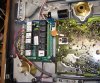
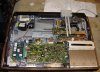
The conversion is actually very easy. I purchased an inexpensive RF remote handpiece and receiver board. The board has relays on it controlled by the handpiece buttons. In brief, I wired the relays in parallel with the turntable's switches so the handpiece can operate 5 of the controls from anywhere in the house. One detail was 12V power for the relay board. I installed a voltage regulator (upper left in the chassis pics) to derive the voltage from the turntable's main supply.
This conversion could be applied to any turntable that used momentary contact electrical switches for the functions. It is necessary to figure out the switch wiring and connect wires in parallel with the switch contacts. I have 7 or 8 other B&O tables here, including 2400, 3400, 5005, RX and something else (?). All, to my knowledge use electrical switches. On some tables it might not be practical to mount the relay board inside the chassis due to space considerations. For these I would recommend installing a DIN type jack on the chassis to bring the switch contact wires out to an external remote control relay box.
I may do a second project with another turntable and the external relay box. I already have the relay box and other hardware for that on hand.
Oddly, this turntable is the only remote control device in my main audio system. My Revox CD player does not have a remote control and my preamp is full manual as well.
 
Fantastic, Bauhausler! Have you considered working up a parts list and instructions? Does this only work with the 4004, since it had the Beosystem interface, or would my 4002 work this way?

Agreed! I have a 3404, gets me thinking... These B&O tables have a multi-pin connector to interface with other B&O components (which I do not have). I wonder if the necessary interface for start/stop/pause is already there.
 
Agreed! I have a 3404, gets me thinking... These B&O tables have a multi-pin connector to interface with other B&O components (which I do not have). I wonder if the necessary interface for start/stop/pause is already there.

My 4004 has the capability to interface with the appropriate rcvr, whatever that was. The only 'remote' function was off/on. If you were listening to a record and hit one of the FM buttons on the rcvr the rcvr would send an 'off' signal to the ttbl. Which is pretty cool.

What would be ideal is if there was a standard pinout for the keypad connectors in the turntables. Then I could gin up a generic cable to convert the turntable to remote. Open it up, attach the cable to the existing keypad connector, run the cable out the back and plug it into the remote unit. Voila, instant remote control ttbl. It ALMOST works that way on the 4004. It's possible I could get limited functions to work on a plug-in connector but I haven't looked into that yet.

That would be a thing, wouldn't it?

EDIT

I have 3400 series, 5005, 2400 series, 4004 and RX here. I should investigate all of them and publish recommendations for remote conversion eventually.
 
Last edited:
The crab walking comment brings up the practical consideration that linear arms need to be kept in proper working condition to be even remotely linear, and given that lubricants dry up and get contaminated by dust etc, its probably fair to say that maintenance is more demanding than with pivoted arms. On the other hand, alignment might be easier, so there is an upside and and downside to both in terms of care and feeding.

I have to say I was skeptical at first. I picked up an HK ST-7 about a month ago. It took lots of cleaning and lubing to get it in good working order. But now that I have it working right, I am truly amazed by it. The action of the arm is pretty darned perfect now. As far as crab walking, I guess that could be an issue but not from my observations. The amazing thing about the ST-7 (and others like it) is that the speed that the arm moves across the carriage is determined by the angle of the tonearm. Once I got it all set right, it is a constant motion with no stops and starts. It moves so slightly I had to add some marks to be able to see it moving. Alignment was easy, and it stays perfect across the entire album. After using this thing for a short time, I am hooked on linear.
John
 
Back
Top Bottom