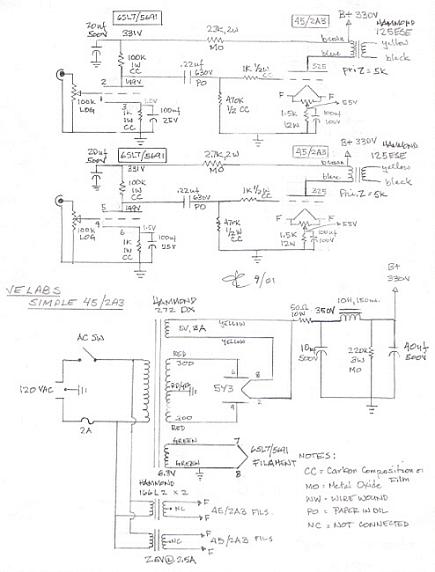
I'll throw my own 2A3 amp into the mix. This is based on
Jack Eliano's DRD amp also known as the
'Monkey'. IMO the key to great sound with a 2A3 is to direct couple the driver to the 2A3. I wouldn't consider any design that RC coupled the driver to the OP tube.
So what's so special about the DRD/Monkey? First of course is the direct coupling, so beyond that you only have 3 caps in the entire amp and good caps are expensive. Excellent coupling caps are very expensive for the best and this amp doesn't have any.
The 6N23P is a super tube: quiet, powerful and great sounding. The 6N23P drives the 2A3 from 1 volt input so no preamp is required and MOST IMPORTANT a preamp will degrade the sound. So now you have an amp with only two stages and no coupling caps. There is not a lot there to muck up the sound. This beast is TRANSPARENT!
Another point: this amp is designed around the JJ 2A3-40 which is another super tube. It is relatively inexpensive and has great sound but most important it can withstand considerably more plate dissipation than the original 2A3: notice the operating point is 290V @ 65mA. You can run a 2A3 at those operating points, but not for long...
I have built this amp with all Magnequest iron and with all Electra-Print iron, but unfortunately neither winder is making power transformers any longer; but Edcor and Hammond make suitable transformers. For the output there are many options, but I like the 3k ohm Electra-Print. Note that 2.5k is the traditional IP impedance used with the 2A3, but I use 3k in my amps. Draw up some plate curves and you will see that there is only a slight difference with the 3k offering a fraction less power and a fraction less distortion.
The 100H plate choke is Electra-Print; the ten ohm resistor is to measure the plate current through the driver to help select the 6N23P. I bought a dozen 6N23Ps off of epay for a few $ each and select those that bias about 120V on the plate @ about 12mA with the diode as bias. Over half were within spec. You can't beat the 5V3A/5AU4 as a rectifier. It is better sounding and more rugged than the GZ34 and costs about $10 on epay.
The 2A3 cathode resistor stack is a little fiddly and the most difficult part of the build. Use some variable power resistors to dial it all in as your power transformer will be different. Select the operating point of the 2A3 and use Ohm's law to determine the resistor values.



 ara: