
• The move to the new server is done. There are some software and database maintenance updates in process. This has us passing the hat around to help out. We appreciate any donations. Seriously, even a dollar helps. The payment page may be found here - https://www.audiokarma.org/support.html

Litz wire??? What can I do with this stuff.

doucanoe

Registered Audio Abuser
For battradio

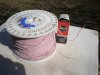
I bought a roll of this at a electronics surplus place a few weeks back thinking I might be able to use it for hookup wire of some sort. Possibly a twisted pair or multiple braided for speaker wire. I didn't know at the time but the general consensus is that what I purchased is Litz wire.

The markings on the spool indicate 105/36 Kerrigan Lewis Wire and it has been served with a cotton (I assume) thread jacket.

Your saying no good for hookup wire but possibly inductors. Can you actually make that happen with that with something that is jacketed like this?

Here are the pics I promised.

RC
 

Attachments

  • LITZ 005.jpg
    LITZ 005.jpg
    111.7 KB · Views: 63
  • LITZ 006.jpg
    LITZ 006.jpg
    123.8 KB · Views: 96
  • LITZ 007.jpg
    LITZ 007.jpg
    80.2 KB · Views: 57
  • LITZ 008.jpg
    LITZ 008.jpg
    68.9 KB · Views: 98
Register to hide this ad
That looks like old fashioned Bell wire used for internal wiring for telephones many years ago. I couldn't really tell from the pic, how many conductor and is it solid copper? I am unfamiliar with what Litz wire is.
 
Last edited:
Well, it says 105/36 so I was thinking 105 strands of 36 gauge from what I understand about Litz wire :dunno:

My only experience with Litz wire is very thin gauge used in tonearm wire. It's copper.

RC
 
I thought the 4th pic was the cotton threads. 36 ga. is so damn fine that it makes it misery to work with usually. I would guess that is pretty supple stuff.
 
For battradio

I bought a roll of this at a electronics surplus place a few weeks back thinking I might be able to use it for hookup wire of some sort. Possibly a twisted pair or multiple braided for speaker wire. I didn't know at the time but the general consensus is that what I purchased is Litz wire.

The markings on the spool indicate 105/36 Kerrigan Lewis Wire and it has been served with a cotton (I assume) thread jacket.

Your saying no good for hookup wire but possibly inductors. Can you actually make that happen with that with something that is jacketed like this?

Here are the pics I promised.

RC
You can buy Cardas headshell connectors and make headshell wires, not being color coded is a pain in the neck for that.

You can entertain yourself braiding a lot of strands until you get 14 AWG, then use it as speaker cable.

You could sell it on EBay.

You could strand it and do some kind of artsy copper figure.

You could use it as hook ups in a Barbie house amplifier.

Sorry, I don't know why you bought it, but not much to do with it.
 
The original cables (that I don't have) for my Kenwood monoblocks were made from Litz wire.
 
You can buy Cardas headshell connectors and make headshell wires, not being color coded is a pain in the neck for that.

You can entertain yourself braiding a lot of strands until you get 14 AWG, then use it as speaker cable.

You could sell it on EBay.

You could strand it and do some kind of artsy copper figure.

You could use it as hook ups in a Barbie house amplifier.

Sorry, I don't know why you bought it, but not much to do with it.


I had no thought about using it for amplifier wiring. Figured that I may be able to use it for x-over wiring or speaker cabling as I said. Why? It was cheap. I did find a website after I bought it that sells a similar strand count and gauge wire. They were selling it for .40 a foot. For what application, I have no idea.

RC
 
You can buy Cardas headshell connectors and make headshell wires, not being color coded is a pain in the neck for that.

You can entertain yourself braiding a lot of strands until you get 14 AWG, then use it as speaker cable.

You could sell it on EBay.

You could strand it and do some kind of artsy copper figure.

You could use it as hook ups in a Barbie house amplifier.

Sorry, I don't know why you bought it, but not much to do with it.

Good call.

B&O tonearm wires didn't even color coding.

You could wind it on a transformer bobbin to make an HF xformer...

BTW, no fun to solder. A solder pot goes a long way with wire like that.
 
Okay okay I will explain. Litz wire is many strands of fine wire, each insulated from the others. It is used in radio frequency coils because it minimizes skin effect at frequencies from about 50kHz to a few MHz. It has no particular application in audio work. It's short for Litzendraht I think.

As frequency increases, the current tends to flow near the surface, so the core of a solid wire becomes useless electrically. If you parallel many wires you can get the losses down but you can't let them touch one another or you have defeated the purpose. (This is the famous skin effect. Google it.)
 
I don't think that is Litz wire as the individual strands don't look to be insulated (wrapped in cotton or similar).
If that's the case I think you could use it for any general application.
Or use it to wire a seriously huge tonearm.
What gauge would you estimate it is collectively?
JimB
 
Ron, you could get some of that teflon spaghetti tubing thats been going around and make yourself some really good speaker wire. What you have there is equivalent to 16 ga.. It would also be good for input wire to anyone in St. Paul that is building a Pass F5 (hint, heh).
All about Litz.
 
I sell things at the flea market and from time to time i'll find something that is just plain odd so i'll put it on my table to see peoples reactions to it.The best bang for the buck is to have something odd that looks like it might be usefull.You'll see guys pick it up and ponder and ponder over it thinking they could surely use it for something important but they just can't figure out what that might be.Finally with a defeated look they'll ask "What the heck is it?"Which is just an opportunity for me to have fun with crazy suggestions and almost believable answers - a cheap thrill.Your roll of wire would be good for that,and my suggestion would be to make a 10ftx10ft spiderweb antenna array that doubles as a cat and bird catcher,but it's not the weekend,when I have my best suggestions!
 
Strands are insulated with enamel - VERY little voltage between strands after all... It's approximately 16 gauge.
 
Great find on the Litz wire...

You could take four of the Litz wire runs and braid them into a really decent speaker cable that had enough conductor area to really carry current for bass reproduction but also carry fine details like a thin wire does...

Or take six runs and braid them to make a bi-wire set...4 for bass and two for treble

You could take three runs and braid them using one run as the hot conductor and two as ground/shield, and leave one of the ground legs floating at one of the RCA plugs...with Litz wire you won't have the same problem as standard stranded wire at that gauge being used as interconnects, normally a reduction and smearing of the high frequencies....

If you read up about Cardas wire you will find that he uses a Litz formula, but using a varied gauge array in a golden section stranding pattern, but Litz nonetheless....

If you do braiding, make sure you cut each run of wire the exact same length before braiding, not after....

Being 16ga., it may really take a solder pot to effectively terminate the wire...trying to heat and tin 105 individual strands together is not an easy task without one....MCM sells an affordable one that is worth way more than you pay for it when you have to deal with Litz wire...after doing hundreds of tinnings of Litz wire myself, it's the only way to fly!
 
Back
Top Bottom