• The move to the new server is done. There are some software and database maintenance updates in process. This has us passing the hat around to help out. We appreciate any donations. Seriously, even a dollar helps. The payment page may be found here - https://www.audiokarma.org/support.html

LK72B rectifier replacement and wiring

sbcrockett

AK Subscriber
Subscriber
Hello everyone,

This is my first post. I've enjoyed reading about other LK72 and Fisher rebuilds and have learned so much from you all.

I'm in the middle of re-capping a functioning LK72B that started having random buzzing issues and upon reading about the selenium rectifier and electrolytics, I realized that I've pressed my luck long enough running with original components and needed to address the aging parts. My question is about the bridge rectifier and how the wires get hooked up. I can easily identify the DC +/- connections on the new part and have the other two pins marked for AC (~). How do I know which AC wires go to which "~" pin? Or, does it matter?

Thanks again for all the information posted here. I'm sure I'll have additional questions after the parts replacement and when I'm ready for powering it back up and checking voltages.

-Steve
 
Register to hide this ad
Check your voltages before, after on the old and new parts. May need to up the resistor.
 
ah, yes. i'll definitely be checking that. since it's a "B" it already has the 33 ohm. thanks for the reminder!

so far i've replaced the 2 electrolytic caps (4uF/250V) that are near V3 and V103 tubes as well as the 50uF@75 that's going to the 100-100-100-100@75 can (also replaced with Hayseed Hamfest). I didn't check any of the voltages before diving in but do you think I should before replacing the selenium rectifier? My plan was to carefully replace all the coupling caps, electrolytics and rectifier and then bring it up with a variac, which is currently en route. Be here Tuesday.

Is having the old voltages so vital that I should get them before going any further? I just assumed since I'd be needing to re-bias everything after replacing so many components that it didn't matter what the original voltages were.
 
Last edited:
One thing that happens often is that tube sockets become intermittent. A good cleaning of the socket and tube pins often alleviates many issues up front. Don't hose down the sockets because it can cause more problems with leakage (read... shorts) between pins. Also, look carefully at the bias bridge. If it is the square, Siemens Selenium Bridge, it is suspect. But the 299D (possible equivalent of the LK-72B) often had silicon rectifiers instead of the bias bridge, and it was mounted up front on the inside of the control mount. If silicon, I would start elsewhere.

Example: I pulled a nice, all original 299C off of my shelf. It was totally dead (meaning input...no output) Problem was totally tube socket intermittent connections, not even visible corrosion. I replaced the bias bridge and every thing is original, tubes, American Radionic capacitors, filters etc.

Trouble shoot first, please if you can.
 
Thanks for your wisdom KV. I did troubleshoot a little, which included finding some intermittent switches and tube sockets. After cleaning and some moderate deoxit, the unit was working normally for a couple of hours without the buzzing. During my research here and familiarizing myself with the unit, I found I did have the Siemens bridge and so started to order caps and such.

Would you recommend I continue replacing the rest of the Hayseed Hamfest cans? I figured doing all the wax and paper caps were a given, especially since there were a couple wax puddles on the bottom panel, but I see the value of keeping it original as much as possible. However, the plan is to use it for daily listening so I'd like to get it as reliable as possible. Also, my amp has two original Scott 7591 tubes!

Funny side note, one of the tube sockets seemed to have some sort of middle plug or cover in the center of the socket. I first thought that it was a manufacturing feature but later found out it was filled with old goopy flux!

I really appreciate everyone's input!
 
I like H&H capacitors. Have four units with them now, no problems at all.
Get wafers when you order. Try and not use them just like to have them if ending up needed.
Don't like stuffing or finding a place underneath especially one with little room to start with.
 
Thank you Oerets. I bought all four cans from H&H but forgot to ask for the wafers. I thought they came with them. The 100x4 went well and I didn't break that wafer so I'll be careful with the others. There's no way I'd be able to find room underneath. The "landscape" is already rather packed under there. Not the cleanest build from the other photos of LK72's I've seen. But I'll be cleaning things up a little along the way :)
 
Just to be clear, does your amplifier already have Hayseed capacitors in it and you intend to replace them? If it has those capacitors in it, they are probably not that old and should be OK. Maybe I am misunderstanding.

As for the wafers, if you can carefully remove any wires from the twisted tabs and either straighten them up to remove the capacitor can or... carefully twist them back and forth and they will break off. Patience is the absolute key.

For the bias bridge, I have this picture of an LK-72B and you probably know where the bias bridge is already, on the side, inside of the control box.
DSC06129.jpg HH Scott LK-72B 001.jpg

Here is another pilfered picture, probably from the auction site. Is this what your amplifier looks like? If you can, post some pictures.
 
Thanks KV! The unit had the original cap cans, and up to this point I have only replaced the 100x4 with a new Hayseed. I was just asking if you thought I should continue replacing the rest of the them.

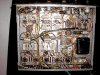
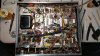
Yes, that is what I'm working on. Mine is a little more chaotic underneath but the faceplate and wood cabinet are quite nice. I don't have any pictures before disassembly but here's one as it currently sits.

1570974245290226075321.jpg

I must say, I'm learning so much. Every time I login to these forums I find something else to consider about this quasi restoration. I'm not second guessing my capacitor choice, polyester film (or maybe I am) but I'm not going to sweat it until I hear the results. I was a little concerned at first about how the Radionics caps had a band indicating some sort of polarity. The Scott assy instructions even call out for them to be installed in a certain direction. It will be hard to tell if there's any appreciable difference in performance once I'm done since a couple of weeks will have passed since I last heard a note out of this amp. Then there's the psychological aspect that it MUST be better since I cleaned it up so nice!

Thanks again for your help and guidance!
 
I will stick my neck out now. We have members who will disagree but that is what makes the world go around.

My first restoration was on an early first edition 299, the one with the 7189 Output Tubes along the left side (viewed from the front). I replaced all of the capacitors with Sprague Orange Drops. It was a task but I took my time and accomplished it. However... as I brought it up slowly on a variac, one of the electrolytic capacitor extruded tar in a long string as soon as the voltage was taken above ~ 60 volts AC.

So, even though I didn't know others were doing it, I opened up the capacitor and replaced the "guts" with individual radial lead electrolytic capacitors. Somewhere there is a thread on this site illustrating step by step how I open them up, and re-stuff them so that they look original. I can re-post it if interested.

Your Hayseed option is a lot easier and I would certainly recommend it.

How, here is where the controversy will begin. Again, everyone is entitled to his/her opinion. I have been working on this stuff since the 50s. My experience is that capacitors, if manufactured properly to spec. do not have a "sound". Also, properly functioning tubes do not have a "sound" (brighter, harsh highs, fatter sound etc.). Especially, rectifiers do not have a "sound"! So, that said, I use good yellow axial lead capacitors to replace any and all of the capacitors in my Scott, Fisher, Harman Kardon, Sansui, Kenwood etc. amplifiers.

Here is something to consider. Your amplifier is one of the later models. Your American Radionic Ceracap capacitors may be Di Film and still work fine. But.... I would at least replace those coupling capacitors that feed the 7591 output tubes. They are the most critical. If they are leaky, what will happen is that the bias that you are trying so very hard to do properly by replacing the bias bridge capacitor (either 75-75-75-75 or 100-100-100-100, depending on what Scott used at the time) will be upset as the plate voltage of the previous tube will slam the output tube grid with a positive voltage. That will cause those very, very special 7591 output tubes to conduct very heavily, possibly even red-plate from too much current flow. The next thing that can happen is that in addition to destroying the tubes, you could also open the primary of the output transformer with excess current flow. Heck, we are only talking four .1µFD capacitors.

As for the tone controls, there isn't much voltage on them. So if you don't replace them, not much can happen other than to "possibly" color the sound. I got anal and replaced all of the capacitors on the selector switch. Talk about tight quarters. But again, you may be just fine.

Picture:

selector.jpg

Summing it up, I don't subscribe to boutique or "audio grade" capacitors. I also prefer NOS tubes over current production. I realise that NOS can be difficult to find. But they were made to very exacting standards in the late 60s early to late 70s. You may find what they call "coin base" tubes. Not a pretty as those Westinghouse manufactured 7591 output tubes labeled "HH Scott". But they work just fine.

Keep us in the loop, good luck and pictures if you can! Feel free to contact me. I have some NOS fiber capacitor mounting wafers should you get into a bind. (been saving them for re-stuffing purposes)
 
Thank you Don. I certainly appreciate you sharing your knowledge here. I ordered all four capacitor cans from H&H and am continuing the parts refresh. I was able to get one of the 30-30's installed without damaging the mounting wafer so 2 down and 2 to go! I appreciate your honesty and what you said about capacitors makes sense. With all of the guidance I'm receiving here I plan on digging into my Fisher X-100 after I get the Scott back up and running. I will absolutely share photos with my progress. I estimate I'm about 1/4 done with all the caps rework. Hopefully I'll be ready to power up by next weekend with the Variac set to be delivered this Tuesday. What a great community here!

Off topic and a little ahead of my project, since you brought up the 7591 tubes, I was eventually going to get everyone's opinion here about the condition of my power tubes and what the likelihood of still being able to use them is:

IMG_20191013_173142008.jpg

There has obviously been some thermal activity going on here but I wanted to ask if this is normal for 50+ yr old tubes. I don't want to just throw money at parts I don't need, but I'm wondering if I ought to consider replacing the 7591's, or at least be prepared if these tubes are too compromised to be reliable.

Again, many thanks for all the great input from you and the others here. I know I'll have loads more questions when it comes time to power it up and dial things in.

-Steve
 
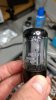
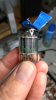
Steve, if you are referring to the shiny spots inside of those tubes, that is the deposits from flashing of the getter. It is entirely normal to see that. However, as the silver spot begins to somewhat disappear or get smaller, it is being consumed and "can" indicate a tube that was run rather hard. But not to worry, I have several 7591 tubes (all USA or Japanese manufactured) that have an almost chocolate brown translucent color. Most of them still test very good with good remaining emission and no grid emission. So, don't be in a hurry to discard them!

Wiki link to "Getter": https://en.wikipedia.org/wiki/Getter

On the Antique Radio Forum (ARF) many of the members are old coots like me (I'm 71) who were in this vacuum tube business for a living; engineers at radio stations, owners/operators of TV shops. They grew up with this and many are Subject Matter Experts. Their advice is the best tube tester is the use the tube in the circuit that was designed to use the tube. You will be surprised how well tubes, which are a little worn will continue to operate.

Your 12AX7/ECC83 tubes would have been Telefunken when the kit was built and should be just about as good as when the amplifier was new.

Now disclaimer: I am very fond of vintage NOS or testing, very lightly used tubes. I have only purchased one modern tube, the Sovtek 5AR4 so far and it seems to work fairly well. I have not tried to use one in a piece of equipment that puts a lot of stress on it. I have no new manufacture 7591 tubes. I have also purchased vintage NOS tubes manufactured in the Soviet Union (not Russia, excepting the 5AR4) in the late 70s to ~ mid 80s. There are equivalents to the 7189 and 6L6GB and they are very good tubes. Mind you, these were produced for the Soviet Military and had to be high quality.

Enjoy your restoration, don't be in a hurry. Mind you, this is a hobby to me and I have been fooling with tubes since the 70s. I have two Motorola PP 6V6 amplifiers on the bench which just got new capacitors. They started to sound better and better as those leaky capacitors were replaced, one by one.

Keep us posted, please!
 
Thanks again Don. I mainly just wanted to know if that amount of flashing was more severe than normal or indicative of something not quite right. Also, I didn't think the flashing happened on the sides of the tubes but the top. I'll put tubes out of my head for the moment and focus on capacitors and the coming power up in a few days.

I'm not familiar with those Motorola amplifiers but I look forward to hearing about your progress :)
 
Steve,

The flashing will be wherever the getter is. If it is in the top, then that is where you will see the silvering. If it is on the side, the silvering will be there.
 
Steve, do you have a brand for those 7591 tubes? Also, look at the base. It is my humble opinion that only two USA manufacturers ever made the 7591. Westinghouse designed them and Sylvania also made them. RCA did not make them, they purchased them and relabeled them as "RCA", usually from Sylvania. I have many, many examples of them. The jury is out as to whether Tung Sol ever made them. "Halo Getter, Square Getter" etc. is how the manufacturer decided to make them and simply a visual thing and has no effect on the "Sound" of a tube.

The type of ink and font used will often immediately tell you who made the tubes.

337 = Westinghouse
312 = Sylvania

Some examples. Japanese tubes (good stuff) seemed to have the getters on the side and the top but round (as opposed to square) holes in the plate for Toshiba.

Also, some "Coin Base" tubes. Since they are not as pretty, one can often get them for a little less money.
Hitachi 7591.jpg Toshiba 7591.jpg Coin Base 7591.jpg
 
I can let you know as soon as I get home. I know two of them were labeled Scott, although I don't know who actually made them. One of them is a Sylvania and the other...possibly RCA??? Interesting about the re-branding. The photo of the flashing were the Scotts, I believe.
 
Hi Don, a few pics of the 7591s and more

IMG_20191014_174427357.jpg IMG_20191014_174433887.jpg

IMG_20191014_173136464.jpg

The GZ34 says it's a Scott:

IMG_20191014_173250363.jpg

And I'll need your help solving my 12AX7 mystery:

IMG_20191014_173435275.jpg
 
Your Baldwin labeled tube could be Sylvania, labeled Baldwin from a Baldwin organ. The GZ34 labeled Scott is probably made by Mullard in Great Britain and and the Realistic Lifetime (Radio Shack) tube is often from Japan.
 
Back
Top Bottom