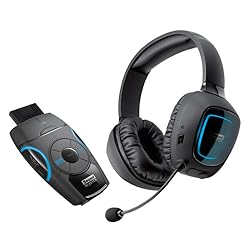
It's here! Whoa! Next day air.
Comparing the 6000 to the Sennheiser Amperior and Shure 1840 tonight, the bass of the 6000 is much heavier than the Amperior which is already slightly excessive around 100 hz, so I set bass reduction for the 6000 to continue the comparison. With bass reducer the 6000 now is very similar to the Amperior, and much stronger than the flat bass of the Shure 1840.
So, running tone sweeps on the bass-reduced 6000 compared to the Amperior which is not EQ'd (played flat), the response from 30 hz up through about 5 khz is comparable, and the Amperior takes a dip around 6 khz while the 6000 rises slightly there. Above 6 khz they're comparable again.
That 6 khz difference, in what I call the "presence" region is significant, because the Amperior treble sounds fairly soft to me compared to the Shure 1840. The 6000 treble sounds pretty similar to the 1840 treble, so here's my overall analysis of the 6000's signature at this point:
The bass-reduced 6000 has the best of the Amperior on the low end and the best of the 1840 on the high end, and does not have the worst of either of those two headphones. So the 6000 is a double winner. Actually, a triple winner since you can get the near-ideal hi-fi sound with bass reduction, or turn the EQ off and enjoy a stronger bass if that's your preference. Although the non-EQ'd stronger bass is not my preference and seems to reduce the effectiveness of the lower midrange, there doesn't seem to be any muddying or boominess with that default bass, so I think triple winner is appropriate.
This is not only a very good signature for $200, you also get active noise canceling (BTW, these tests were with noise canceling on).



 I am presently listening to my wired Creative Sound Blaster Tactic360 Sigma Gaming Headset it has the same 50mm Neodymium magnet drivers as the Omega Wireless, The Omega besides being wireless has a different digital processing package, other wise the spec's are the same. These headsets can reproduce the sound of an atomic bomb going off, dynamically there is nothing these Sound Blasters cannot handle. I have yet to find music these headsets cannot do a fantastic job with, Classical, New Age , Euro Trance, Orchestral Metal, Battle Metal, classic be-bop, rockabilly, Rock-n-Roll, Jazz, Dixie Land, etc. I tried out the wireless ones and liked the sound but at the time could not afford the purchase price so I have Tactic360 Sigma's instead which as I said above the same drivers as the wireless version. They are much cheaper then some as has been mentioned above.