• The move to the new server is done. There are some software and database maintenance updates in process. This has us passing the hat around to help out. We appreciate any donations. Seriously, even a dollar helps. The payment page may be found here - https://www.audiokarma.org/support.html

Looking for advice how to make counterweights for an ADC LMF tonearm

T68

Super Member
Hi!
I´ve been asking about ADC tonearms in this thread.
https://audiokarma.org/forums/index.php?threads/educate-me-on-the-adc-tonearms.934549/

But now when I got one and have this very specific question I thought I might as well start a new thread about it. Hope that´s ok.

So I got this really good deal on a Lenco L75 turntable that I will probably use mostly as a spare parts donor. But it came with an ADC LMF-1 tonearm that seems to be in good shape. Except for one thing: it´s missing the balance counterweights. If i´ve understood correctly they came with three different weights that are used depending on the weight of the cartridge, 7, 15 and 30 grams.

I will of course try to find/buy original weights somehow. Nut if I fail or this takes time: do you think it would be possible to have them manufactured in some way? I´m not sure if they are just supposed to slide on to the tonearm. According to the manual it seems so. But then: how to make them stay in place? Should there be a grub screew to lock them in place when the arm is balanced?
Materials to use? Any quick-and-dirty job that could work?

Thanks in advance for input!

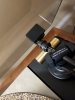
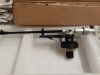
The parts that´s missing:
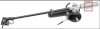
adc_weight.jpg
 
Register to hide this ad
Be resourceful, initially. These arms are designed for high compliance, low mass carts.

Can you drill through a cylindrical piece of non-magnetic alloy or stainless steel in order to make a suitable counterweight ? Start with a small drill bit for the "pilot hole." Then, change to a bit larger bit and keep increasing the hole until it "friction fits" comfortably. A set-screw on the side might be helpful, too...

Another fine trick is wrapping thick solder around the rear shaft, tightly wound. Some flea markets will surprise you with hardware goodies.

Lastly, a want ad in Barter Town here or checking the online sites often should help ur search...

Remember that it is easy to increase an arm's or headshell's mass, but very difficult or impossible to lower a typical tonearm's mass. Again, resourceful attempts might be the answer...Why spend money if u can DIY ?

Enjoy the audio adventures...
 
  • Like
Reactions: T68
I recently bought a Marantz 6110 tonearm with no counterweight. I measured the diameter of shaft with calipers, and bought a used counterweight with the same bore on Ebay for ~ $10. It's not the original counterweight, so I had to make a guess about the original weight, but it fits like a glove. I ended up adding a bit of golf/tennis weighted tape to increase the weight a bit.
 
Last edited:
Looking at the manual on Vinyl Engine gives a little insight.

https://www.vinylengine.com/library/adc/lmf-1.shtml

The counterweight is only moved to rough in the neutral balance of the arm. Tracking force is set via the fine adjuster on the end of the tonearm stub.

The manual doesn't mention turning a screw to move the counterweight, so I assume the originals were friction fit. I would measure the stub and go rummage around the hardware store for a metal spacer or plumbing fitting I could slide over the stub. Cut to length for the desired weight. Maybe use heatshrink over the stub to keep the finish from getting marred.

Use the temporary measure until you source an original. Something like that would be easy for a machine shop to turn on a lathe too, which might be an option depending on how much you want to spend.
 
  • Like
Reactions: T68
Thanks for good pointers!
Out on the hunt for something with 15,1 mm inner diameter (finally found my calipers to get a decent measure)!
 
I bought an upgrade brass counterweight for my Linn Basik arm. Lower center of gravity than original. Made by Ebay seller Xaudiodesign. His have different adapter collars for various arms. Mine has a collar set screw clamping on shaft. Has two o'rings on collar for damping. No helix fine adjustment. Maybe he could make a special for you. If you furnished shaft diameter and calculate weight needed. I have no connection to seller. Edit: seller is in UK. Or, find a local machine shop. Might be pricey.
16056536034214827447893062421525.jpg

The original Linn counterweight has a rubber sleeve between shaft and CW collar.

For temporary CW, you could try making a sleeve of wrapped bicycle tube or like rubber gasket. To help fill gap to a larger ID nut or collar. Without useing set screw clamp. Or use rubber sleeve in combination with a set screw clamp.

For close to a 15,1 mm ID collar, try searching brass or bronze bushings at industrial supply companies. In USA we have McMaster Carr or MSC Supply. Without a lathe, will be difficult to duplicate weights you may want.
Good luck.
 
Last edited:
  • Like
Reactions: T68
Afaik the important specs are:
Inner diameter: I have measured the main fixed counterweight to be 15.1 mm in diameter. These balance weights slide onto that so the inner diameter of those should be the same. But I am not entirely confident in the caliper i used. Have to get another to compare.

Weights: according to a data sheet I have found these arms were delivered with a set of three balance weights that are 7, 15 and 30 grams. I think that (according to pics studied) these weights were of different thicknesses and lenghts. So that the heavier weight was of bigger outer diameter but shorter. Unfortunately I have not found those measurements. But a am thinking that the important thing is to get the right weights. Maybe it can work with using the same diameter and just make them different lenghts?

But looking at Old Guy8:s post above I thing using orings around the main weight and hanging a balance weight from those I probably could diy to get the arm working.

I´m not in a hurry to get this done since I also first need to figure out on which of my l75 to use it and adapt top plate for right mounting distance etc. The fixer upper L75 it came with had a really bad (even for a diy:er like myself) solution for this :-). Probably need to make an adapter armboard type of thing.
 
I know where I live, finding a machinist or shop that will do small specialty work is a problem.

If it were me, after calling all the local shops/machinists, if no luck I’d look on eBay for someone who makes TT feet. See if they can machine you 3 stainless collars with same ID, 12 mm wide, machined down to your desired weights. Satin finish after mill finish. Not hard for a machinist, but hard to get a shop to do it for less than $80/hour. If a CNC shop, they can program in your dimensions. They can use software to determine the size (OD) needed for each finished weight. I used to do that 4 years ago replicating parts for paper mills. I’d CAD the parts I needed, the vendor would price the parts, labor and materials.
 
  • Like
Reactions: T68
Afaik the important specs are:
Inner diameter: I have measured the main fixed counterweight to be 15.1 mm in diameter. These balance weights slide onto that so the inner diameter of those should be the same. But I am not entirely confident in the caliper i used. Have to get another to compare.

Weights: according to a data sheet I have found these arms were delivered with a set of three balance weights that are 7, 15 and 30 grams. I think that (according to pics studied) these weights were of different thicknesses and lenghts. So that the heavier weight was of bigger outer diameter but shorter. Unfortunately I have not found those measurements. But a am thinking that the important thing is to get the right weights. Maybe it can work with using the same diameter and just make them different lenghts?

But looking at Old Guy8:s post above I thing using orings around the main weight and hanging a balance weight from those I probably could diy to get the arm working.

I´m not in a hurry to get this done since I also first need to figure out on which of my l75 to use it and adapt top plate for right mounting distance etc. The fixer upper L75 it came with had a really bad (even for a diy:er like myself) solution for this :). Probably need to make an adapter armboard type of thing.
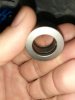
FYI, the brass CW and the collar are attached by a single threaded rod (or set screw) in tap holes in each part. Two o'rings are in grooves on collar. Are slightly compressed when parts are drawn close together. And dampen any vibration.
 
You missed point of posts.
How so? T68 is looking to replace missing CW on his ADC tonearm. Yours may cost more than having one made that looks OEM, and works OEM.

I have mounted my variable speed electric drill in my bench vice. Then I have mounted brass, aluminum, stainless steel bar stock in the chuck using an adapter I made. Using a file set, I have turned basic shapes I needed. Dremel used to make a small lathe also. Where there’s a will....
 
If it were me I'd 3D print it. Design the print so the inner hole is offset toward the top so the weight would be underslung. Pause the print 3/4 of the way through and add pre-measured lead shot for your desired weight, then resume the print to seal the lead shot inside. Make up a few of them with different amounts of lead shot added to cover all 3 available OEM weights and you're set.

The great thing about 3D printing is that it's super cheap (the prints I've mentioned, aside from the lead shot, would cost less than $0.25 in plastic and take no more than 2hrs to print). It's also very easy to iterate until you have exactly what you need. Inner diameter not quite small enough? Scale the print to 99% and reprint it, rinse & repeat until perfect. It would be extremely easy to add a threaded hole for an M3 set screw too.
 
If looks don’t matter, order a box of washers that fit. Stack ‘em.

Or carve out a pattern, use plaster to make a mold. Fill the mold with melted solder, of the pre-weighed amount you need.
 
Thanks for good pointers!
Out on the hunt for something with 15,1 mm inner diameter (finally found my calipers to get a decent measure)!
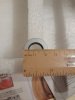
Hi T68, I have the ADC tonearm LFM with only one original counterweight, please see the photos for the dimensions. It's weights 32 grms. Regards, Juan.
 

Attachments

  • 20201118_215448.jpg
    20201118_215448.jpg
    57.8 KB · Views: 28
  • 20201118_215251.jpg
    20201118_215251.jpg
    62 KB · Views: 26
  • 20201118_214925.jpg
    20201118_214925.jpg
    59.2 KB · Views: 24
  • 20201118_214725.jpg
    20201118_214725.jpg
    54.6 KB · Views: 23
  • 20201118_214446.jpg
    20201118_214446.jpg
    64.1 KB · Views: 25
  • 20201118_213939.jpg
    20201118_213939.jpg
    83 KB · Views: 26
Last edited:
Don’t you have to have a 3D model made (3D CAD) to give directions to the printer?

Yes definitely. I make simple models in a program called Tinkercad. All I would need is the inner diameter, the rest I would just make up dimensions that 'look right' as the weight in my model would be determined by lead shot added by the end user, not the density/size of the actual weight body.

T68, if you can't find anything or can't get something cut on a lathe, feel free to PM me I'm happy to print a few out for the cost of shipping. I could design them so you add the lead shot yourself through an access panel then seal it shut with super glue (to reduce shipping cost).
 
Thanks for great input, guys!
bichitus: great pics! Big help if/when I need to DIY :thumbsup:

Bootbox: thanks for the offer! I´ll ponder alternatives and keep searching for originals for a little while more. But then I may just take you up on it :)
 
I got a Grace G707 last year with no counterweight. Initially I just stuck an appropriate weight old brass fitting from my decommissioned biodiesel processor in the garage, onto the end of the arm, with a bit of Blu Tac to isolate and damp it.

It worked so well, and looked so steampunk, I almost didn't want to replace it with the correct counterweight when I finally found it. Photos somewhere on this site. But I imagine you want something looking extra swanky!
 
Back
Top Bottom