• The move to the new server is done. There are some software and database maintenance updates in process. This has us passing the hat around to help out. We appreciate any donations. Seriously, even a dollar helps. The payment page may be found here - https://www.audiokarma.org/support.html

Luxman A3550 Restoration Journey: Taming a Williamson Legend

frend2001

Active Member
I’m kicking off a thread to document my restoration journey with a classic Luxman A3550 tube power amplifier.

Built around the legendary four-stage Williamson circuit topology and packing those massive, highly coveted Luxman OY-type output transformers, this amp is an absolute masterpiece of engineering, but it definitely needs some bench time to get back to its prime.

The auction description said, " While playing music heard an arc and switched it off, after that didn't power it on, sold as is"

I took my chances dreading fate of OY-15 output transformers.

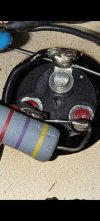
The unit arrived and upon checking found a scorched bias measurement resistor under 6550 tube.

Found and got another GE 6550 tube as I think the tube runaway caused this resistor to burn, can't risk placing that old tube again to test, as I think the output transformers are most precious thing in the whole amp.
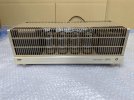
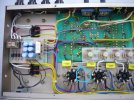
Luxman 1.jpeg


Luxman 2.jpeg


Will post as I go along.
 
Register to hide this ad
Changed the bias measurement resistor and brought it up slowly on DBT with power tubes removed.

At about 80v input the DBT brightened for a second and than sort of started pulsating and I could hear some sort of click.

Power off, investigation on.

I saw the filtering cap for bias circuit is directly below the choke and looked heat stressed. Taken it out, it tested absolutely fine but changed anyway with same value but higher voltage and temp rating.

Still same behavior, the click type of sound as if a relay is closing.

The plot thickens.....
 
usually when I've had that its been some old capacitor breaking down with high voltage applied. They often test OK on a low voltage tester, need to do HV testing to confirm. Or you can do it by reading voltage drop across the resistors supplying them but probably need to not have the DBT in the circuit for this, otherwise the supply voltage is going to shift whenever it arcs internally.
 

has a schematic if you didn't already find that. I see a relay, looks like its speaker impedance switching. Any chance thats whats activating?
 
Changed the bias measurement resistor and brought it up slowly on DBT with power tubes removed.

At about 80v input the DBT brightened for a second and than sort of started pulsating and I could hear some sort of click.

Power off, investigation on.

I saw the filtering cap for bias circuit is directly below the choke and looked heat stressed. Taken it out, it tested absolutely fine but changed anyway with same value but higher voltage and temp rating.

Still same behavior, the click type of sound as if a relay is closing.

The plot thickens.....
I mean, there is a relay in your photo.

All tubes removed, forget the variac and just DBT it. Check the power supply voltages.
 
Turn out it isn't related to the relay in schematics.

In a totally darkened room, again slowly brought it up, saw an arc between positive and negetive terminal of main filtering dual cap of 100uf+100uf

The clicking sound was the arc at the cap.
 

Attachments

  • Screenshot_2026-06-19-01-02-42-19_6012fa4d4ddec268fc5c7112cbb265e7.jpg
    Screenshot_2026-06-19-01-02-42-19_6012fa4d4ddec268fc5c7112cbb265e7.jpg
    84.3 KB · Views: 39
This cap isn't the changed one.

It's on B+ rails.
I strongly recommend changing all the main power supply caps. And check the values of the power rail resistors.

Actually, when I do main power supply R&Rs, I change all the resistors, too. I usually keep the chokes, unless they show outward damage.

The new caps' initial inrush can sometimes push old borderline resistors over the edge. I like metal-oxide or low-inductance wire-wound resistors in the power rail. ;)
 
Last edited:
Noted.

It's my first tube power amp and I'm quite new to this hobby. In fact started just about 2-3 years ago on solid state amps.

Thankfully have a veteran guru who guides me thru and tolerates my noob questions and queries.

So going slow and gulping all the knowledge as I proceed.

I'm planning to restuff the cap can.

Originally Luxman A3550 used to ship with Rubycon Black gates for main filtering but sadly in my unit they are TMC.
 
Yeah, temptations sometimes gets the best of us and it could be at these very times that we just want to hear it that is when disaster strikes, don't risk it. It only takes a micro second to cause serious damages.
 
I couldn't get multican cap here so for now restuffed the old can with 2 x 100uf 500v caps. New ones are soo small. But I Know I have to order proper 3x100uf+100uf multicans.

For now, did cut the old can about 1 cm below the lip, discarded the old stuff, cleaned it and tied the negatives on new caps, poked small holes near terminals of old can. Pulled the new caps terminals out thru & tied them to old terminals and then soldered them.

Put JB weld in the old cap top between the terminals to further insulate them from shorting / arcing. It also fixed the newer caps in.

Wired and tested for shorts.

Soldered the B+ lines, bleeder resistor and tested for shorts again, all good.

Got it up slowly on DBT. No surprises, all line volatges steady and solid.

Time for sound test.

Got the sound. No surprises here either.

So to the allignment, I turned down the bias and waited for amp to warm up.

Against factory recommended .45v across the bias measurement resistor on pin 1 & 8, I adjusted it at .36v

Slightly cold biased power tubes are happy tubes, as my guru says.

Too cold bias and you get distortion, hot bias shortens the life span of tubes. Slight cold biasing is considered ok.

Once again please excuse my rants, I'm still learning and updating my knowledge & skills. So will gladly welcome any bit of correction, advice or guidance.
 
Last edited:
Congrats and enjoy!

Just a stupid little comment from me, and I know it's confusing, but "underbiased" means biased hot. And "overbiased" means biased cold. That's why I just say "hot" and "cold" these days, to avoid confusion.


Anyway, a very good job! And here's to years of good tunes!

:thumbsup:
 
should probably see what the actual plate dissipation . Plate volts * cathode current will give you plate+screen dissipation. No idea what the factory bias setting puts that at, but if its reasonable, run it. Some things really tortured the tubes though.
 
Congrats and enjoy!

Just a stupid little comment from me, and I know it's confusing, but "underbiased" means biased hot. And "overbiased" means biased cold. That's why I just say "hot" and "cold" these days, to avoid confusion.


Anyway, a very good job! And here's to years of good tunes!

:thumbsup:
Updated my knowledge and my post with right hot / cold terminology.
 
should probably see what the actual plate dissipation . Plate volts * cathode current will give you plate+screen dissipation. No idea what the factory bias setting puts that at, but if its reasonable, run it. Some things really tortured the tubes though.
Yes, I plan to do that next.

Just wanted to first make it stable for once and let it sing.

Will post findings here
 
Back
Top Bottom