• The move to the new server is done. There are some software and database maintenance updates in process. This has us passing the hat around to help out. We appreciate any donations. Seriously, even a dollar helps. The payment page may be found here - https://www.audiokarma.org/support.html

Luxman A3550 Restoration Journey: Taming a Williamson Legend

I also own an A3550. These are incredibly rare amps here in the US; beyond us, there can't be many (if any) other A3550 owners on AK.

It looks like yours is wired for triode, while my amp is set to pentode operation.

The magic is in the transformers and choke, which Luxman is famous for. I’d suggest doing only what's required to get it running well before jumping into a wholesale parts swap. If the caps aren't deformed or getting hot, and the amp sounds good and looks clean on a scope, I wouldn't replace them. That said, if you have an ESR meter, it wouldn't hurt to check the main filter caps while you're in there.

Feel free to send me a PM if I can help. I'm happy to share my experiences and some otherwise "unobtainium" technical documentation.
 
Last edited:
The audio database calls the stereo connections “Beam tube connection” and “3-pole tube connection”.
50watts vs. 30watts
In mono configuration these are called Beam tube and “Triode”. 100watts vs. 60watts.

In my MB3045, the choices are triode and ultra linear but gadget calls one of the pentode, I think. He’ll add to this as needed as I know he likes anything tube it seems and these amps for sure. So he’ll see it.

Luxman had 59 years experience building transformers when this amp came out in 1984, per the database.

As to bias and the calculation Thain mentions wrt the 3045. Maybe they were biased to the point of short tube life with the original 8045G power tubes because that amp could use them up.
 
I'm assuming "3 pole" is some translation glitch for "3 element", aka "triode" mode. Pentode mode does approx double the power in most amps, so those figures seem reasonable. All depends where the screen feeds, if its tied to B+ its pentode mode. If its tied to the plate, its triode mode.

If there is a screen tap on the transformer thats ultralinear mode.

The MB3045 doesn't have screen taps, so that isn't an option. Screen goes to B+ for pentode mode or plate for triode mode. That amp is interesting in that it doesn't change the power output. I had a pair here briefly for some work and they did the same power either way. Offhand I want to say it was pretty near 50 watts either way.
 
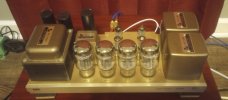
Sharing some pics of my A3550.

I really, really, like this amp and can't see myself letting go of it. Electro-Harmonix 6550 output tubes and vintage RCA 6CG7 input tubes.

Overall, a very nice amp with variable output, a switch to enable/disable NFB, and a mono switch. It's dead silent on my high efficiency speakers. My only complaint about this and other Luxman tube amps would be, more ventilation on the top of the tube cage wouldn't have hurt. That said, I have a pair of variable speed fans of the rear of the tube cage to pull out the hot air.

1000002263.jpg
1000002267.jpg
 
So all things have cleared up.

The bias is holding good, after a good listening session, the tubes are hot, the transformer is warm to touch. Usual business ?

The sound quality is exceptional, it's making my ancient boutique Enbee speakers sing like never before.

The vocals are forward but very very pleasant.

I thru a good measure of 60s, 70s, 80s & newer songs to it and it didn't disappoint me once.

So I've heard 2 very distinct personalities, at one end is my Sansui AU D707 & on other end is the Luxman A3550 and both excite me to no end.

When an amplifier makes you think to THAT long forgotten track which you used to listen to daily once, the amp is doing something.

The Luxman has me recall many such songs and I've thoroughly enjoyed listening to them.

So far that part is complete. The amp is stable and singing.

Now next I'm planning to change the 0.22uf 600v coupling caps. Don't know how leaky they've gotten. Can't risk that can we ?

Any suggestions ?
 
Maybe something like these, or you can use orange drops, they are very popular and used often.


I have used both the Solen and Orange drops.
 
So all things have cleared up.

The bias is holding good, after a good listening session, the tubes are hot, the transformer is warm to touch. Usual business ?

The sound quality is exceptional, it's making my ancient boutique Enbee speakers sing like never before.

The vocals are forward but very very pleasant.

I thru a good measure of 60s, 70s, 80s & newer songs to it and it didn't disappoint me once.

So I've heard 2 very distinct personalities, at one end is my Sansui AU D707 & on other end is the Luxman A3550 and both excite me to no end.

When an amplifier makes you think to THAT long forgotten track which you used to listen to daily once, the amp is doing something.

The Luxman has me recall many such songs and I've thoroughly enjoyed listening to them.

So far that part is complete. The amp is stable and singing.

Now next I'm planning to change the 0.22uf 600v coupling caps. Don't know how leaky they've gotten. Can't risk that can we ?

Any suggestions ?

Yes, totally normal for tubes to be hot and transformers to be warm.

I think you've answered the questions on what to do next based on your enthusiastic feedback and impressions of the amp. Just listen and enjoy the amp.

Your main concern would be the electrolytic capacitors used in the power supply section. If they are not leaking fluid, bulging, or hot when the amp is in operation I wouldn't worry about changing them out; if you're still concerned, check them with an ESR meter. You've already confirmed that the amp sounds great. The other verification would be to check the performance using dummy loads and an oscilloscope for things like channel balance and peak output. Leave the coupling caps alone, don't change them for the sake of changing them, they're not liquid filled and will last for many, many, decades without issue.
 
You can use an IR gun to measure the amp's temp. Don't point it directly at the tube, but a little above it. Take several measurements.

The output section can run +250ºF, without ventilation. Gain stages are cooler, maybe around 200ºF.
 
Leave the coupling caps alone, don't change them for the sake of changing them, they're not liquid filled and will last for many, many, decades without issue.
Old coupling caps can fail at any time. They usually begin to leak DC, which means the dielectric is breaking down. Replacing caps that are more than 25 years old is good insurance against damage to output tubes and transformers.

Jack
 
Old coupling caps can fail at any time. They usually begin to leak DC, which means the dielectric is breaking down. Replacing caps that are more than 25 years old is good insurance against damage to output tubes and transformers.

Jack
My experience is that DC-leaky caps can make gain stages noisy and output tubes hard to hold bias.

If the unit has good poly non-polar caps, I'd prolly just measure for DC voltage on the grid sides of the caps. Any capacitor that measures near 1 VDC should be replaced. Really, you want the voltage in the mV range.

Any old paper-in-oil caps get replaced. Any old Astrons get replaced. Anything with paper on the outside gets replaced. Any old gray Japanese coupling cap gets replaced. Don't even bother measuring DC voltage.

:)
 
Last edited:
Looks like yellow film caps in there now. Those are not typically problematic but maybe worth looking up those specific caps to see if they have a history of trouble.

The power supply caps tend to be a higher concern for me than any flavor of film cap. Then again I'm the guy running 60 year old films that he put in the dish washer as a test. They are still fine BTW.
 
Old coupling caps can fail at any time. They usually begin to leak DC, which means the dielectric is breaking down. Replacing caps that are more than 25 years old is good insurance against damage to output tubes and transformers.

Jack

I think that's a bit of an overgeneralization. The fact that the bias is stable is far more meaningful than the age of the coupling caps. The amp is also reported to sound excellent, and there have been no reports of red plating, runaway bias, or other signs of excessive output tube current.

For quality film capacitors, especially poly caps, it's not unusual for them to remain perfectly serviceable after decades of use. While a failing coupling cap can certainly cause problems, stable bias and normal operation are pretty good evidence that the coupling caps are still doing their job.
 
I think that's a bit of an overgeneralization. The fact that the bias is stable is far more meaningful than the age of the coupling caps. The amp is also reported to sound excellent, and there have been no reports of red plating, runaway bias, or other signs of excessive output tube current.

For quality film capacitors, especially poly caps, it's not unusual for them to remain perfectly serviceable after decades of use. While a failing coupling cap can certainly cause problems, stable bias and normal operation are pretty good evidence that the coupling caps are still doing their job.
Yeah, just measure the DC voltage on the anode and grid sides. That will eliminate any worries.

e412007e-972e-4927-b4ae-67b7419024f0.jpg

DC voltage on the anode side of the coupling cap.


5fc2771b-e6a9-439c-980d-9a4b652bad85.jpg

DC voltage on the grid side of the coupling cap.
 
I would think that amp is already more than decades old. Isn't that amp already around 40 years old? One filter cap already failed, the OP started the thread off with a concern of not wanting to risk his precious transformers.

Anyway, it is a lovely amp, and I bet has a great sound. I will put this model on my bucket list to consider if one comes around at the right price/condition.
 
Yeah, just measure the DC voltage on the anode and grid sides. That will eliminate any worries.
How often should the owner of an older amplifier do that in order to prevent damage? Once a year? Once a month? Every day? Or maybe just leave a meter on top of the ampfier all the time? Not being snarky here, just emphasizing again that old coupling caps can and do fail at any time. And I consider this a much more significant risk than power supply caps. Those typically blow a rectifier and maybe a fuse when they fail, or maybe just arc intermittently and annoy the owner. Coupling caps on the other hand often fail gradually, causing the associated tubes to overheat and maybe taking the transformer(s) with them. I don't understand why anyone would not want to minimize this risk, especially considering the ridiculously low cost of high quality polypropylene caps.

Jack
 
Last edited:
How often should the owner of an older amplifier do that in order to prevent damage? Once a year? Once a month? Every day? Or maybe just leave a meter on top of the ampfier all the time? Not being snarky here, just emphasizing again that old coupling caps can and do fail at any time. And I consider this a much more significant risk than power supply caps. Those typically blow a rectifier and maybe a fuse when they fail, or maybe just arc intermittently and annoy the owner. Coupling caps on the other hand often fail gradually, causing the associated tubes to overheat and maybe taking the transformer(s) with them. I don't understand why anyone would not want to minimize this risk, especially considering the ridiculously low cost of high quality polypropylene caps.

Jack

I am inclined to agree with you on this. Even the general consensus seems tis that it's always better to change the components that's seen a good life in the heat.

I also agree that by changing a very inexpensive component if you can ensure life of output tube and transformers, it's a no brainer.

As my Guru says one tends to become obsessive with the change and upgrades so lets just first address the critical components only.

I appreciate all valuable suggestions by FMs, each message has improved my knowledge curve.

And needless to say, keep all the good ideas rolling.
 
How often should the owner of an older amplifier do that in order to prevent damage? Once a year?

Jack
Yes, you don't need to measure the DC voltage at set time intervals.

If you are "eating" 12AX7s (or other gain-stage tubes), or they are getting noisy prematurely (like within a year). If you are having trouble with the output tubes holding a steady bias, then measuring the DC leakage in the coupling caps is warranted.

Yes, if you go with quality poly caps, they should last forever unless they are defective from the manufacturer — provided all the electrical settings around the cap and stage are within tolerance.
 
Last edited:
Back
Top Bottom