Hello, A few months ago I retrieved my Luxman l-80v from storage. After connecting it up it started humming aggressively so I turned it off and let it rest for a bit. On the second attempt, the humming grew and the old 50v 10000uf Capacitors exploded. All 3 of the 0.3A 250v 6x30mm fuses were blown so I replaced them and the system turned on but no sound. So I ordered replacement capacitors and waited for them to arrive. I wired them up today and after wiring them up on the first attempt I heard the relay click and to my suprise the amplifier worked and played for a few minutes until the 125v 5a fuse burst into a green spark and one of the new caps smelt a bit and looked as if it had expanded a bit but was still intact however to note this capacitor was the only one that was hot out of the two. After this I replaced the 125v 5a with the only replacement I had on hand which according to online sources would be alright to replace with a 250v 5a fuse. After letting the amp rest I powered it on and sounded like it was shorting so I immediately turned it off on the second attempt I replaced the capacitor grounding rod with a wire and this time the new capacitiors blew again . Hopefully someone can help and also to add ive noticed the relay is now a bit cloudy but im not sure if this was already like this previously as I heard it clicking.


You are using an out of date browser. It may not display this or other websites correctly.
You should upgrade or use an alternative browser.
You should upgrade or use an alternative browser.
Luxman L-80V Problems! Help!
- Thread starter AmpSound
- Start date
Register to hide this ad
Thanks, but Where exactly and how do I check this ?Check your rectifier. If AC gets through to the smoothing capacitors it takes about half a minute and they are toast.
You need to replace them again.
First off, build a dim bulb tester, it's a current limiting device, numerous plans on AK, google.
Second, slow down, check your work, were the new caps installed with correct orientation?
Do you have any test equipment, multimeter? oscilloscope...
Download the service manual from hifiengine, need to register, it's safe, no spam, become familiar with its content, ie, schematic, board layout...
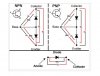
Diode test the rectifier diode/bridge using diode function on MM, google AK if in doubt, also this from markthefixer
Second, slow down, check your work, were the new caps installed with correct orientation?
Do you have any test equipment, multimeter? oscilloscope...
Download the service manual from hifiengine, need to register, it's safe, no spam, become familiar with its content, ie, schematic, board layout...
Diode test the rectifier diode/bridge using diode function on MM, google AK if in doubt, also this from markthefixer

The above!
Sounds like you should do a little more research before you destroy your amp further.
Sounds like you should do a little more research before you destroy your amp further.
Hello, I am a new member getting ready to recap my original Luxman L-507. I understand the L-80v is very similar and has a service manual at hifiengine. For absolutely inexplicable reasons, I can not register, send a request, am banned or somehow shut out despite having never communicated with them previously or engaged in improper use of the internet. I am an old guy and do not understand either how this happened or how to circumvent or even contact these people for an explanation. Can someone please help me get the service manual? Thanks!First off, build a dim bulb tester, it's a current limiting device, numerous plans on AK, google.
Second, slow down, check your work, were the new caps installed with correct orientation?
Do you have any test equipment, multimeter? oscilloscope...
Download the service manual from hifiengine, need to register, it's safe, no spam, become familiar with its content, ie, schematic, board layout...
Diode test the rectifier diode/bridge using diode function on MM, google AK if in doubt, also this from markthefixer
View attachment 2814330

restorer-john
Addicted Member
Google is your friend. The schematic is literally the first result and that's all you need.Hello, I am a new member getting ready to recap my original Luxman L-507. I understand the L-80v is very similar and has a service manual at hifiengine. For absolutely inexplicable reasons, I can not register, send a request, am banned or somehow shut out despite having never communicated with them previously or engaged in improper use of the internet. I am an old guy and do not understand either how this happened or how to circumvent or even contact these people for an explanation. Can someone please help me get the service manual? Thanks!
What is wrong with the L-507?
Google is your friend. The schematic is literally the first result and that's all you need.
What is wrong with the L-507?
Thanks for your reply. The schematic does not provide alignment guidance, like desired idle current, etc as far as I know. Amp works ok but controls/switches need cleaning and sound no longer has the clarity it once had. After 52 yrs, recapping is a likely solution (in addition to pot cleaning) and if I do that, I might as well align to spec or as close as I reasonably can without extensive semiconductor replacements. I expect to have a better sense once I put the scope and signal generator on it.Google is your friend. The schematic is literally the first result and that's all you need.
What is wrong with the L-507?

See the last two posts in this thread for bias:Thanks for your reply. The schematic does not provide alignment guidance, like desired idle current, etc as far as I know. Amp works ok but controls/switches need cleaning and sound no longer has the clarity it once had. After 52 yrs, recapping is a likely solution (in addition to pot cleaning) and if I do that, I might as well align to spec or as close as I reasonably can without extensive semiconductor replacements. I expect to have a better sense once I put the scope and signal generator on it.
Looking for help with Luxman L-80V
restorer-john
Addicted Member
Thanks for your reply. The schematic does not provide alignment guidance, like desired idle current, etc as far as I know. Amp works ok but controls/switches need cleaning and sound no longer has the clarity it once had. After 52 yrs, recapping is a likely solution (in addition to pot cleaning) and if I do that, I might as well align to spec or as close as I reasonably can without extensive semiconductor replacements. I expect to have a better sense once I put the scope and signal generator on it.
35mA is the Lux specified output stage standing (current) for the L80, L80V and the L81. It is not critical. The other pots are of course for DC balance.
The pots are very easily cracked at nearly 50 years old so if they are in the ballpark, leave them alone.
I would definitely replace/remove the likely cracked and/or exploded Rifa caps (2 of them- one on the switch, one on the primary)
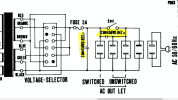
I would also be replacing the VD1221/SV02/03 "blob' diodes with 2/3x1N4148 in series before something bad happens to the power stages. Go by the schematic- two in series for D104 and 3 in series for D102. Measure the voltage drop of the ones you remove one at a time to be sure.
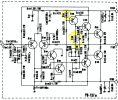
Then inspect all the caps on PB884 (regulator PCB). They WILL need replacing for sure.

Set your bias using the voltage drop method- NOT Luxman's cut-a-wire method which is risky.
Then thoroughly test the amplifier before throwing a whole lot of uneccessary components at it with all the inherent risk of doing that. You've got phono (RIAA), tone, mic, filter/loudness, PSU, protector and two power amps to deal with and you need to know before going all in with a bag of components what you stand to gain- if anything.
Last edited:
Wow - this is so helpful! Thanks very much. I do have the schematic now and getting ready to open it up and start inspecting. Are there any particular brands of caps that are preferred? I presume the sources to check are Mauser and Digi-key. What about the diodes? Should the bias be checked with a load (I have 100W 8 ohm resistors) or without? (I was “taught” at a very young age to never turn on an amp without a load connected.). This is my first such project and as you may imagine, and as the original owner, I don’t want to screw up what has been a faithful, long standing ‘friend’. It has already saved my life once - as a new owner, I was distraught by the erratic noise it had. Turned out there was nothing wrong with the amp; I was detecting serious arcing in a bad circuit breaker in the electrical panel in my rented house. The owner was very happy I saved his house from a potential fire (and me with it!).
restorer-john
Addicted Member
@MarkH2 , cool story! Yes those Lux amps are something special aren't they? I have several, a few L81s, L85V and a couple of smaller models too. Got an L100 here also to restore for my best mate (if I ever get around to it).
They are all minor variations on a theme. Lux stuck to their designs for the most part of a decade or more and they are all pretty easy to fix once you know their 'secrets'.
The bigger models had some hidden nasties in terms of tantalums and many of the other models got killed by those wretched SV-xxx (blob diodes).
Otherwise, you'll be on a nice easy resto, start with the main power amp/psu/protector boards and move to the tone boards once you've got the main part buttoned up.
They are pretty much bang on spec for power output but they all gave out a decent amount more into low impedances.
As for turning on/off without a load, it doesn't matter with SS (solid state). Sure for tubes- very good advice and you were taught well. Pick good quality brands for any components you replace, but consider semis (transistors) should be replaced with devices that are not just "equivalent" but also (hand) matched from channel to channel and device to device.
Post any questions you have, these classic Lux amps are worth the time, even though they are not SOTA (state of the art), but they are worth throwing some time and a few dollars at. Cheers.
They are all minor variations on a theme. Lux stuck to their designs for the most part of a decade or more and they are all pretty easy to fix once you know their 'secrets'.
The bigger models had some hidden nasties in terms of tantalums and many of the other models got killed by those wretched SV-xxx (blob diodes).
Otherwise, you'll be on a nice easy resto, start with the main power amp/psu/protector boards and move to the tone boards once you've got the main part buttoned up.
They are pretty much bang on spec for power output but they all gave out a decent amount more into low impedances.
As for turning on/off without a load, it doesn't matter with SS (solid state). Sure for tubes- very good advice and you were taught well.
Pick good quality brands for any components you replace, but consider semis (transistors) should be replaced with devices that are not just "equivalent" but also (hand) matched from channel to channel and device to device. Post any questions you have, these classic Lux amps are worth the time, even though they are not SOTA (state of the art), but they are worth throwing some time and a few dollars at. Cheers.
Last edited:

Dswankey
Lunatic Member
Might I suggest he start his own thread, as this thread title make no mention of L-507 which if it did he might get even more folks stopping by to assist, help advice etcPost any questions you have,